
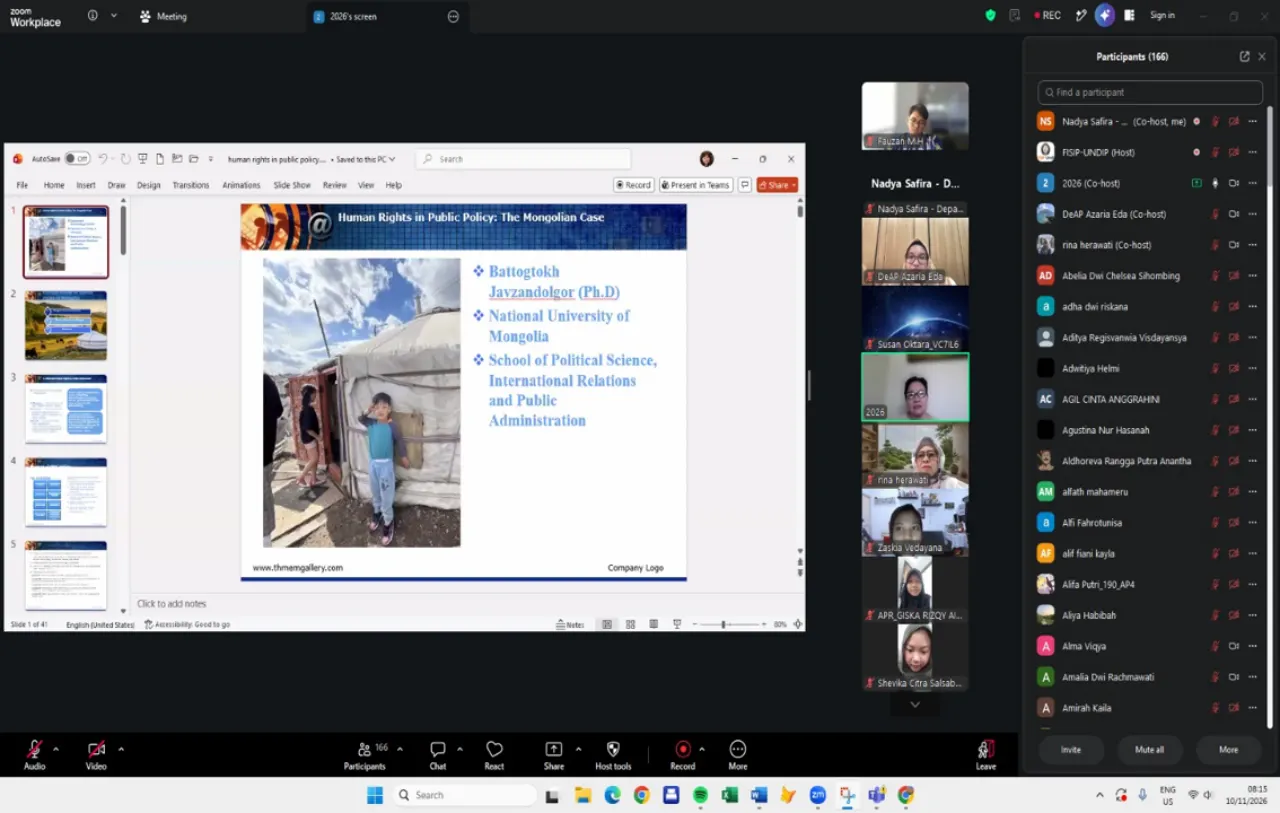
SEMARANG – The Master of Public Administration Study Program, Faculty of Social and Political Sciences (FISIP), Diponegoro University (UNDIP), has once again expanded its international academic network through the UNDIP Global Classroom (UGC) program. The world-class lecture activity, integrated into the Public Policy and Its Applications course, was held online on Tuesday, November 10, 2026, at 8:00 AM WIB, featuring an academic from the School of Political Science, International Relations and Public Administration, National University of Mongolia, Prof. Battogtokh Javzandolgor, Ph.D., as the keynote speaker, accompanied by two discussant lecturers from FISIP UNDIP, namely Dr. Dra. Augustin Rina Herawati, M.Si. and Dr. Dra. Ida Hayu Dwimawanti, M.M.
In the online lecture session, Prof. Battogtokh presented material entitled “Human Rights in Public Policy: A Case Study of Mongolia.” She outlined that the integration of human rights (HAM) in public policy rests on three main state obligations, namely the obligation to respect (not violate rights), protect (prevent violations by other parties), and fulfill (take legislative, administrative, and budgetary steps to realize human rights). These principles must be concretely reflected in education, health, environmental, labor, and social policies.
Highlighting the case study of Mongolia in the post-Soviet era, she explained how the 1992 Mongolian Constitution became the main legal foundation guaranteeing equality before the law, freedom of expression, and adopting international treaties into domestic law. Despite successfully abolishing the death penalty entirely since 2017, Mongolia still faces a number of crucial challenges in fulfilling citizens’ rights, including:
- The Right to a Healthy Environment: The extreme air pollution crisis in the capital Ulaanbaatar due to coal burning in ger settlements and Gobi Desert dust storms affects approximately 43% of the population, while 50% of the population still consumes drinking water below ecological standards.
- Protection of Children’s Rights and Social Vulnerability: Although it has enacted the Child Protection Law (effective September 2024) and established special children’s courts (effective January 2026), challenges of poverty, rural inequality, child labor practices, and human trafficking still require strict oversight.
- Legal Reform and Anti-Torture: The UN Committee Against Torture (CAT) highlighted the need for an independent investigation unit free from conflicts of interest as well as oversight of arrests without court warrants.
In response to the presentation, Dr. Dra. Augustin Rina Herawati, M.Si. and Dr. Ida Hayu Dwimawanti, M.M. provided comparative reviews that enriched the discussion perspective by comparing the dynamics in Mongolia and conditions in Indonesia. Both discussants highlighted that both Indonesia and Mongolia place human rights guarantees strongly in their constitutions and have ratified various international human rights instruments, yet both still face similar challenges at the level of public policy implementation.
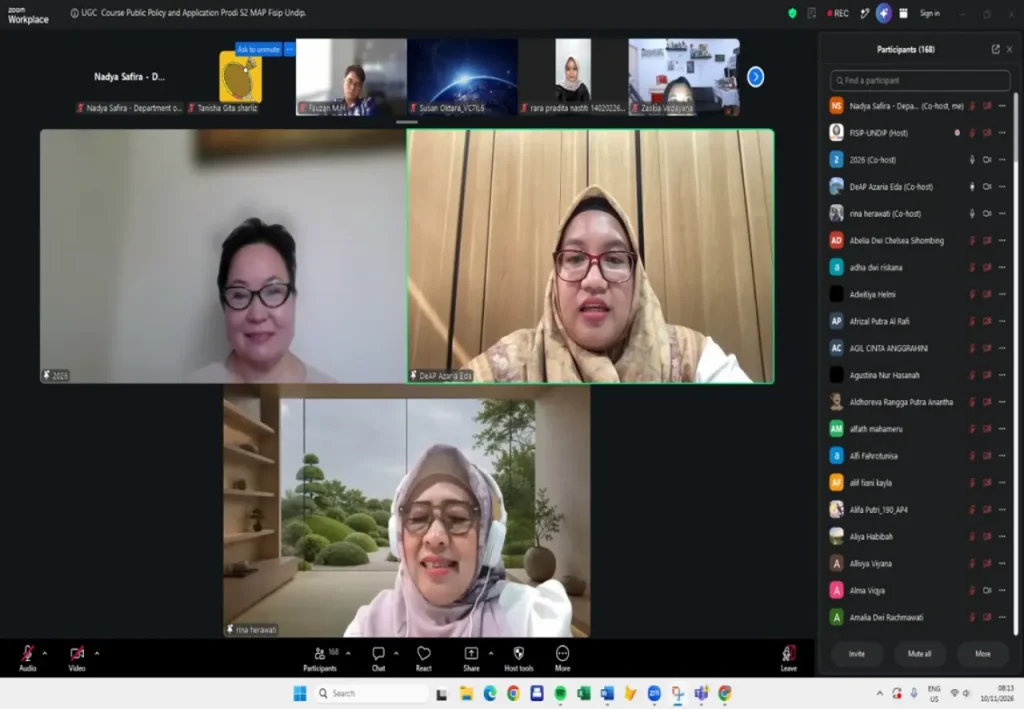
In their reviews, the main comparison was seen in the issue of the right to a healthy environment and the protection of vulnerable groups. While Mongolia grapples with extreme air pollution due to coal heating in winter and a clean water crisis, Indonesia also faces serious challenges in controlling air pollution in urban and industrial areas, as well as equitable access to sanitation and safe drinking water in underdeveloped regions. In addition, regarding child protection, both discussant lecturers underlined that Indonesia already has legal instruments such as the Child Protection Law and the Juvenile Criminal Justice System in line with legal reform steps in Mongolia, but the effectiveness of field oversight to suppress child labor and domestic violence remains a shared homework for the bureaucracy and policymakers.
The enthusiasm of students participating in the Public Policy and Its Applications course in the Master of Public Administration Study Program at FISIP UNDIP was evident throughout the interactive discussion session that proceeded dynamically online. Through this comparative analysis between Mongolia and Indonesia, students gained empirical insights into how human rights principles are translated into governance and contemporary public policy.
Going forward, the Master of Public Administration Study Program at FISIP UNDIP is committed to continuing to intensify the UNDIP Global Classroom program by presenting international experts from various countries to strengthen an inclusive, critical, and world-standard educational ecosystem.