

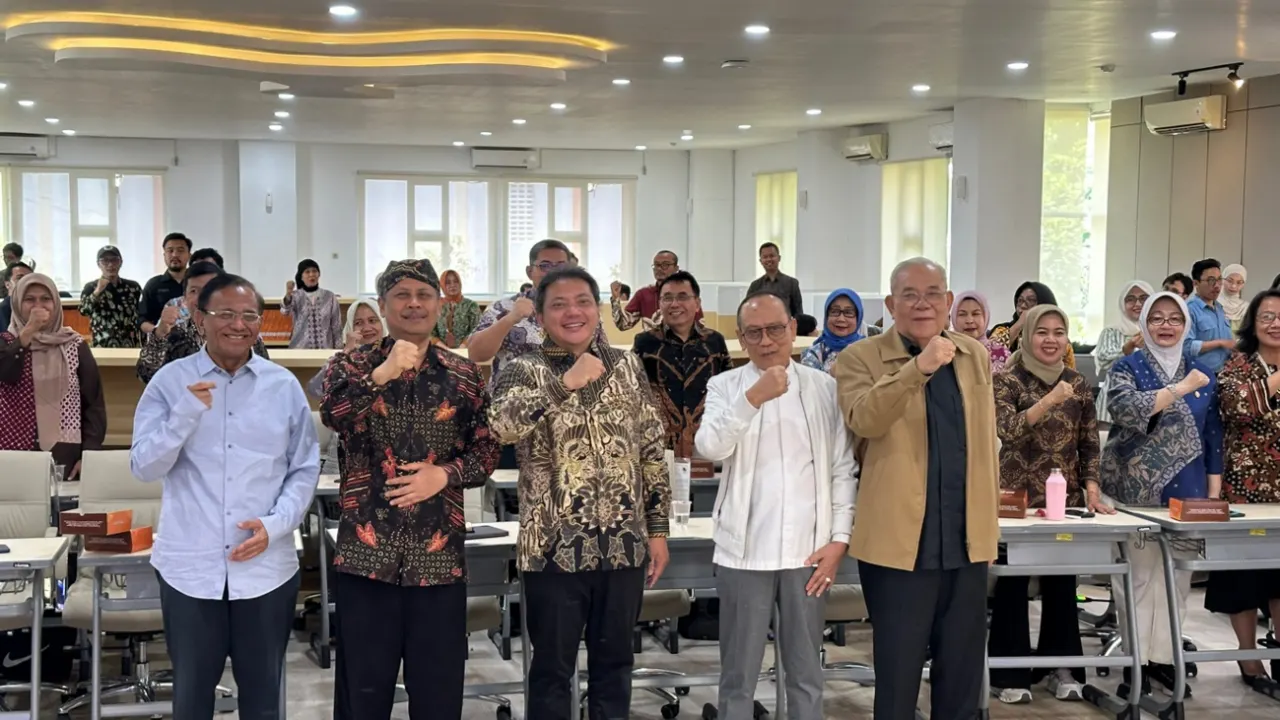
SEMARANG – The Department of Politics and Government, Faculty of Social and Political Sciences (FISIP), Diponegoro University (Undip) hosted a Constitutional Discussion event in collaboration with the Constitutional Study Commission of the MPR RI. With the theme “Institutionalizing the Broad Guidelines of State Policy Within the State System,” this strategic academic forum was held on Thursday, 5 November 2026, on the FISIP Undip campus, Semarang.
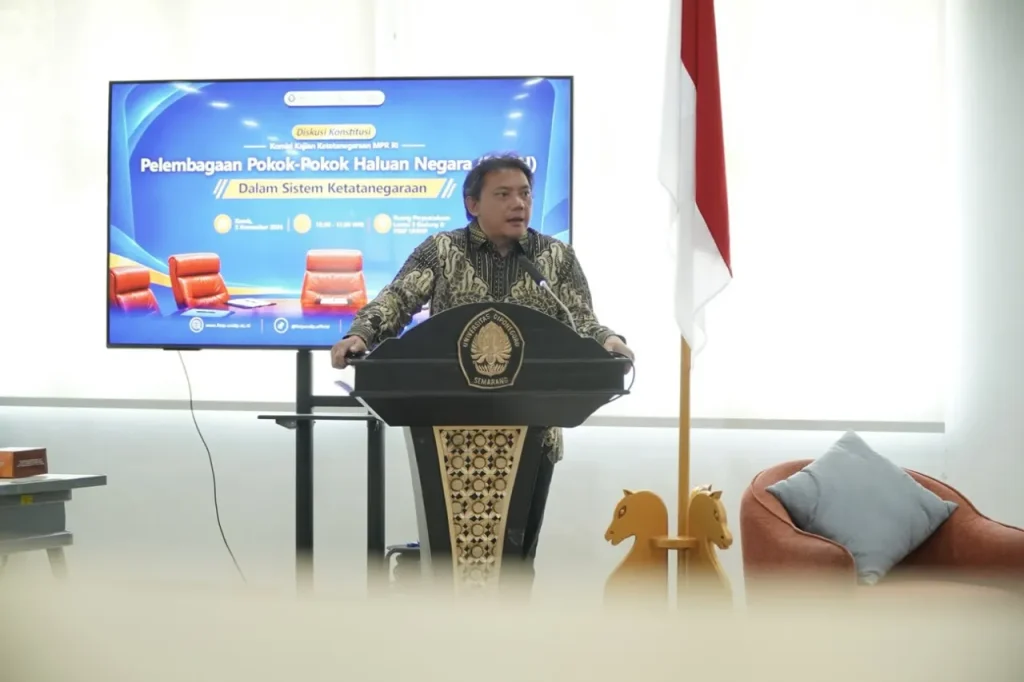
The event commenced solemnly with an official opening and the singing of the national anthem, Indonesia Raya. The agenda continued with remarks from the Dean of FISIP Undip, Prof. Dr. Drs. Teguh Yuwono, M.Pol.Admin., and was officially opened by the Chair of the Constitutional Commission of the MPR RI, Taufik Basari, S.H., S.Hum., LL.M.
This event was attended by members of the MPR RI, FISIP Undip professors, lecturers, academics, and student representatives affiliated with the Student Organization (Ormawa) of FISIP Undip.
The panel discussion session was methodically moderated by the Discussion Moderator, who is also the Chair of the Department of Public Administration at FISIP Undip, Retna Hanani, S.Sos., M.PP.
The Constitutional Discussion by the Constitutional Study Commission of the MPR RI held at the Faculty of Social and Political Sciences, Diponegoro University (FISIP Undip) featured in-depth presentations from four expert speakers who explored the key theme of Institutionalizing the Broad Guidelines of State Policy (PPHN) from various scientific perspectives.
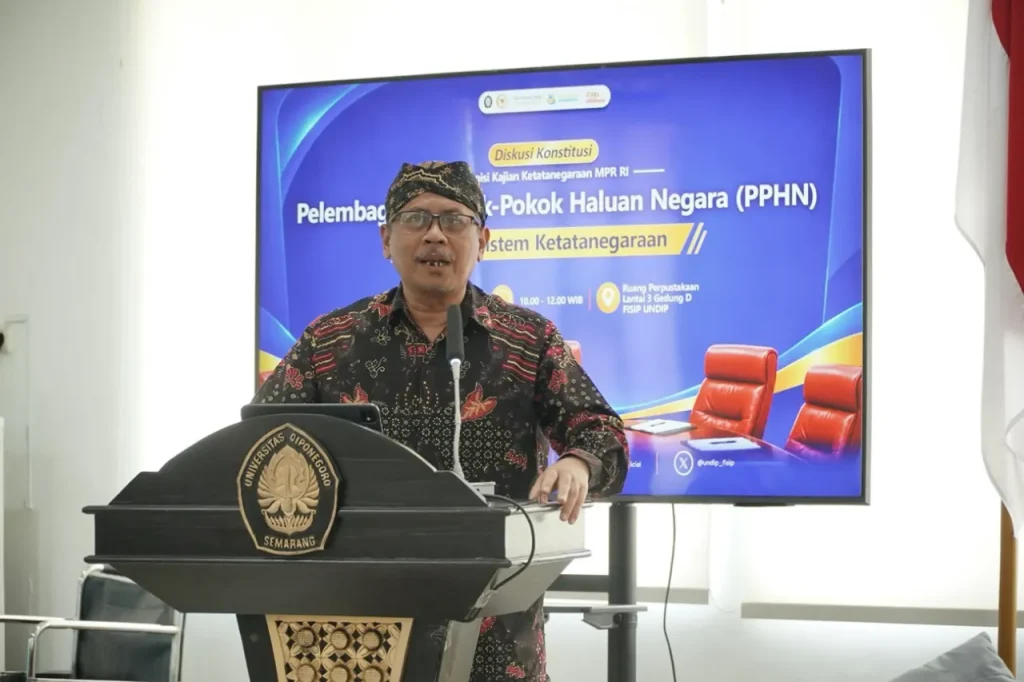
From a governance perspective, Prof. Dr. Drs. Teguh Yuwono, M.Pol.Admin. stated that the presence of the PPHN aims to ensure the continuity of national development across government periods without sacrificing constitutional democracy. Within the current constitutional system, Indonesia is not actually in a legal planning vacuum, as it already has a foundation through Law Number 25 of 2004 on the National Development Planning System and Law Number 59 of 2024 on the 2025–2045 National Long-Term Development Plan (RPJPN). The fundamental issue that needs to be addressed is not the lack of instruments, but rather problems of implementation such as policy fragmentation, budget inconsistencies, weak cross-sectoral coordination, and suboptimal evaluation. Therefore, if the PPHN is to be institutionalized, its substance must focus on cross-generational strategic principles such as strengthening a productive economy, social justice, environmental conservation, digital transformation, public institution reform, and not merely duplicating a list of technical projects.
From the legal and constitutional perspective, Prof. Dr. Ani Purwanti, S.H., M.Hum. emphasized the importance of maintaining the consistency of Pancasila as the source of all sources of state law (staatsfundamentalnorm) as enshrined in the fourth paragraph of the Preamble to the 1945 Constitution. Pancasila functions normatively and constitutively as the idea of law (rechtssidee), serving as both the static foundation uniting the nation and the dynamic guiding star (leitstar dinamis) directing the formation of positive law. When formulating effective laws and regulations, a policy must fulfill three elements of truth according to Gustav Radbruch’s legal theory: philosophical justice, sociological utility, and juridical legal certainty.
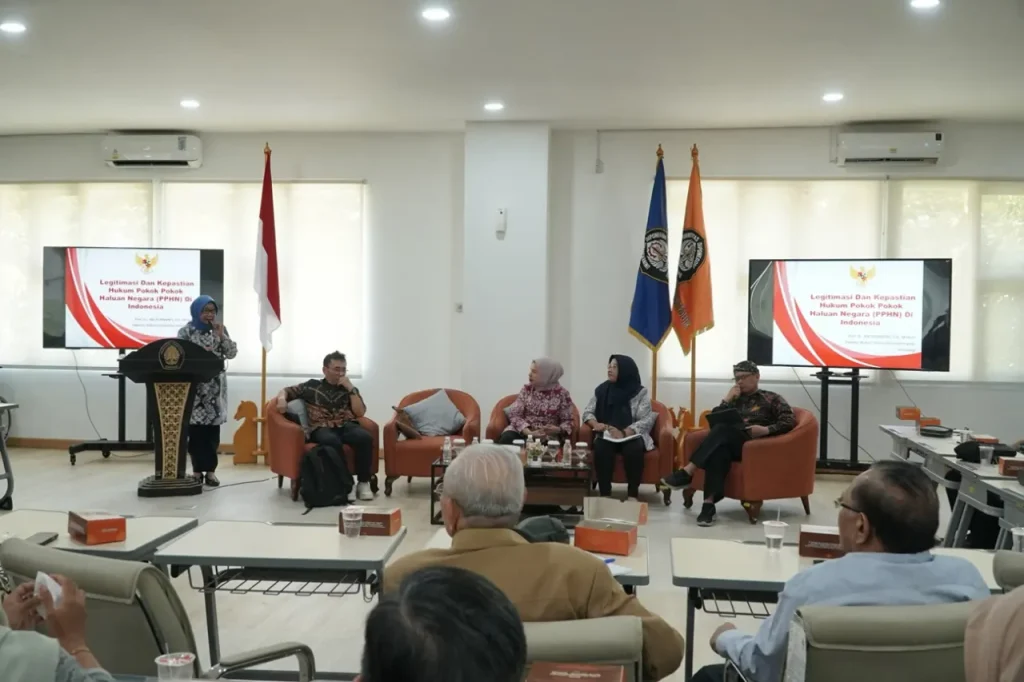
From the lens of regional and spatial economics, Prof. Dr. Fransiscus Xaverius Sugiyanto, M.S. explained that Indonesia faces a destiny of multi-plurality, whether historically, geographically, sociologically, or demographically. Based on a political-economy approach and theories of justice, the existence of interregional disparities is not an unchangeable fate, but the result of governance choices that require planned intervention. Research findings on regional convergence across Indonesia demonstrate that reducing disparity quickly depends greatly on improving connectivity, investment in education and health sectors, and strengthening basic infrastructure adapted to each region’s characteristics—such as the archipelagic nature of Maluku or the customary region base in Papua. Therefore, the PPHN must accommodate the principle of spatial justice realized through an asymmetric spatial decentralization paradigm, where the central government is obliged to integrate regional uniqueness and diversity into the national development planning framework.
Meanwhile, from a political and constitutional system perspective, Dr. Sos. Dra. Fitriyah, M.S. highlighted the challenges of institutionalizing the PPHN within Indonesia’s multiparty presidential system. According to comparative government theory, the post-amendment 1945 Constitution presidential system positions both the President and the legislature as having a direct mandate from the people, so policy design must be careful to avoid the risk of institutional conflict or dual legitimacy. Empirical experience shows that political stability in Indonesia heavily depends on the management of parliamentary coalitions. To ensure that the PPHN does not become a rigid instrument or, on the contrary, undermine executive autonomy, the most ideal form of its institutionalization is through a directive-coordinative model by law. With this scheme, the PPHN serves to provide strategic direction and a “comply or explain” obligation for each administration, without having to change the president’s position to MPR mandate holder or disrupt the well-established checks-and-balances mechanism.
To enrich insight and provide further depth to the speakers’ presentations, the event continued with discussants from the Department of Politics and Government, FISIP Undip, namely Bangkit Aditya Wiryawan, Ph.D. and Nuruddin Al Akbar, M.A. The response and Q&A session was interactive, offering critical space for academics and students to examine the position of the PPHN within the constitution and the state system of modern Indonesia.