

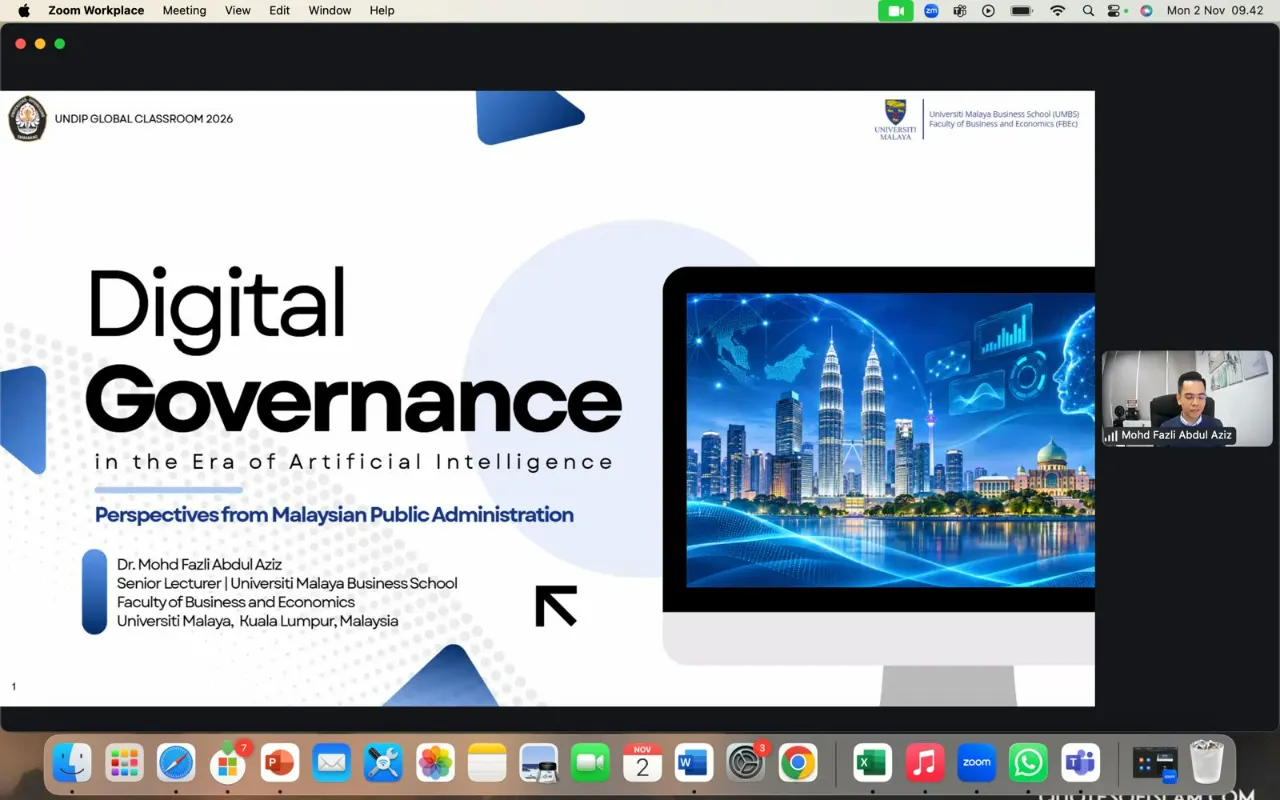
Semarang, November 2, 2026 The Faculty of Social and Political Sciences, Universitas Diponegoro, through its Department of Public Administration, organized an Undip Global Classroom as part of the Digital Governance course under the theme “Digital Governance in the Era of Artificial Intelligence: Opportunities and Challenges.” The session was held online via Zoom on Monday, November 2, 2026, at 9:30 a.m. Western Indonesia Time.
The Global Classroom featured M. Fazli A. Aziz, Ph.D. from Universiti Malaya, Malaysia, as the international academic speaker. His lecture presented perspectives from Malaysian public administration on the development of artificial intelligence and its implications for digital governance.
In his presentation, M. Fazli emphasized that the adoption of artificial intelligence in government should not be understood merely as a technological issue. AI can help public institutions process information, support administrative tasks, and inform decision-making. Nevertheless, public decisions must remain subject to human and institutional responsibility. Governments cannot transfer public accountability to algorithms.
The discussion was particularly relevant for Public Administration students, as AI is increasingly transforming the ways governments deliver services, manage information, and support administrative decisions. In public service delivery, AI may assist with routine citizen enquiries, classify requests, organize records, and identify cases requiring further attention. However, such technological capabilities do not automatically translate into better public services without appropriate governance arrangements.

The Malaysian experience became an important point of reference during the session. The lecture highlighted Malaysia’s ambition to develop an AI-enabled public sector, including efforts to improve public service delivery, strengthen policymaking, increase administrative efficiency, expand the use of data and AI, and enhance digital capability and inter-agency coordination.
At the same time, institutional readiness for AI extends beyond technological infrastructure. The lecture identified several important dimensions, including staff competencies, organizational culture, leadership, data readiness, and coordination. Simply purchasing or deploying AI software does not automatically make a public organization ready to govern and use artificial intelligence effectively.
The session also addressed the importance of fairness, transparency, and public trust. AI-assisted administrative decisions must ensure that inaccurate data or system rules do not unfairly disadvantage citizens, that decisions can be explained to those affected, and that mechanisms for review and correction remain available when errors occur.
Data governance was another central issue. Government AI systems require reliable and appropriate data, responsible information sharing, and adequate protection of sensitive information. This demonstrates that digital transformation is not only about technology, but also about rules, institutions, organizational capacity, and accountability mechanisms.
The Global Classroom also involved academics from the Department of Public Administration, FISIP UNDIP, as discussants, including Prof. Dr. Dra. Hartuti Purnaweni, M.P.A.; Dr. Dra. Augustin Rina Herawati, M.Si.; and Juang Abdi Muhammad, S.A.P., M.A.P., along with other faculty members. The session was moderated by Azaria Eda Pradana, S.A.P., M.A.P.
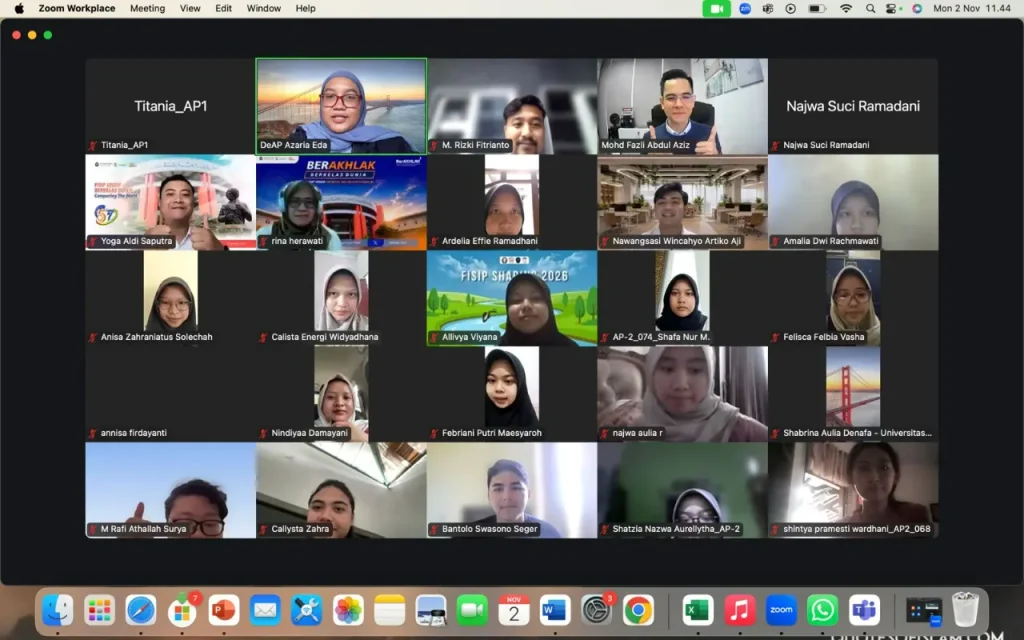
The participation of FISIP UNDIP academics as discussants provided an opportunity to connect Malaysia’s digital governance experience with the Indonesian public administration context. The forum encouraged participants to consider not only how AI can be introduced into government, but also how it should be governed in ways that safeguard accountability, fairness, transparency, and the public interest.
The lecture concluded with three key messages for the future of AI in public administration. First, technology creates opportunities to support services and public decisions, but its benefits are not automatic. Second, public institutions remain responsible for preserving professional judgement, fairness, and accountability. Third, public value must remain the ultimate objective, assessed through administrative efficiency, service outcomes, fair treatment, and accountability.
The Undip Global Classroom forms part of FISIP UNDIP’s continuing commitment to strengthening the internationalization of learning and providing students with direct exposure to global academic perspectives. The participation of a scholar from Universiti Malaya enabled students to engage with developments in digital governance from a comparative perspective while reflecting on similar challenges facing public administration in Indonesia.
Through this activity, the Department of Public Administration, FISIP UNDIP, continues to promote learning that is responsive to technological developments, informed by comparative perspectives, and firmly grounded in public values. The program also contributes to FISIP UNDIP’s institutional performance and its vision of becoming a world-class faculty that remains committed to the spirit of “Bermartabat dan Bermanfaat.”