

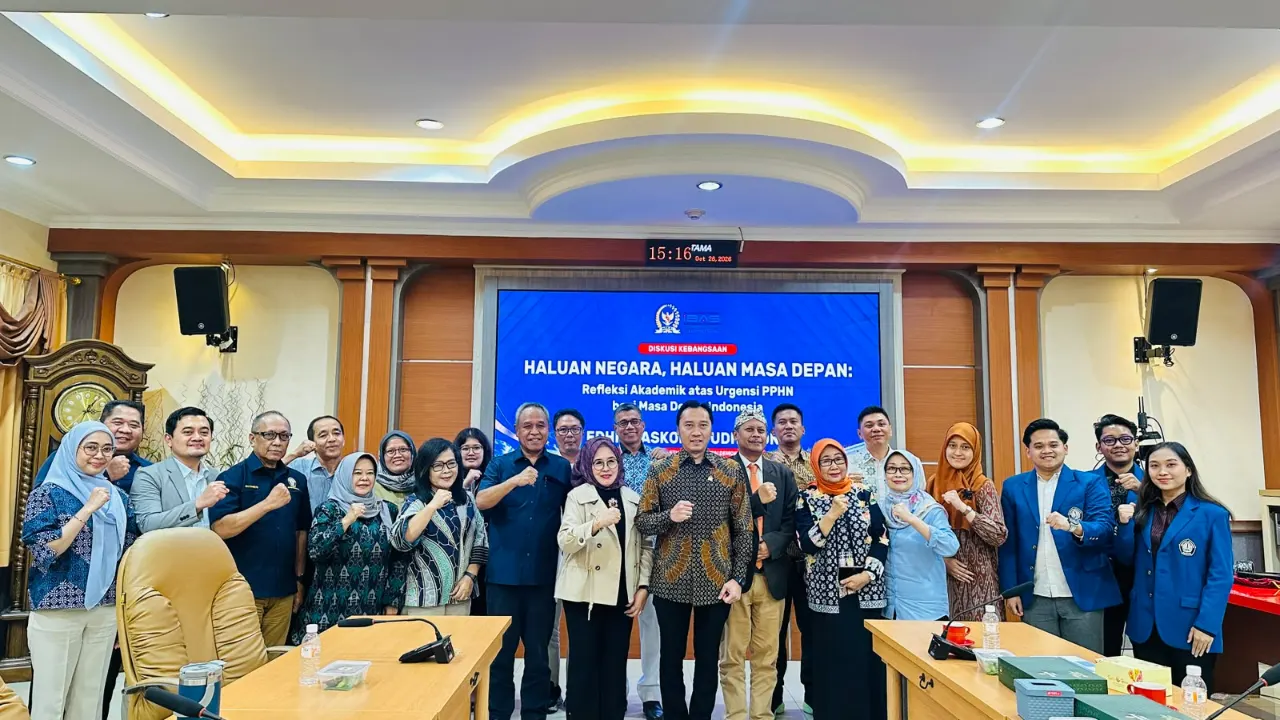
SEMARANG – The Dean of the Faculty of Social and Political Sciences (FISIP), Diponegoro University (UNDIP), Prof. Dr. Drs. Teguh Yuwono, M.Pol.Admin., attended as an expert speaker in the National Dialogue on the Main Guidelines of State Policy (Pokok-Pokok Haluan Negara / PPHN) with the Vice Chairman of the People’s Consultative Assembly of the Republic of Indonesia (MPR RI), Dr. H. Edhie Baskoro Yudhoyono, B.Com., M.Sc., at the Main Meeting Room of the Faculty of Law, UNDIP, Semarang, on Monday (26/10/2026).
Carrying the theme “State Direction, Future Direction: Academic Reflection on the Urgency of the Main Guidelines of State Policy (PPHN) for Indonesia’s Future,” this activity served as a dialogue space between the MPR RI and the UNDIP academic community to gather views, criticisms, suggestions, and input regarding the urgency of PPHN, particularly concerning institutional aspects and its position as a guideline for the implementation of national development.
The MPR RI visit was also attended by MPR RI members Dr. Benny K. Harman, S.H., Dr. Hinca I.P. Pandjaitan XIII, S.H., M.H., ACCS, and Jansen Sitindaon, S.H., M.H. The discussion involved Professors, lecturers, and students from the Faculty of Law and FISIP UNDIP.
Dean of FISIP UNDIP Strengthens Governance Perspective
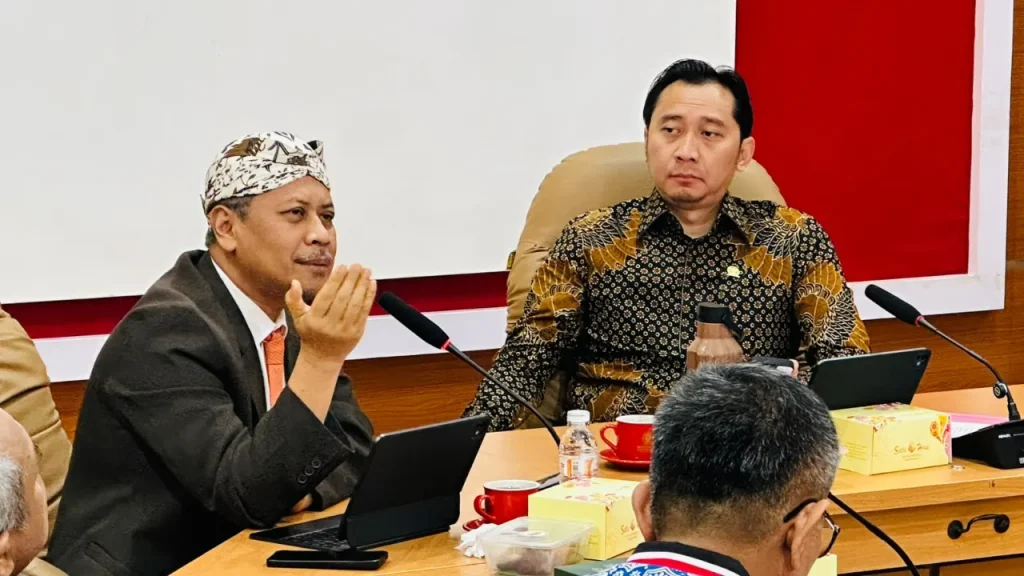
The presence of Prof. Teguh Yuwono as an expert speaker provided a governance perspective in the discussion regarding the direction of national development. As a Professor in the field of Governance, the involvement of the Dean of FISIP UNDIP enriched the dialogue, which not only discussed PPHN from legal and constitutional perspectives but also from the viewpoints of politics, public administration, and government administration.
In the context of national development, the discussion on state direction relates to the importance of continuous policy direction, inter-institutional coordination, and the targeted implementation of development programs. The governance perspective is relevant for examining how development guidelines can be translated into policies and programs implemented by government institutions.
This discussion also opened space for academics to examine the relationship between long-term development planning, government dynamics, and the evolving needs of society. These various aspects are an important part of the discussion regarding the urgency and possible implementation of PPHN in Indonesia.
In addition to the Dean of FISIP UNDIP, the discussion also featured Bangkit Aditya Wiryawan, S.I.P., M.A., Ph.D., a lecturer in Politics and Government Science at FISIP UNDIP. The involvement of FISIP UNDIP academics strengthened the scholarly contribution in the fields of politics and government in this national forum discussing the direction of Indonesia’s development.
UNDIP Academics Discuss the Urgency and Position of PPHN
In the forum, the MPR RI gathered the views of the academic community regarding the need for guidelines that can provide direction for national development. The discussion covered the urgency of PPHN, institutional design, and its position as an instrument for guiding the implementation of development at the national level.
Participants generally viewed that the existence of a national development guideline is needed. However, the technical aspects of implementation, the details of substance, and the institutional design of PPHN still require further discussion.
This exchange of views is part of an important review process to understand various legal, political, and administrative considerations before the PPHN idea is discussed further. Academic input is expected to help enrich perspectives on how the direction of national development can be maintained continuously while still taking into account the constitutional system and democratic dynamics.
Collaboration of Legal and Political Perspectives
The national dialogue also featured a number of Professors and experts from the Faculty of Law, UNDIP, including Prof. Dr. Yos Johan Utama, S.H., M.Hum.; Prof. Dr. Retno Saraswati, S.H., M.Hum.; Prof. Dr. Lita Tyesta A. L. W., S.H., M.Hum.; Prof. Dr. F.X. Adjie Samekto, S.H., M.Hum.; Prof. Dr. Ani Purwanti, S.H., M.Hum.; Prof. Dr. Fifiana Wisnaeni, S.H., M.Hum.; Dr. Kadek Cahya Susila Wibawa, S.H., M.H.; and Hasyim Asy’ari, S.H., M.Si., Ph.D.
These diverse scholarly perspectives broadened the discussion space for PPHN, ranging from state administrative law, constitutional law, international law, law and society, to politics and governance.
The involvement of cross-disciplinary academics demonstrates the importance of a comprehensive approach in examining strategic national policies. The discussion on PPHN requires not only consideration of legal and institutional foundations but also studies on policy implementation, government coordination, and the continuity of development planning.
The participation of students from the Faculty of Law and FISIP UNDIP also broadened the academic dialogue space. The involvement of the younger generation is an important part of building understanding of national issues while encouraging critical participation in public policy discussions.
Strengthening UNDIP’s Role in National Dialogue
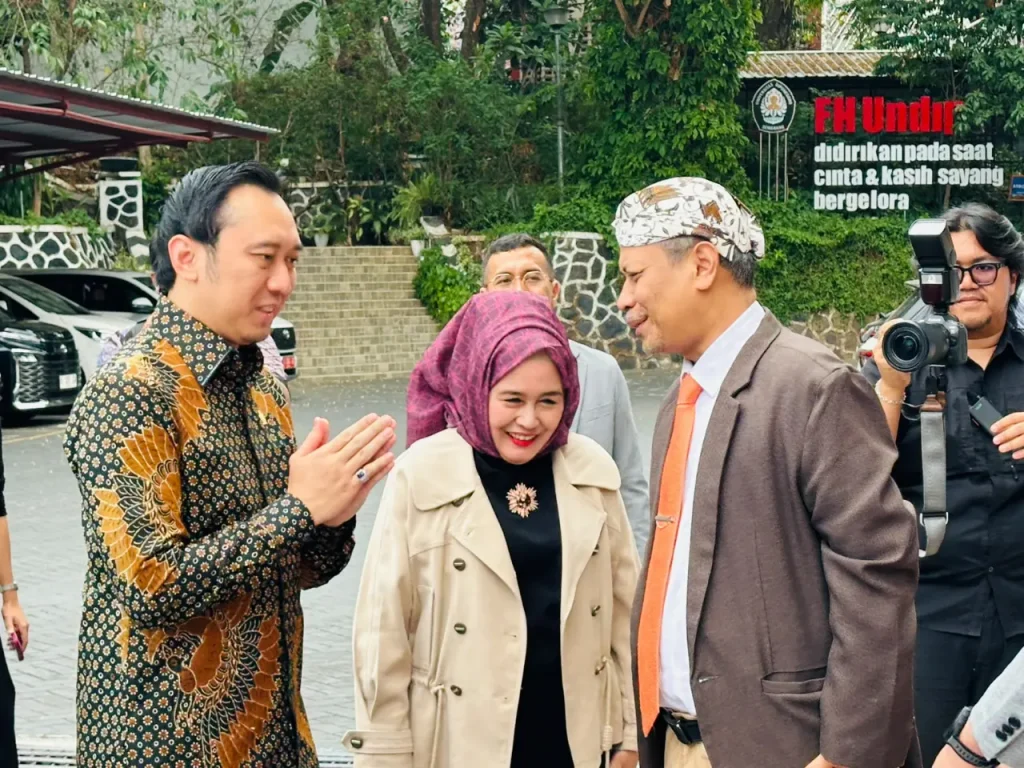
The MPR RI visit to UNDIP is part of the effort to gather input from academics at various universities. In addition to UNDIP, the MPR RI delegation also visited several other campuses, including Universitas Padjadjaran (UNPAD) and Universitas Indonesia (UI).
Through this forum, universities serve as a dialogue space that brings together academic perspectives with the process of reviewing national policy. Input from Professors, lecturers, and students is expected to enrich the discussion regarding the urgency, position, and institutional design of PPHN.
The participation of the Dean and academics of FISIP UNDIP in this discussion reflects the contribution of social and political sciences, particularly in the fields of politics, public administration, and governance, in discussing Indonesia’s development challenges. Cross-disciplinary synergy within UNDIP is expected to continue strengthening the role of higher education as a center for knowledge development and a dialogue partner on strategic national issues.
Through the active involvement of the academic community, FISIP UNDIP continues to take part in the space for exchanging ideas regarding the administration of government and national development that is sustainable, accountable, and oriented toward the interests of society.