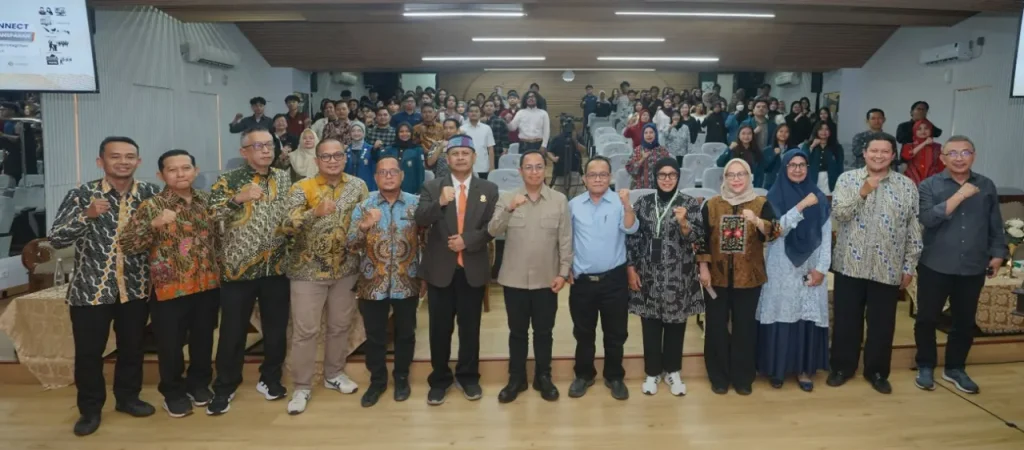
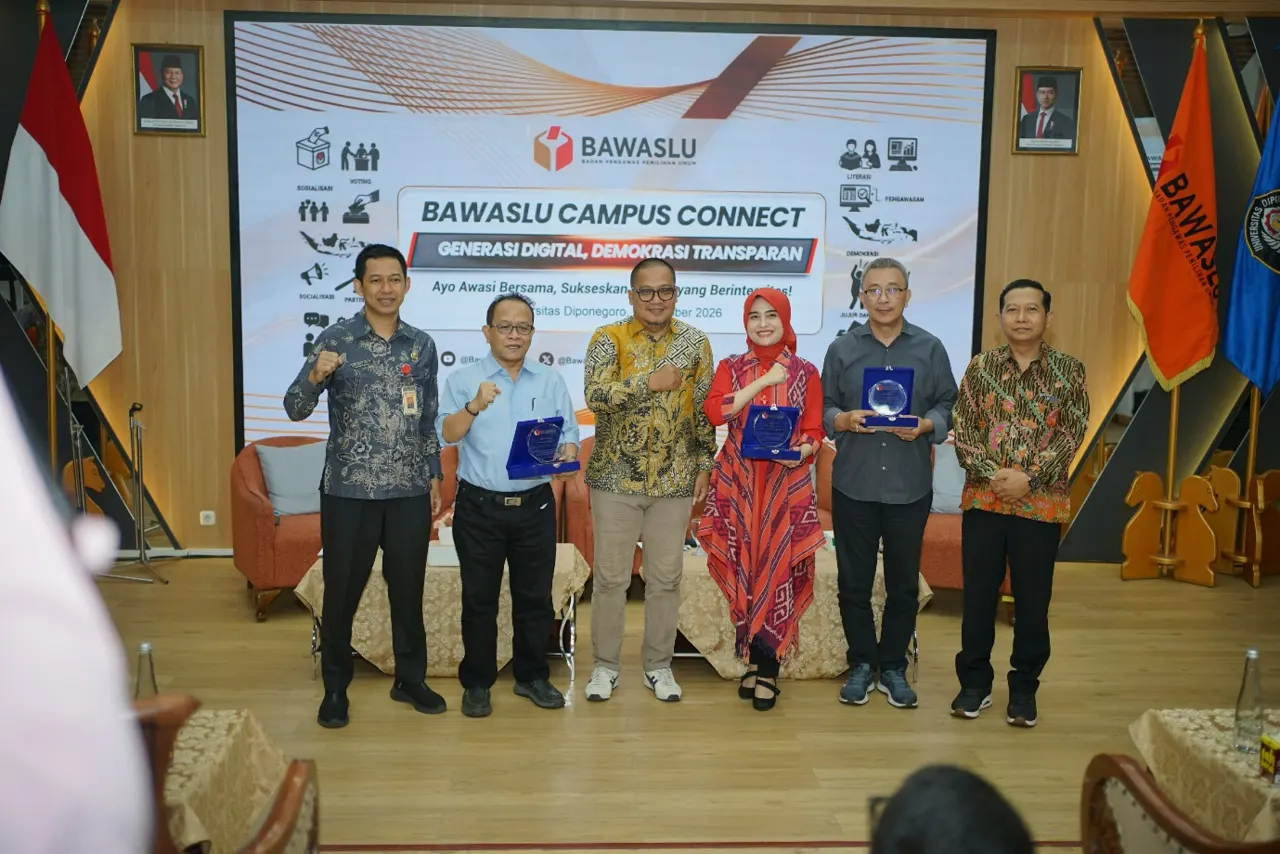
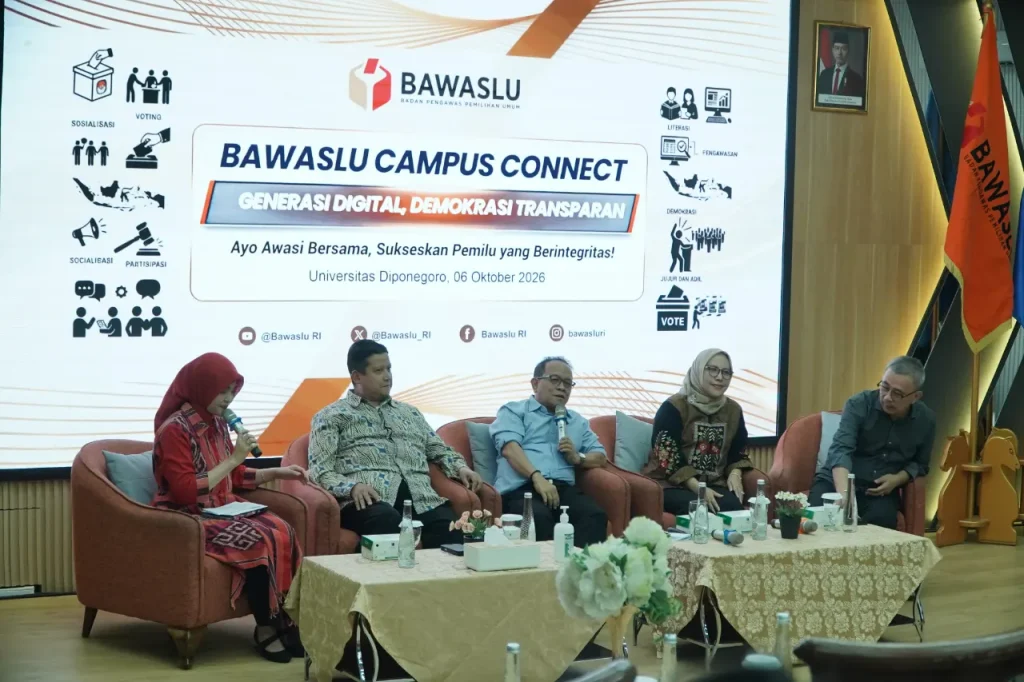
Semarang—The Department of Government Studies, Faculty of Social and Political Sciences, Universitas Diponegoro, together with the General Election Supervisory Agency (Bawaslu) of the Republic of Indonesia, held Bawaslu Campus Connect entitled “Digital Generation, Transparent Democracy” on Tuesday (6/10/2026) at the Theater Room, Building C, 1st Floor, FISIP Campus, Universitas Diponegoro, Tembalang, Semarang City. The event featured five speakers: Prof. Dr. Phil. Aditya Perdana, S.I.P., M.Si., Lecturer at the Department of Political Science, Universitas Indonesia; Dr. Nur Hidayat Sardini, Lecturer at the Department of Politics and Government Studies, FISIP Undip; Prof. Dr. Muhammad, S.IP., M.Si., Professor of Political Science at Universitas Hasanuddin; Prof. Dr. Evi Satispi, S.P., M.Si., Dean of FISIP Universitas Muhammadiyah Jakarta; and Jeirry Sumampow, Coordinator of the Indonesian Voters Committee.
The event served as an academic forum to discuss the role of the digital generation in safeguarding democratic transparency, particularly in election oversight, as the digital public space has become a primary arena for shaping political opinion. It began at 10:00 a.m. WIB with an opening by Dr. H. Puadi, S.Pd., M.M., Coordinator of the Division for Violation Handling, Data and Information of Bawaslu RI, and welcoming remarks from the Dean of FISIP Universitas Diponegoro, Prof. Dr. Drs. Teguh Yuwono, M.Pol.Admin, and was attended by members of the academic community and students from various study programs at FISIP Undip. In his presentation, Dr. Puadi stressed that Bawaslu’s digital transformation is not mere administrative digitalization but a shift toward proactive, data- and risk-based oversight that involves the public and universities, with technology serving as an instrument that must safeguard ethics, data security, and citizens’ constitutional rights.
Prof. Dr. Phil. Aditya Perdana emphasized that citizen participation is the core of digital democracy and that the digitalization of oversight needs more measurable targets. He urged students to become polling station (TPS) supervisors or join civil society communities such as Mafindo and KawalPemilu.
Dr. Nur Hidayat Sardini stressed the urgency of election cyber capacity as violations shift toward e-wallets and encrypted messaging. He encouraged Bawaslu to partner with universities on algorithm audits and digital forensics, particularly now that national and regional elections have been separated under Constitutional Court Decision No. 135/PUU-XXII/2024.
Prof. Dr. Muhammad observed that election digitalization offers efficiency and transparency but faces cyber threats and infrastructure gaps. He therefore called for periodic technology audits and the adoption of open-source and cryptographic principles. Meanwhile, Prof. Dr. Evi Satispi highlighted the large share of Gen Z and millennial voters in the 2024 election (58.38 percent) and the challenge of disinformation in digital spaces. She stressed that AI should assist, not replace, human legal judgment, and encouraged campuses to become digital democracy laboratories.
Jeirry Sumampow noted that the arena of democracy has now moved into the digital space, so election integrity also depends on the information ecosystem. He urged students to act as participatory supervisors who report, verify, and document findings without passing judgment. The session continued with a discussion moderated by Hanifa Maylasari, S.IP., M.Sos.
Through this event, participants were expected to broaden their understanding of the role of the digital generation in realizing transparent democracy and to recognize the campus as a strategic partner in election oversight. Bawaslu Campus Connect “Digital Generation, Transparent Democracy” also brought together the perspectives of academics, election administrators, and civil society with technological developments at FISIP Undip.