

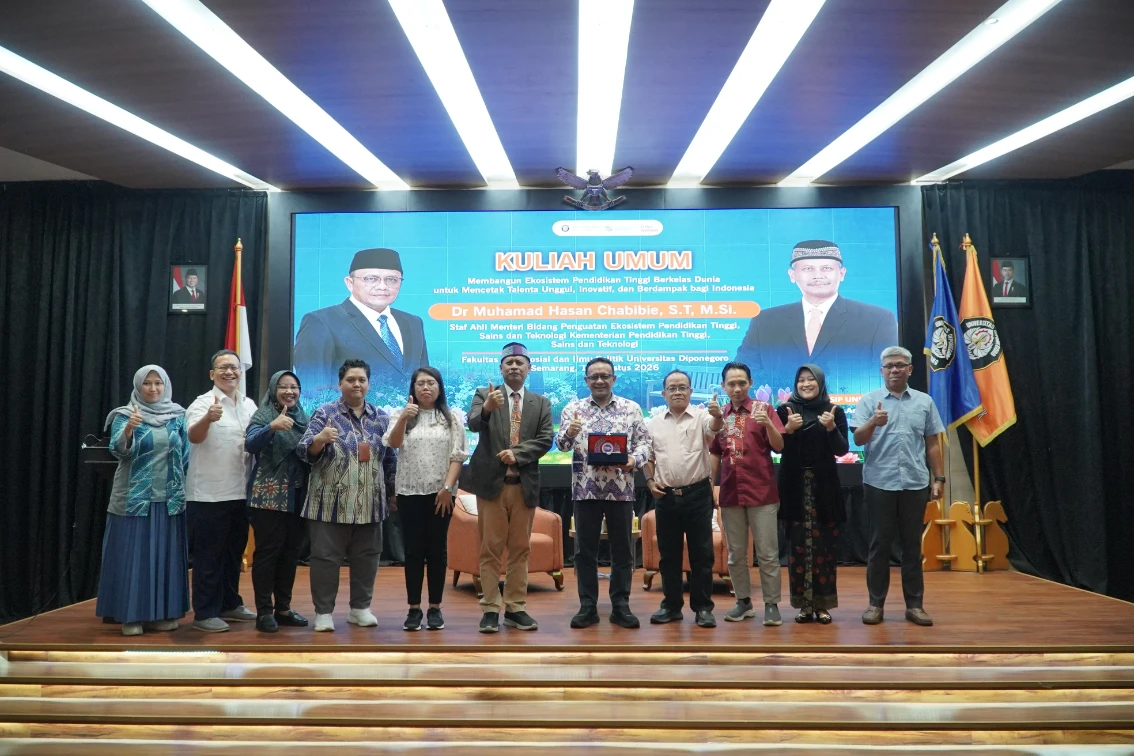
Semarang (18/8) – The Faculty of Social and Political Sciences (FISIP), Diponegoro University (UNDIP), held a Public Lecture on the theme “Building a World-Class Higher Education Ecosystem to Produce Excellent, Innovative, and Impactful Talent for Indonesia” on Tuesday (August 18, 2026), from 10:00 AM WIB until completion, at the FIMENA R Auditorium, FISIP UNDIP. The event featured Dr. Muhamad Hasan Chabibie, S.T., M.Si., Expert Staff to the Minister for Strengthening the Higher Education, Science, and Technology Ecosystem at the Ministry of Higher Education, Science, and Technology.
In his presentation, Hasan Chabibie emphasized that the rapid changes in the world of work are accelerating alongside developments in artificial intelligence (AI), digitalization, the green transition, and geopolitical dynamics. These conditions demand that universities not only produce graduates with knowledge mastery but also talent capable of adapting, innovating, solving problems, and working in a global environment.
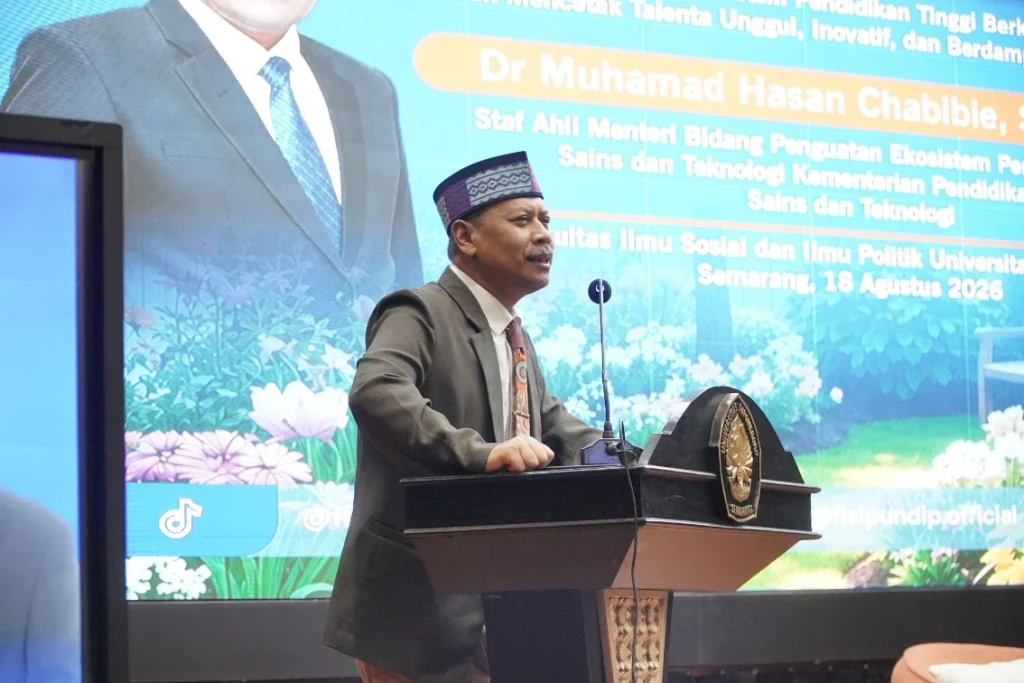
Dean of FISIP UNDIP, Prof. Teguh Yuwono, M.Pol.Admin., stated that strengthening the higher education ecosystem is an important part of FISIP UNDIP’s journey toward becoming a world-class faculty. According to him, internationalization must be accompanied by improvements in the quality of learning and graduate competencies.
“We do not only want to produce academically smart graduates, but also graduates who are able to compete, adapt, and make an impact at both national and global levels. Therefore, we must build the educational ecosystem together so that students gain relevant experience and competencies for future needs,” said the Dean.
Prof. Teguh Yuwono, M.Pol.Admin., added that FISIP UNDIP’s achievements at the global level must be accompanied by strengthening internal quality, ranging from learning, research, community service, to student and alumni development. FISIP UNDIP itself continues to push for strengthening academic reputation and internationalization as part of its commitment toward becoming a World Class Faculty.
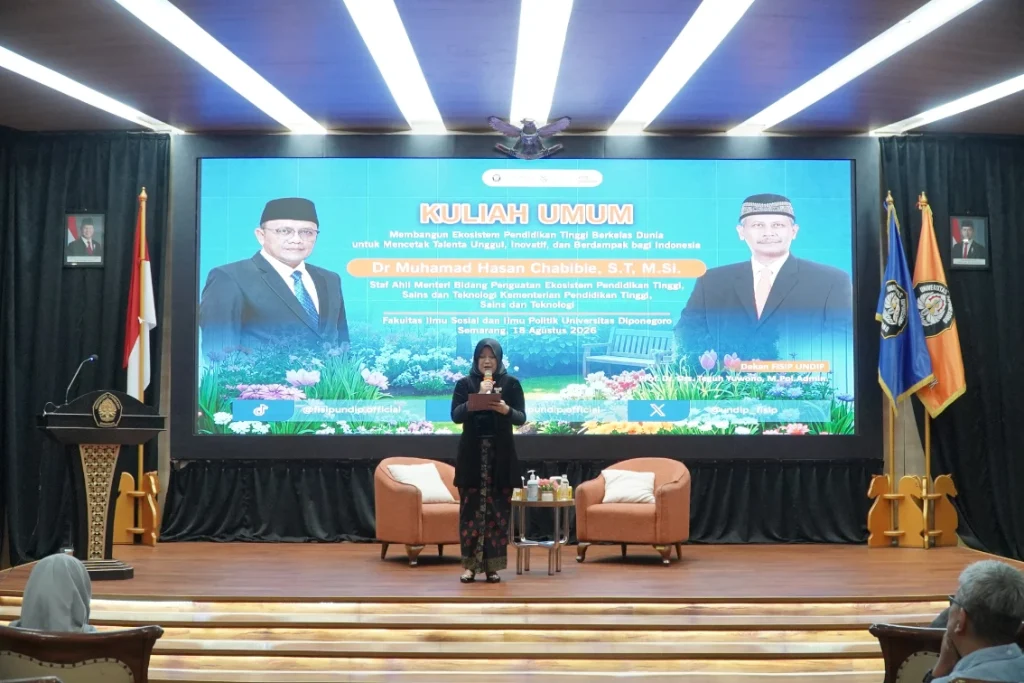
One of the main ideas in the public lecture was the need to shift the orientation of internationalization from mere activities to the development of an “operating system for talent.” Campuses need to provide global experiences through curricula, cross-country collaborative projects, virtual mobility, international lecturers and practitioners, global case studies, and various real-world problem-based projects.
This approach also encourages a transformation in learning from “what students know” to “what students can do.” Students need opportunities to apply their knowledge through policy analysis, case studies, policy briefs, simulations, research, policy labs, internships, and international projects.
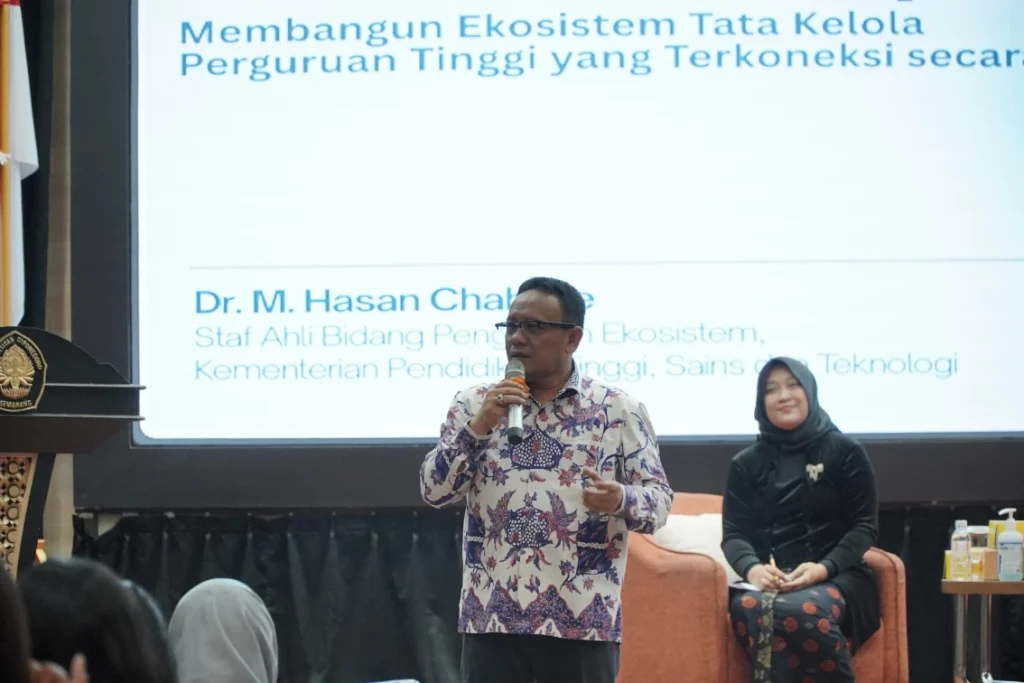
For students, these competencies are becoming increasingly important. Graduates are expected to understand global issues while possessing analytical skills, digital and AI literacy, cross-cultural communication skills, and the ability to make decisions in complex situations.
This public lecture also affirmed that employability is a campus ecosystem responsibility. Career development must begin when students enter university through portfolio building, project experience, professional networking, and connections with international organizations, multinational companies, NGOs, think tanks, and various other institutions.
Through this activity, FISIP UNDIP reaffirms its commitment to building a higher education system that not only produces graduates but also global talent that is excellent, innovative, adaptive, and impactful for Indonesia.