

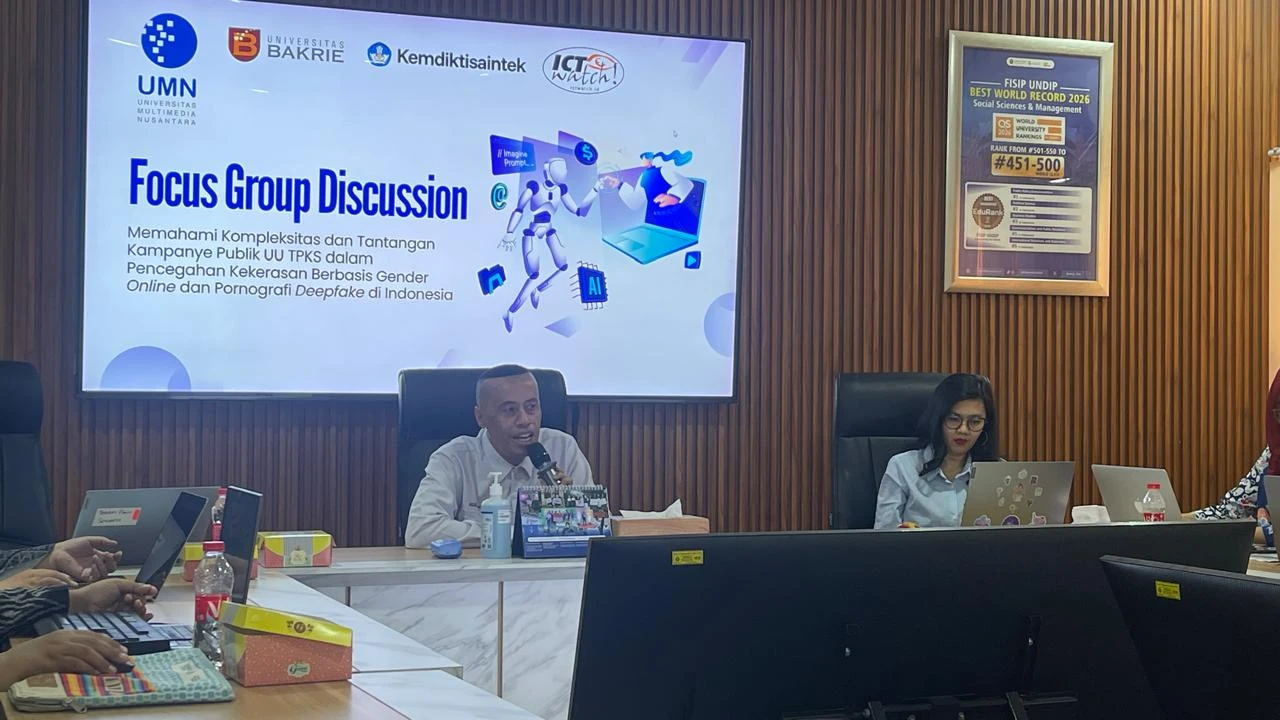
FISIP Undip – The rise in cases of online gender-based violence (KBGO) and the emergence of deepfake pornography as a result of advancements in artificial intelligence (AI) technology have become a serious concern for various groups. This phenomenon is considered increasingly complex and requires a comprehensive strategic response, particularly through the strengthening of coordinated public awareness campaigns.
In response to these challenges, a research team from Multimedia Nusantara University (UMN), in collaboration with Bakrie University and ICT Watch, organized a Focus Group Discussion (FGD) titled “Understanding the Complexities and Challenges of Public Campaigns on the TPKS Law in Preventing Online Gender-Based Violence and Deepfake Pornography in Indonesia.” The event took place in the Antawirya Room, Faculty of Social and Political Sciences (FISIP), Diponegoro University (UNDIP), Semarang, on Monday (July 20).
This FGD is part of a basic research study aimed at strengthening public campaign strategies related to the implementation of the Law on Sexual Violence Crimes (UU TPKS), particularly in preventing online gender-based violence (KBGO) amid the emergence of a new threat in the form of deepfake pornography. In addition, this research also seeks to map out potential cross-sectoral collaboration between the government, civil society organizations, the media, universities, and digital platforms.
The event was also attended by various stakeholders, including Nur Laila Hafidhoh, M.Pd., from LCR-KJHAM Semarang; Prof. Dr. Ir. Aisyah Endah Palupi, M.Pd., Head of LLDIKTI Region VI; Girindra Whardana from AJI (Independent Journalists Association) Semarang; Dr. Ristina Yudhanti, S.H., M.Hum., Chair of the UNNES PPKPT Task Force; Annastasia Ediati, S.Psi., M.Sc., Ph.D., Psychologist and member of the UNDIP PPKPT Task Force; Kinanti Widyaningsih, S.Psi., M.Si., from the Unika Soegijapranata PPKPT Task Force; Desi Maulia, S.Psi., M.Psi., Psychologist, from PGRI University of Semarang; and Raden Rara Ayu Hermawati Sasongko, S.H., M.H., from LBH Apik.
The FGD was opened by the Chair of the Department of Communication Sciences at UNDIP’s Faculty of Social and Political Sciences (FISIP), Dr. Agus Naryoso. In his opening remarks, he emphasized that the development of digital technology presents increasingly complex new challenges, necessitating a collaborative, cross-sectoral approach to address them.
The head of the research team, Intan Primadini, explained that the development of AI has changed the patterns of gender-based violence in the digital space. One form that has now become a global concern is deepfake pornography—visual manipulation that superimposes a person’s face onto pornographic content without their consent.
“This phenomenon not only has a psychological impact on victims but also presents new challenges in law enforcement, digital literacy, and public communication strategies,” he said.
Furthermore, he emphasized that KBGO is an ecosystem-wide issue that cannot be resolved in isolation. Therefore, synergy is needed among various stakeholders, ranging from the government, civil society organizations, the media, universities, to digital platforms.
“So far, much research has focused on legal aspects or the victims’ experiences. In fact, preventing KBGO requires an integrated, cross-sectoral collaborative approach,” he added.
Through this research, the team aims to develop a cross-sectoral public communication strategy model that can serve as a reference for the government, civil society organizations, the media, educational institutions, and digital platforms in strengthening the implementation of the TPKS Law.
The results of the FGD, which involved representatives of the Task Force for the Prevention and Handling of Violence in Higher Education (Satgas PPKPT) from various universities in Semarang, non-governmental organizations working on gender issues and the protection of women and children, and LLDIKTI Region VI, indicate that advancements in AI technology are further increasing the complexity of KBGO issues. Therefore, building the capacity of human resources in prevention and response efforts has become crucial.
In conclusion, this event underscored the importance of cross-sectoral coordination and collaboration among higher education institutions, the government, NGOs, and the media in addressing the challenges of sexual violence against women and deepfake pornography, which continue to evolve in the digital age.***