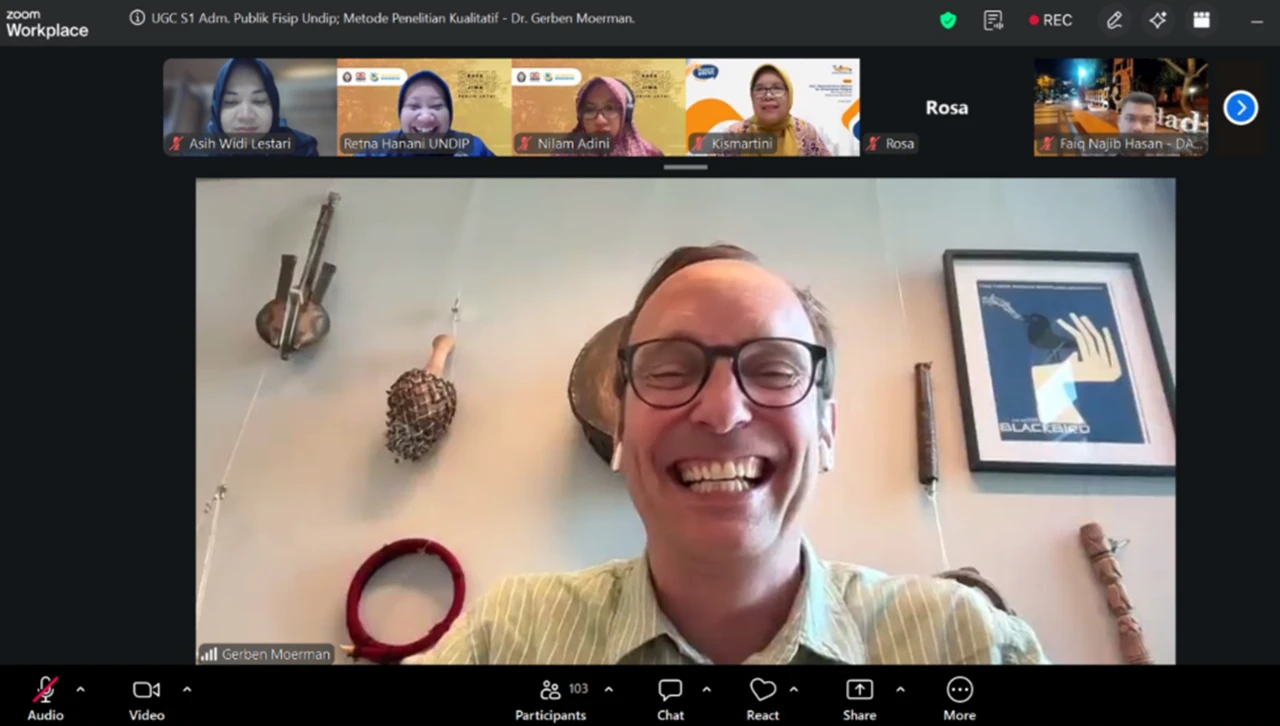
Semarang, May 22, 2026 — The Department of Public Administration, Faculty of Social and Political Sciences, Universitas Diponegoro, held an Undip Global Classroom session as part of the Qualitative Research Methods course. The event discussed the topic “Qualitative Research Method in Public Administration” and featured Dr. Gerben Moerman from the University of Amsterdam as the invited speaker.
This activity reflects the Department of Public Administration’s commitment to strengthening international learning experiences, particularly in the field of qualitative research methodology. Through this session, students gained direct insights from an international scholar regarding the development, potential, and challenges of qualitative research in public administration studies.
In his presentation, Dr. Gerben Moerman explained the importance of collaborative inquiry in qualitative research. He emphasized that collaboration in qualitative analysis enables researchers to think with bigger data and address broader research questions. He also highlighted the importance of theory, meaning, interpretation, and collaboration among analysts in maintaining the quality of qualitative data analysis. The presentation further discussed big textual data, automated coding, semantic analysis, machine learning, natural language processing, and artificial intelligence, while stressing that validity and meaning must remain central concerns in qualitative research.
Dr. Moerman also provided examples of how researcher collaboration can enrich the analytical process, including coder training, the use of software such as ATLAS.ti, inter-coder reliability testing, and team-based discussion to validate meaning. According to the presentation, coding in qualitative research is not only useful for organizing data, but also for identifying patterns, answering research questions, and generating new analytical insights.
The session also underlined the importance of involving diverse perspectives in qualitative research. Collaboration allows researchers to better understand different contexts, access diverse participants, and develop richer methodological approaches. In the context of public administration, this approach is highly relevant because public issues are often complex, multi-actor, and require a deep understanding of social meanings, experiences, and institutional dynamics.
Through this Global Classroom, students not only strengthened their conceptual understanding of qualitative research methods, but also gained practical knowledge about how qualitative research can be conducted collaboratively and internationally. The discussion enriched students’ understanding of how qualitative methods can be applied to analyze public administration, public policy, public service, and governance issues in a more critical and reflective manner.
The Department of Public Administration, FISIP UNDIP, hopes that this Undip Global Classroom will continue to enhance the international academic atmosphere, improve students’ methodological capacity, and encourage the development of high-quality, contextual, and globally relevant public administration research. This program also demonstrates the department’s commitment to supporting the internationalization of higher education at Universitas Diponegoro.