

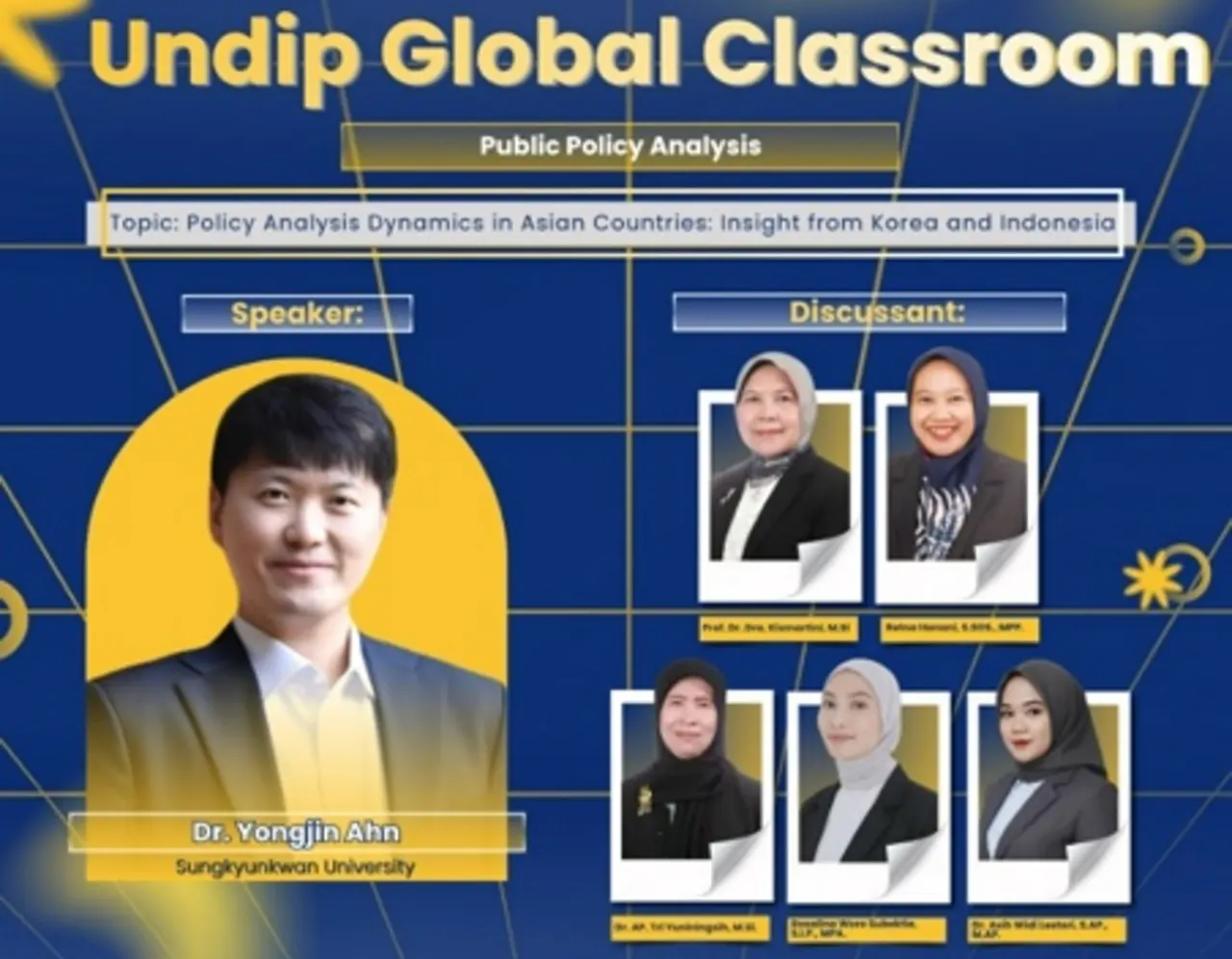
Semarang, November 26, 2026 – The Department of Public Administration, Faculty of Social and Political Sciences (FISIP), Diponegoro University (UNDIP), held an UNDIP Global Classroom entitled “Policy Analysis Dynamics in Asian Countries: Insights from Korea and Indonesia” on Thursday (26/11). The activity featured Dr. Yongjin Ahn, Assistant Professor from the Department of Public Administration and Graduate School of Governance, Sungkyunkwan University, South Korea, as the keynote speaker.
This activity served as a space for exchanging knowledge and academic perspectives regarding the dynamics of public administration, particularly the relationship between politics and administration, bureaucratic professionalism, the merit system, decentralization, and government accountability in the context of South Korea and Indonesia.
In his presentation, Dr. Yongjin Ahn reviewed the challenges of modern bureaucracy in balancing political responsiveness with the professionalism and neutrality of the apparatus. He also explained the importance of the merit system through competitive recruitment, transparent selection processes, and competency-based career development as the foundation of a professional bureaucracy.
In addition, the discussion covered South Korea’s experience in strengthening decentralization since 1995, demographic challenges in the form of declining birth rates and an aging population, as well as government policy innovations in responding to these issues. One interesting issue also discussed was the relocation of some government functions from Seoul to Sejong.
“Public administration is not just about how government works, but also about whom it works for.”
This reflective message became one of the common threads of the discussion, emphasizing that the effectiveness of public administration is not only measured by the government’s capacity to manage institutions but also by the extent to which the bureaucracy is able to serve the interests of society professionally, responsively, and accountably.
South Korea’s experience in relocating government functions from Seoul to Sejong also opened a space for comparison with Indonesia, which is currently developing Nusantara as its new capital. Although they have different political and institutional contexts, both countries face challenges related to equitable regional development, institutional coordination, and policy sustainability.
The discussion became even richer through the responses of academics from the Department of Public Administration at UNDIP, namely Prof. Dr. Dra. Kismartini, M.Si., Retna Hanani, S.Sos., MPP., Dr. AP. Tri Yuniningsih, M.Si., and Dr. Asih Widi Lestari, S.AP., M.AP. The question-and-answer session also provided an opportunity for students to engage in direct dialogue with the speaker regarding bureaucratic reform, public accountability, decentralization, and policy innovation.
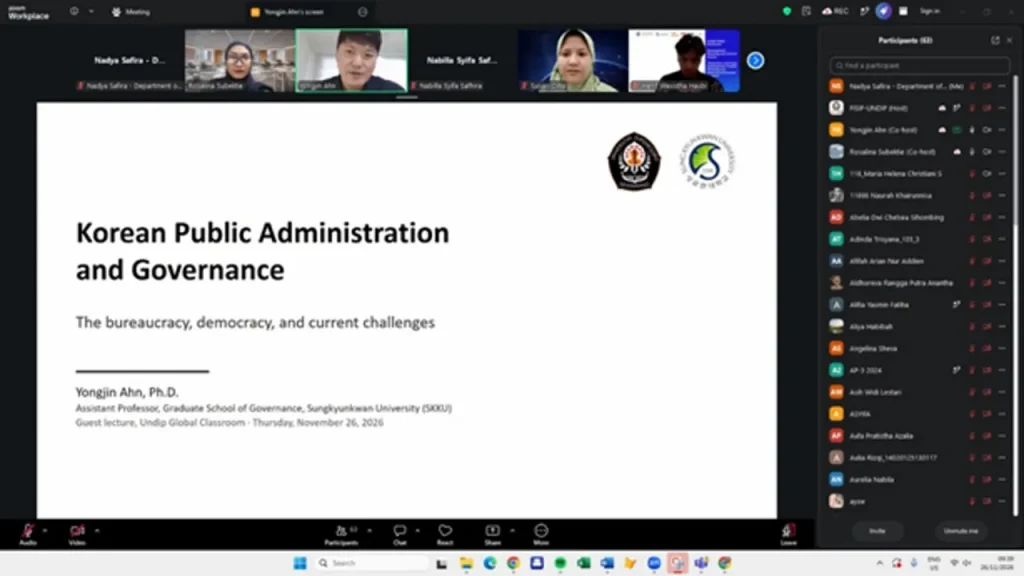
Through this activity, the UNDIP Global Classroom reaffirmed the importance of a comparative perspective in public administration studies. South Korea’s experience does not merely serve as a model to be replicated but rather as a critical reference for understanding how government institutions can adapt to social change, maintain professionalism, and produce policies oriented toward the public interest.
This activity also strengthened the commitment of the Department of Public Administration at UNDIP to expanding international academic networks and presenting globally oriented learning for the academic community.