
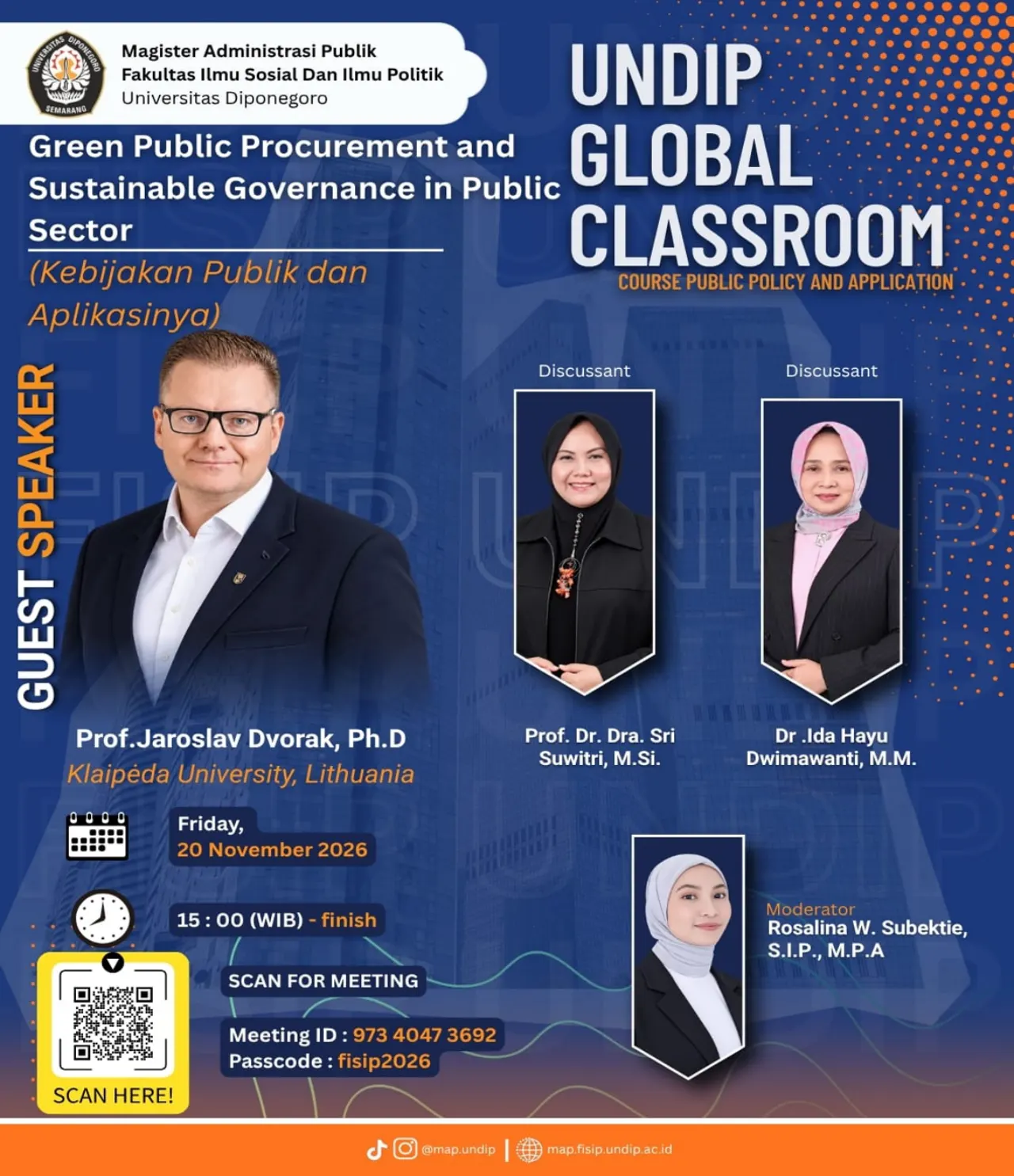
SEMARANG, November 20, 2026 — The Master of Public Administration Study Program, FISIP Diponegoro University, held an Undip Global Classroom activity in the Public Policy and Its Applications course, raising the theme “Green Public Procurement and Sustainable Governance in Public Sector.” This internationally scaled lecture activity featured the keynote speaker Prof. Jaroslav Dvoral, Ph.D., accompanied by discussant lecturer Prof. Dr. Dra. Sri Suwitri, M.Si.
The organization of this Global Classroom aimed to broaden students’ insights regarding the integration of environmental sustainability principles into the government goods and services procurement system (Green Public Procurement), while also strengthening public sector governance that is responsive to the challenges of climate change and sustainable development.
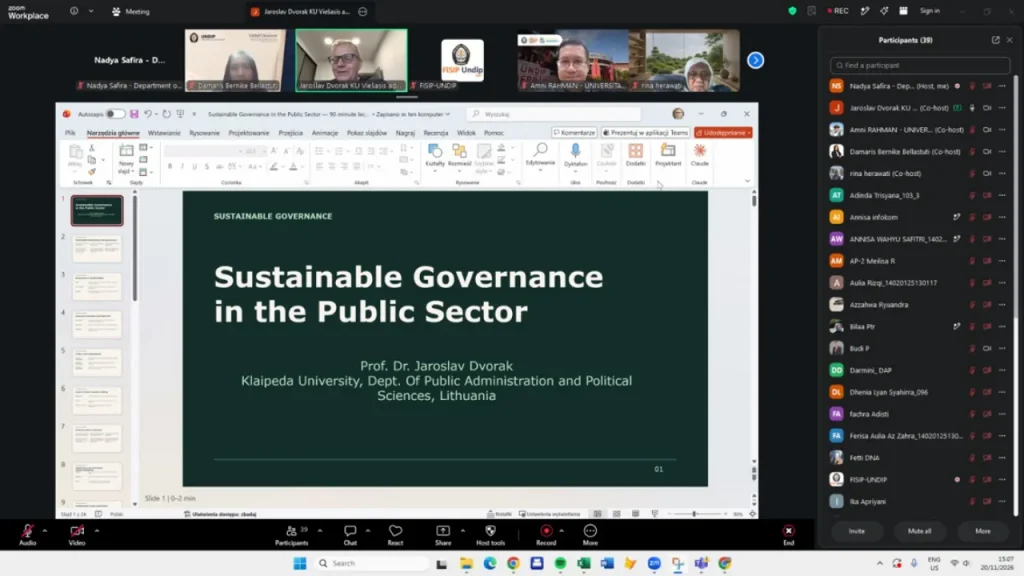
In his presentation, Prof. Jaroslav Dvoral, Ph.D. reviewed how public procurement instruments can be optimized not merely for budget efficiency but also as a driver of green transition in the government sector. He emphasized the importance of environmentally friendly criteria standards in the government supply chain, transparency in vendor evaluation, and regulatory synergy so that green procurement policies can be implemented consistently.
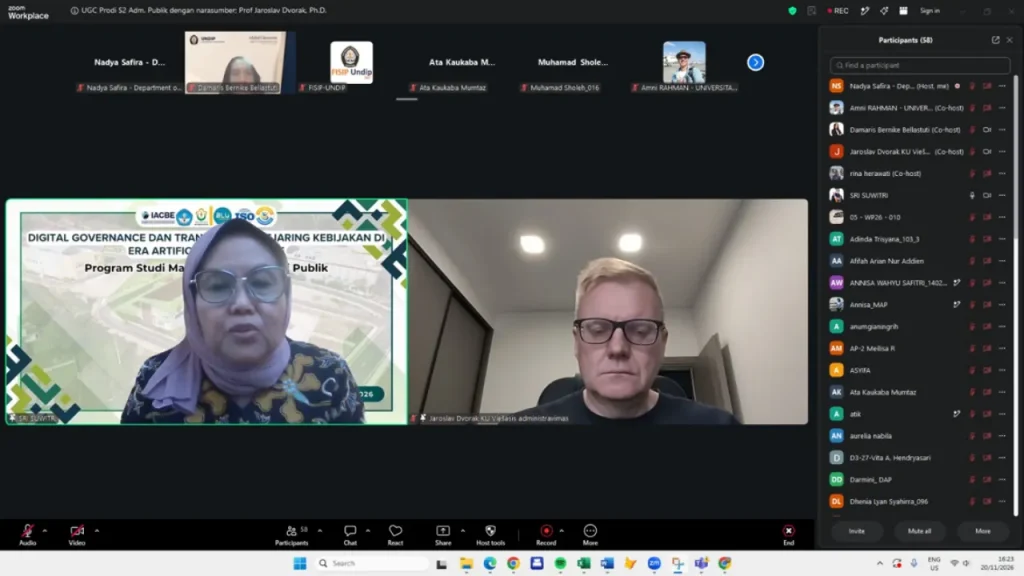
In response to the presentation, Prof. Dr. Dra. Sri Suwitri, M.Si., as the discussant lecturer, enriched the discussion through a comprehensive review from various dimensions of public policy, ranging from regulatory formulation, institutional governance, to implementation at the bureaucratic level:
- Harmonization of Regulations and Policy Instruments: The need for alignment between government goods and services procurement policies and the low-carbon development agenda, including the preparation of technical guidelines and clear green criteria standards for both central and regional government agencies.
- Institutional Capacity and Bureaucratic Human Resources: The readiness of procurement management apparatus and selection working groups in understanding environmental sustainability indicators and product life-cycle costing analysis, so that the evaluation process does not only rely on the lowest price.
- Collaborative Governance and Market Ecosystem: The importance of cross-actor synergy between government, business actors, and stakeholders in building an environmentally friendly supply chain, accompanied by policy incentives so that local providers and MSMEs are able to adapt to green procurement standards.
- Accountability, Oversight, and Policy Impact Evaluation: Strengthening environmental performance-based monitoring systems and digital transparency to ensure that green procurement policies truly have a real impact on emission reduction and the prevention of unaccountable procurement practices.
Through interactive discussions in this global classroom, students were invited to compare best practices of sustainable procurement policies at the international level with the dynamics of public policy implementation in Indonesia. The Undip Global Classroom program is expected to continue to serve as a space for cross-country academic idea exchange that enriches the quality of learning and prepares graduates who are adaptive to global governance issues.