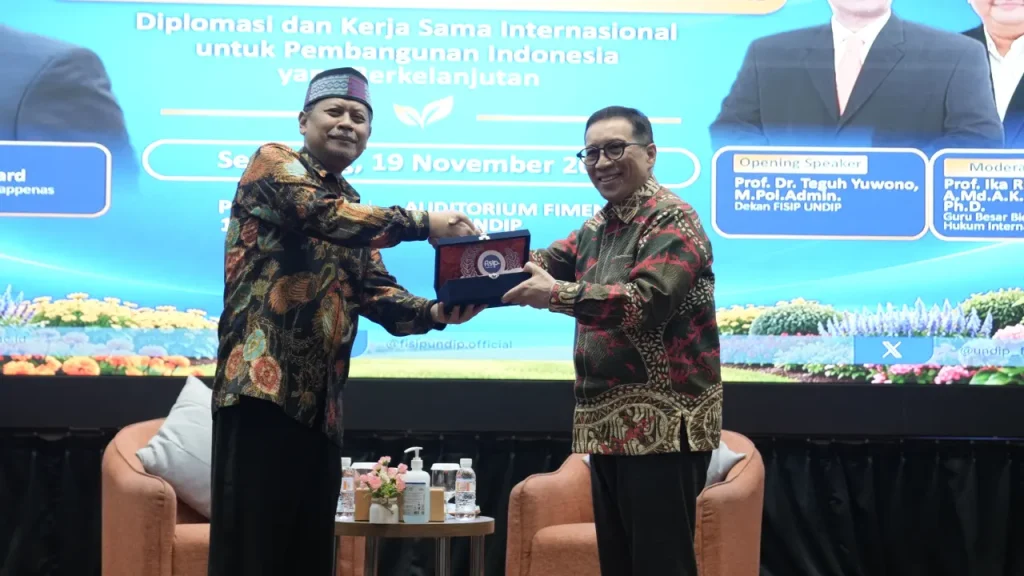

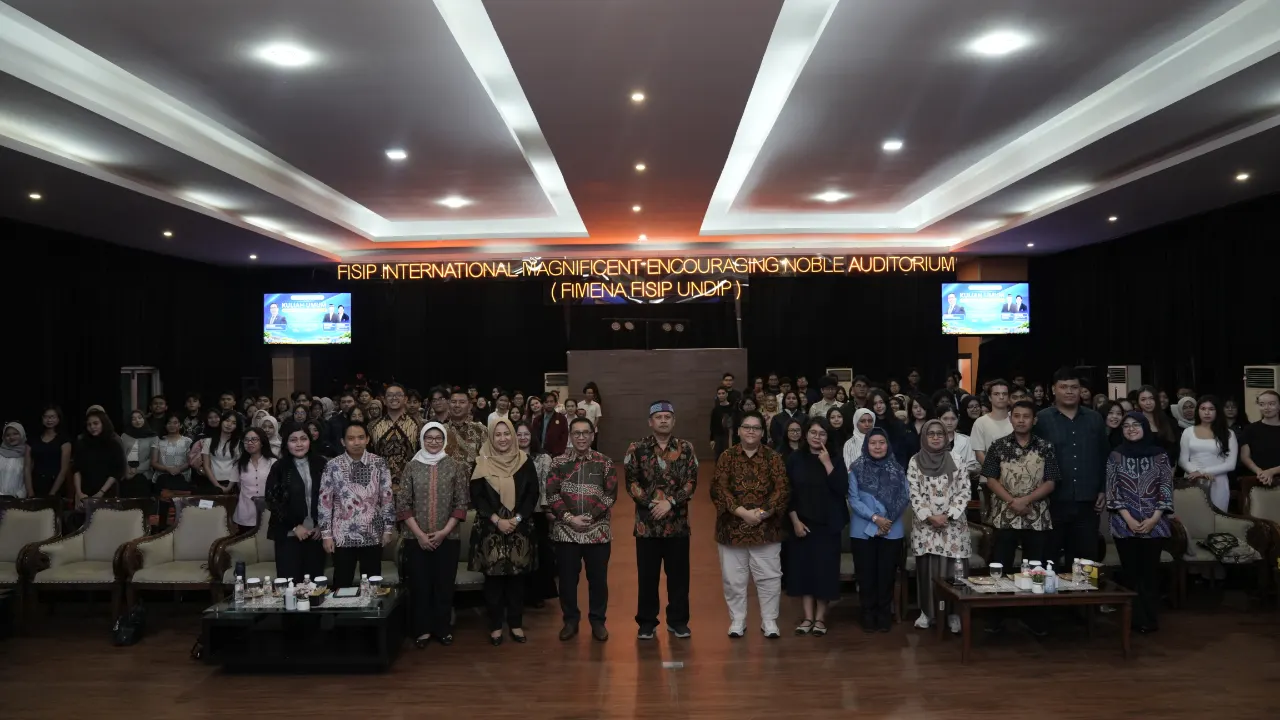
SEMARANG – The Faculty of Social and Political Sciences (FISIP), Universitas Diponegoro (UNDIP), held a public lecture featuring Deputy Minister of National Development Planning (PPN)/Deputy Head of the National Development Planning Agency (Bappenas), Febrian Alphayanto Ruddyard, on Thursday, November 19, 2026. The event, themed “Diplomacy and International Cooperation for Indonesia’s Sustainable Development,” took place at the FIMENA Auditorium, FISIP UNDIP, from 1:00 to 4:00 p.m. Western Indonesian Time (WIB). The discussion was moderated by Professor Ika Riswanti Putranti, A.Md.A.K., S.H., M.H., Ph.D.
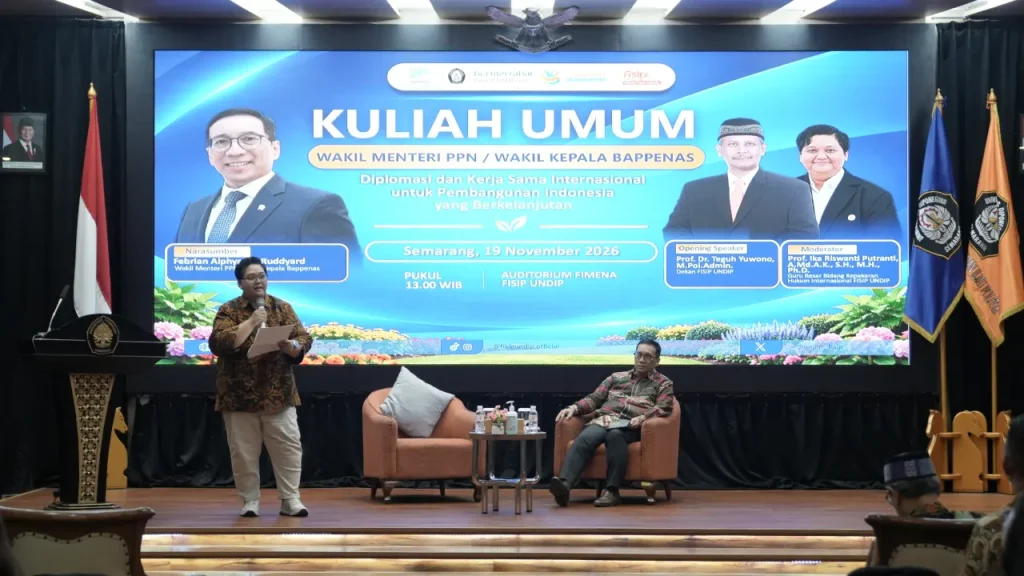
In his presentation, Febrian emphasized the strategic role of diplomacy in supporting Indonesia’s national development agenda, particularly in promoting economic growth, attracting investment, and strengthening the country’s competitiveness. The lecture began with an overview of Indonesia’s national development priorities through the presentation of the Asta Cita 2025–2029, which outlines the government’s commitment to economic growth, improved connectivity, and industrial downstreaming.
He explained that successful national development depends not only on the availability of natural and economic resources but also on a country’s ability to manage and maximize its potential. In this regard, diplomacy plays an important role in expanding international cooperation opportunities and ensuring that incoming investments generate tangible benefits for the national economy and public welfare.
Febrian also highlighted the 1955 Asian-African Conference in Bandung as an example of Indonesia’s ability to establish international influence through ideas, solidarity, and soft power. Amid globalization and evolving geopolitical dynamics, Indonesia needs to strategically manage its interdependence with other countries while ensuring that its national interests remain a priority.
From a foreign policy perspective, he also introduced the concept of Two-Level Games, which explains how diplomacy operates simultaneously at the international and domestic levels. He emphasized that the success of international agreements depends not only on negotiations between countries but also on domestic support and alignment with national interests and conditions. Therefore, international development cooperation should position Indonesia as an equal partner, rather than merely a recipient of assistance, providing opportunities for mutual learning, knowledge exchange, and capacity building.
The discussion sessions addressed several strategic issues, including Indonesia’s 8 percent economic growth target, energy transition, industrial downstreaming, and the role of foreign investment in promoting national development.
Responding to questions about economic growth, Febrian explained that investment should be directed toward industrial development, job creation, and improving public welfare. Meanwhile, the transition toward a green economy needs to take into account the readiness and specific characteristics of each region, including local potential and opportunities for technological development.
The discussion also highlighted the growing impact of Artificial Intelligence (AI) on the labor market. Technological advancements are expected to transform employment patterns by reducing demand for certain occupations while creating new professions and opportunities. This development requires human resources to adapt to technological changes while maintaining the essential human capacity for critical judgment and decision-making in evaluating AI-generated analysis.
Through this public lecture, students were encouraged to recognize that diplomacy is not exclusively the domain of diplomats and policymakers but also involves academics, universities, and younger generations. Universities can contribute through research, knowledge exchange, and international academic collaboration, thereby strengthening national capacity and supporting sustainable development.
The event also broadened students’ understanding of the relationship between International Relations, diplomacy, geopolitics, and development policy, particularly in advancing Indonesia’s national interests amid an increasingly dynamic global environment.