

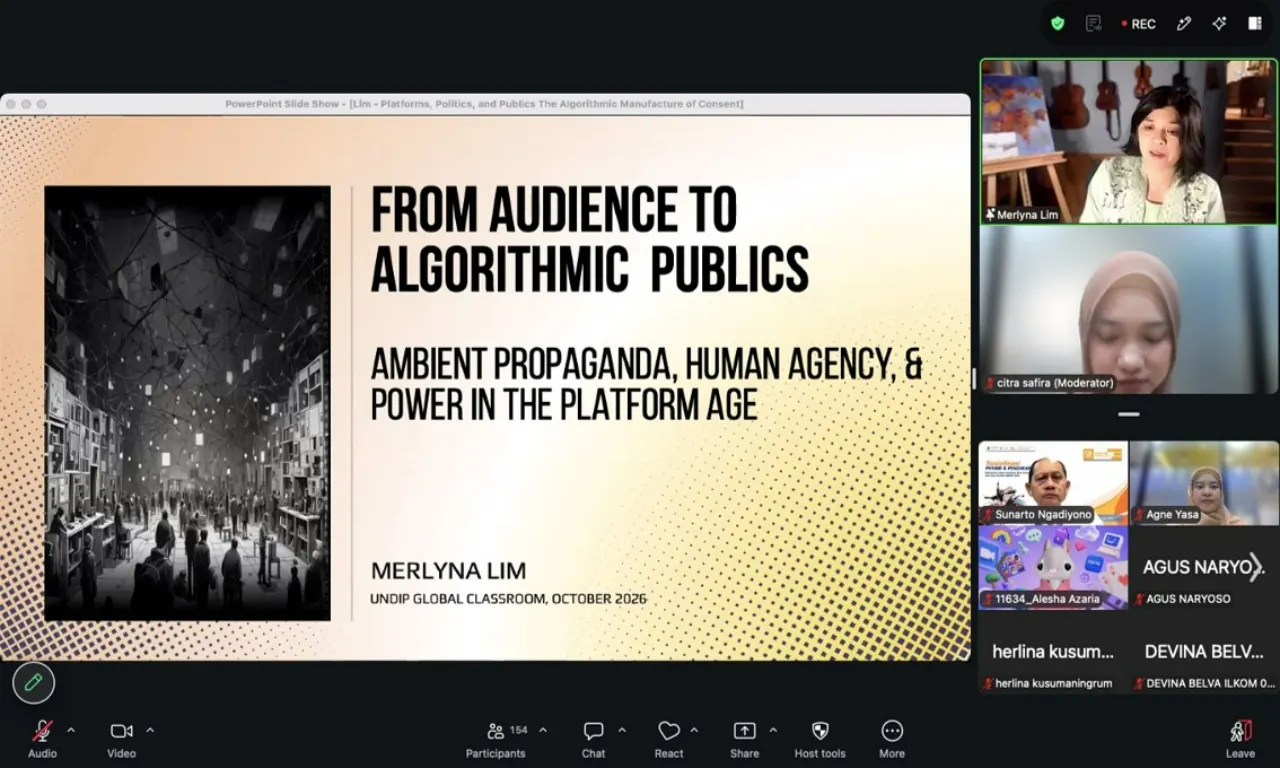
Semarang, November 2026 – The development of social media and artificial intelligence (AI) has changed the way society receives, processes, and disseminates information. Audiences are no longer merely recipients of media messages. They now also produce content, build opinions, form communities, and influence the circulation of information through various digital platforms. However, behind this participatory space, algorithms also have the power to determine what information is visible, who can reach it, and how public opinion is formed.
This issue was one of the main concerns in the Undip Global Classroom featuring Prof. Merlyna Lim on October 1, 2026. Through the theme “From Audiences to Algorithmic Publics: Audience Transformation, Human Agency, and Power in the Age of Social Media and AI,” the activity discussed the transformation of audiences as well as the relationship between human participation, platform power, and algorithmic mechanisms in the contemporary communication ecosystem.
This program was organized by the Media, Journalism, and Gender Communication Expertise Cluster (KBK), one of the expertise clusters in the Department of Communication Science, Faculty of Social and Political Sciences (FISIP), Diponegoro University. This activity was specifically integrated with the Media Communication and Audience Analysis course for third-semester students of the Communication Science Study Program.
In her presentation, Prof. Merlyna Lim proposed a critical perspective on the changing position of audiences in the digital media ecosystem. If in the mass communication paradigm audiences were more often positioned as consumers of information, the development of digital platforms has changed them into producers, curators, commentators, as well as amplifiers of message distribution. Every digital activity, from liking content, commenting, sharing posts, to following certain accounts, can generate data that platforms utilize to organize communication.
This change is related to the concept of algorithmic publics, namely a public whose formation process, visibility, information circulation, and boundaries of connectivity are increasingly influenced by computational systems. In this condition, the public is not only formed through discussion and shared interests but also through interactions between users, platforms, institutions, and data.
Prof. Merlyna Lim also raised the concept of ambient propaganda to explain how influence and persuasion work in everyday digital life. Propaganda does not always appear in the form of openly organized campaigns. Influence can spread through the information environment, algorithmic recommendations, message repetition, and interaction patterns that gradually shape public perception.
This issue becomes increasingly complex when algorithms also influence the distribution of information based on user engagement and emotional responses. In the discussion on algorithmic enclaves and affective politics, Prof. Merlyna Lim explained how digital spaces can form public groups based on patterns of connectivity, sense of belonging, as well as emotions such as fear, anger, pride, anxiety, and hope. This condition opens up participatory space but also has the potential to strengthen public fragmentation and social polarization.
One important question that emerged was regarding the authority of truth in digital spaces. When platforms increasingly determine the visibility of information, the issue of credibility is no longer only related to who delivers the message but also to who has the authority and infrastructure to determine what information is considered true. The discussion on disinformation, including the phenomenon of disinformation plug’n’play, showed that digital influence operations can be developed modularly, replicated, and expanded through platform infrastructure.
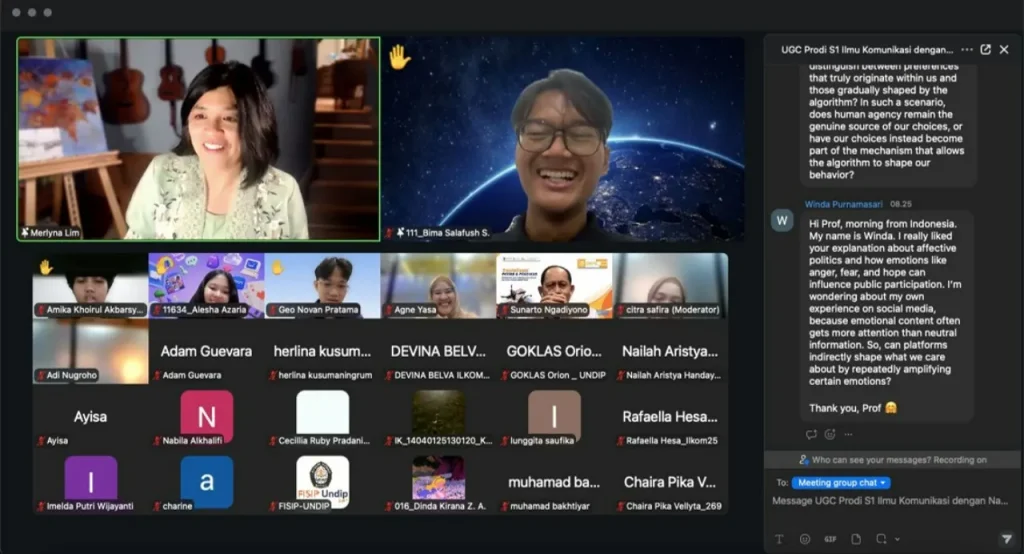
Nevertheless, Prof. Merlyna Lim emphasized that human agency is not entirely lost amid the dominance of algorithms. Humans still have the ability to interpret information, make decisions, build participation, and engage in creative resistance. The challenge is to understand that all these activities take place within digital infrastructure that can observe, process, and redirect patterns of user participation.
This perspective provides important relevance for media communication studies and audience analysis. Students are not enough to only study the demographic, psychographic characteristics, and media consumption behavior of audiences. They also need to understand how algorithms shape media experiences, how platforms manage public attention, and how user participation contributes to the production and distribution of information.
Through the Undip Global Classroom, the Media, Journalism, and Gender Communication Expertise Cluster strives to bring together classroom learning with the development of communication thought and research at the global level. The presence of an academic with an international perspective provides an opportunity for students to develop a critical understanding of changes in the media landscape, while also connecting communication theory with social issues developing in society.
The discussion raised by Prof. Merlyna Lim also provides one important reflection for the development of communication studies: when algorithms increasingly play a role in shaping public space, how do humans maintain their agency and responsibility in communicating?
This question becomes important, especially for the younger generation growing up alongside social media and AI technology. They are not only platform users but also part of the process of opinion formation, information distribution, and the construction of social reality.
Through academic forums such as the Undip Global Classroom, the Department of Communication Science at FISIP Undip continues to encourage students not only to understand changes in communication technology but also to be able to critique the power behind it and take a responsible role in the digital media ecosystem.
Media, Journalism, and Gender Communication Expertise Cluster
Communication Science Study Program
Department of Communication Science
Faculty of Social and Political Sciences
Diponegoro University