

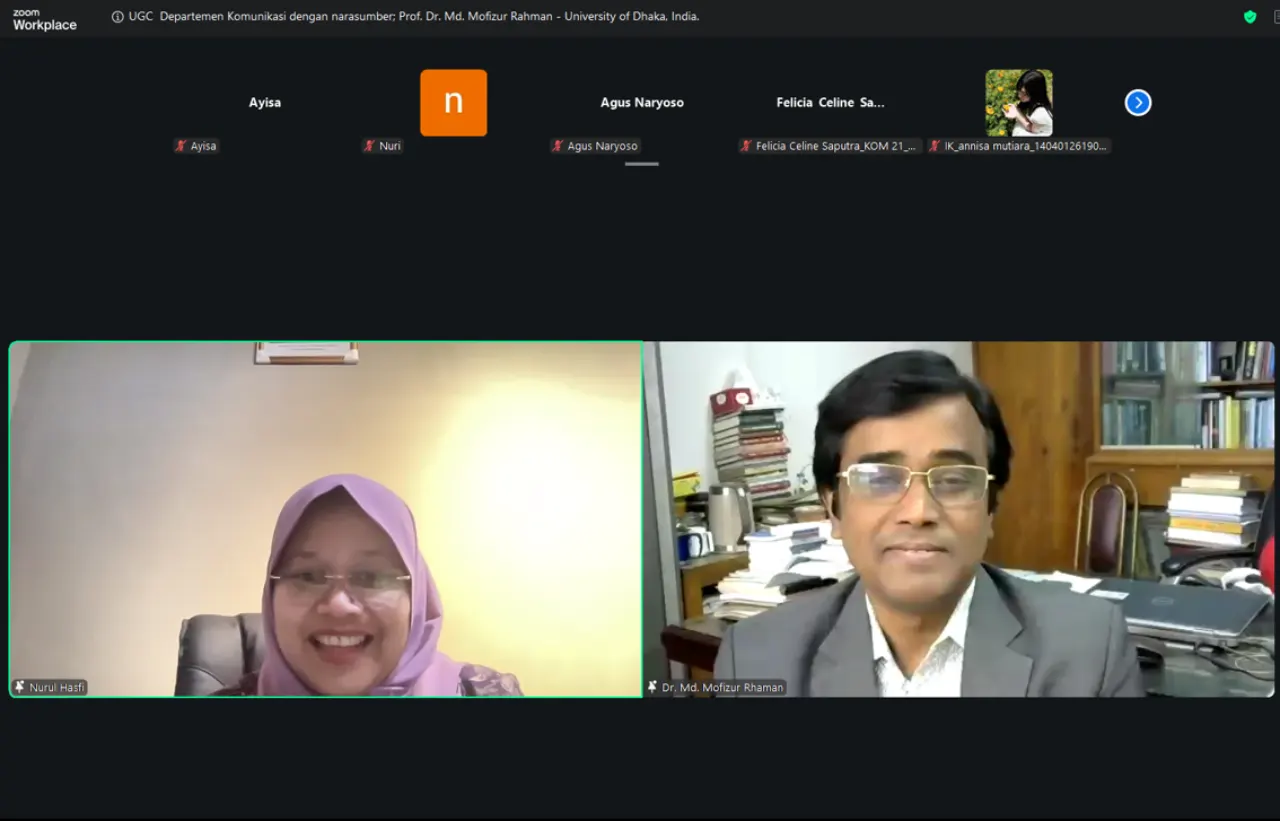
SEMARANG – The Faculty of Social and Political Sciences (FISIP), Universitas Diponegoro (UNDIP), through its Research Cluster on Media Sociology, organized an Undip Global Classroom (UGC) program entitled “How to Address Climate Change Issues in Journalism? The Experience from Bangladesh” on Tuesday, November 17, 2026. The event was conducted online via Zoom Meeting and featured Professor from the University of Dhaka, Bangladesh, Prof. Dr. Md. Mofizur Rahman.
The Undip Global Classroom program served as an initiative by FISIP UNDIP to strengthen academic insights and broaden global perspectives, particularly regarding the role of media and journalism in communicating climate change issues. Drawing on the experience of Bangladesh, participants were invited to explore how journalism can contribute to raising public awareness, promoting climate justice, and communicating the various impacts of climate change that directly affect people’s lives.
The event commenced with opening remarks from the Head of the Media Sociology Research Cluster, Dr. Nurul Hasfi, S.Sos., M.A., who also served as the moderator. In her remarks, Dr. Nurul Hasfi expressed her appreciation and gratitude to Prof. Dr. Md. Mofizur Rahman for his willingness to attend and share his academic knowledge and experience with the FISIP UNDIP academic community. The event was also attended by all members of the Media Sociology Research Cluster, namely Dr. Yanuar Luqman, S.Sos., M.Si.; Dr. Agus Naryoso, S.Sos., M.Si.; Dr. Phil. Nuriyatul Lailiyah, S.Sos., M.I.Kom.; Muchammad Yuliyanto, S.Sos., M.Si.; Herlina Kusumaningrum, S.Sos., M.A.; and Muhammad Rif’at Al-Razi, S.I.Kom., S.Pd., M.I.Kom.
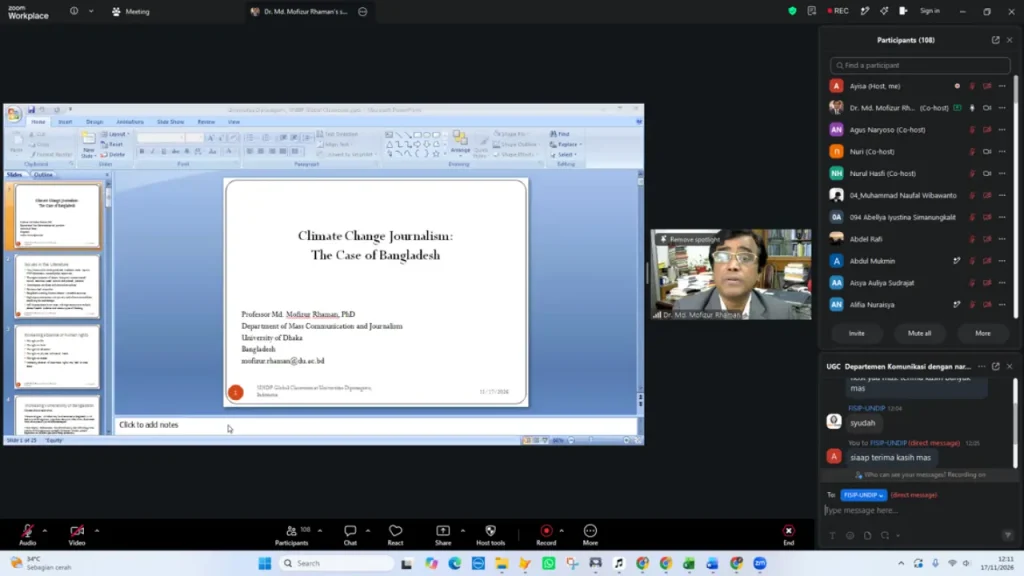
In his presentation entitled “Climate Change Journalism: The Case of Bangladesh,” Prof. Dr. Md. Mofizur Rahman discussed how climate change has become a multidimensional issue that affects not only the environment but is also closely connected to economic, social, cultural, and political aspects, as well as the fulfillment of human rights. He explained that Bangladesh is among the countries highly vulnerable to the impacts of climate change. Its significant exposure to various climate-related threats, including rising sea levels, cyclones, floods, and extreme rainfall, is further exacerbated by poverty, inadequate infrastructure, and limited community adaptation capacity.
Furthermore, Prof. Md. Mofizur Rahman highlighted how the impacts of climate change threaten people’s fundamental rights, including the right to life, food, education, physical and mental health, and adequate shelter. Rising sea levels and saltwater intrusion, for instance, have the potential to cause loss of homes, population displacement, biodiversity degradation, and the loss of livelihoods among coastal communities, particularly fishermen and farmers.
In this context, the media plays a strategic role as a watchdog and as a means of safeguarding public interests. Prof. Md. Mofizur Rahman also presented his research findings on climate change coverage in two Bangladeshi newspapers, namely The Daily Star and The Prothom Alo, during four United Nations Climate Change Conferences (COP), specifically COP13 in Bali (2007), COP15 in Copenhagen (2009), COP17 in Durban (2011), and COP19 in Warsaw (2013). The study recorded a total of 475 news articles from both newspapers. The highest volume of coverage occurred during COP15 in Copenhagen, with 317 articles, while coverage declined to 16 articles during COP19 in Warsaw. These findings demonstrate that media attention to climate change issues can fluctuate in response to global developments and the dynamics of particular events.
Beyond discussing the volume of news coverage, the presentation also emphasized the importance of development journalism and advocacy journalism approaches in reporting climate change. Journalism should not merely convey information about disasters or environmental phenomena but should also connect climate change issues with people’s everyday lives, amplify the voices of vulnerable groups, and highlight issues of climate justice. Through these approaches, news coverage can help the public understand the relationship between climate change, responsibility, policies, and their impacts on everyday life.
Prof. Md. Mofizur Rahman further emphasized that climate change journalism requires the ability to translate complex scientific information and research findings into language that is accessible to the general public. Journalists need to strengthen climate literacy, conduct research-based reporting, incorporate the perspectives of affected communities, and prioritize solution-oriented journalism. The use of multimedia approaches, visualization of climate change impacts, and the development of specialized reporting beats on climate change are also essential to improving the quality of journalism.
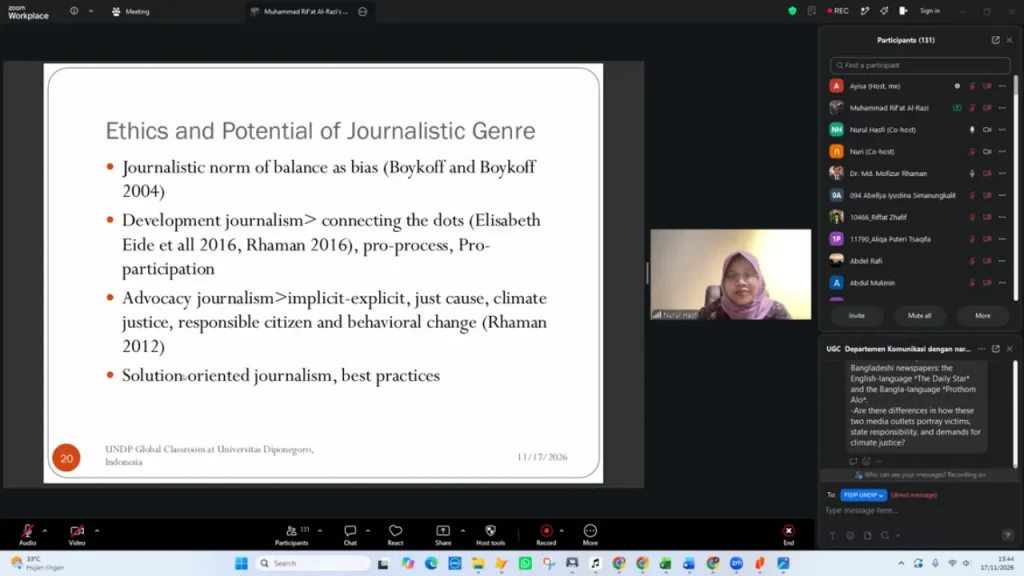
Equally important, the presentation highlighted ethical considerations in climate change journalism. Journalists are expected to maintain scientific accuracy, verify facts, and avoid misleading or sensationalized reporting, as well as the creation of false balance when presenting scientific evidence. Editorial independence, transparency, accountability, and fair representation of vulnerable communities are also essential principles in establishing responsible climate journalism.
Following the presentation, the event continued with an interactive discussion and question-and-answer session. Participants demonstrated great enthusiasm by raising various questions and sharing responses related to the topics presented. This session provided a platform for exchanging knowledge and academic experiences while offering new perspectives on the challenges and opportunities of journalism in addressing climate change issues across different countries.
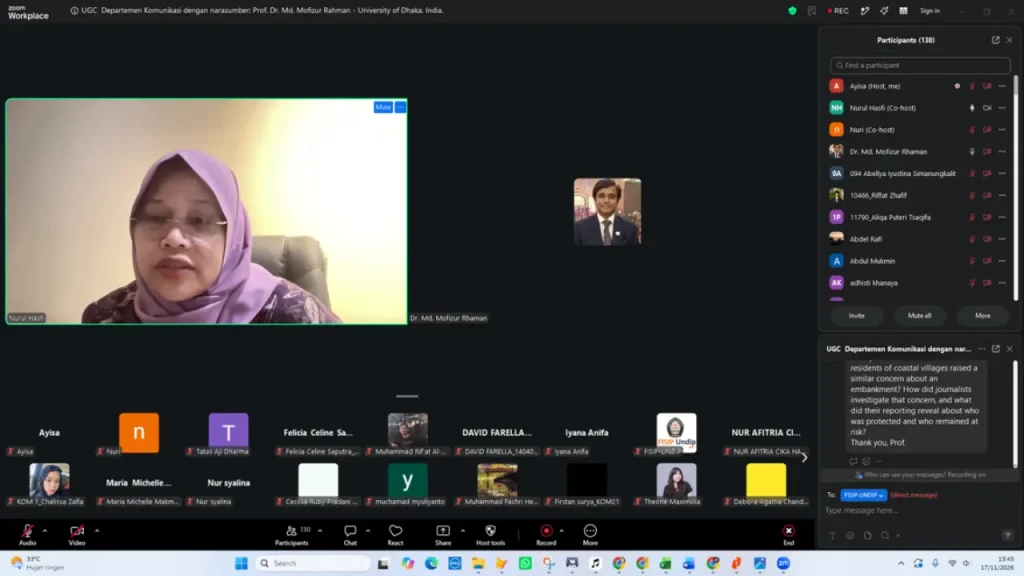
The Undip Global Classroom program concluded with a group photo session as a form of documentation and appreciation for the successful implementation of this international academic collaboration.
Through this activity, the Media Sociology Research Cluster of FISIP UNDIP hopes that the knowledge and experiences shared by Prof. Dr. Md. Mofizur Rahman will benefit all participants, particularly in enriching their perspectives on climate change journalism practices. This issue is increasingly relevant in today’s evolving journalistic landscape, where the media is not only expected to deliver information quickly and accurately but also bears the responsibility of improving public literacy, advocating for climate justice, and encouraging public awareness and participation in addressing climate change challenges.
The organization of this Undip Global Classroom program further reaffirms FISIP UNDIP’s commitment to promoting the internationalization of academic activities, expanding global collaboration networks, and providing learning opportunities that bring together the perspectives of academics from different countries in responding to contemporary social and environmental challenges.