

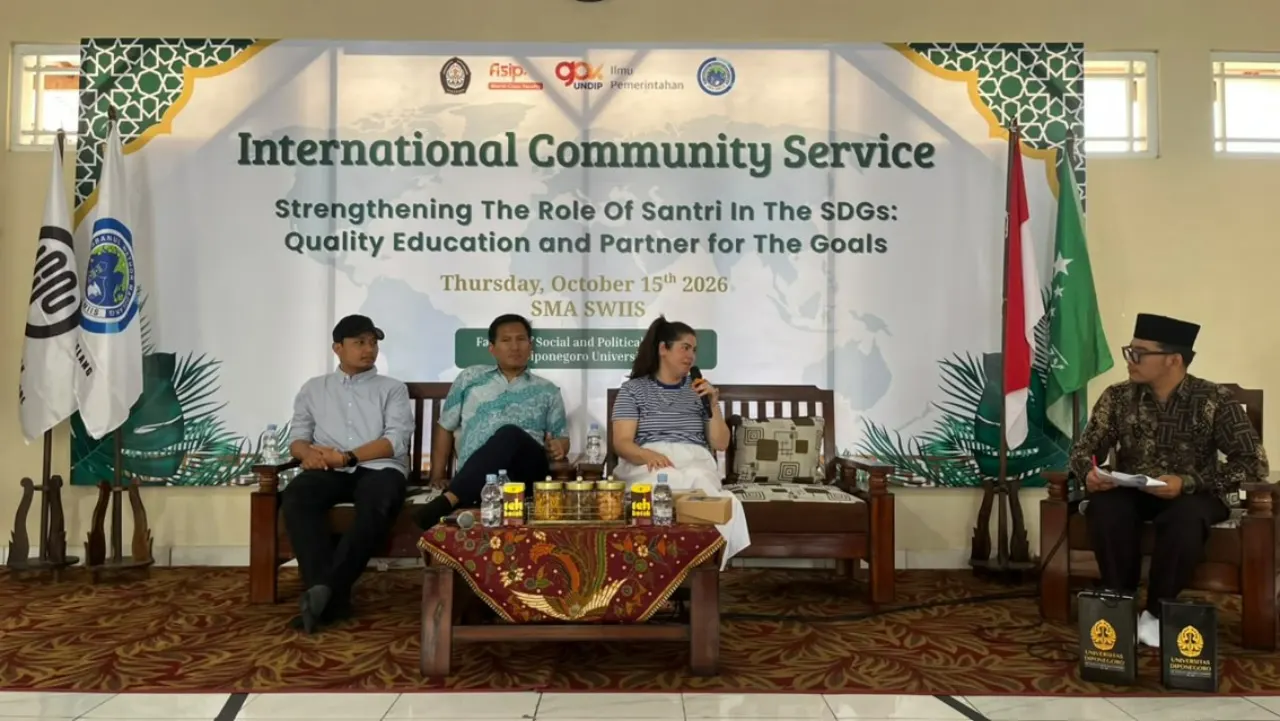
Magelang — The International Community Services event titled “Strengthening the Role of Santri in the SDGs: Quality Education and Partnership for the Goals” was organized by the Department of Politics and Government, FISIP, UNDIP at SMA SWIIS (Syubbanul Wathon Integrated Islamic School) Magelang as part of the World Class University (WCU) program, with the aim of strengthening the role of santri in supporting sustainable development through quality education and international partnerships. This initiative was motivated by the importance of the santri’s role in the development of Indonesian society and the need to expand access and opportunities for santri to advance to higher levels of education. Through this event, santri are encouraged to identify educational opportunities, scholarships, and international academic experiences as part of efforts to improve human resource quality.
This service program aims to raise santri’s awareness of the importance of higher education, broaden their insight on the challenges and opportunities of studying abroad, and foster collaboration between universities, pesantren, and international partners. Through the exchange of experience and knowledge, the event is expected to inspire santri to plan their educational future more purposefully. This initiative also affirms the importance of support from educational environments, parents, and various stakeholders in opening up access to inclusive and quality higher education.
During the experience-sharing session, Selin Aydin from Germany expressed her positive impression upon discovering the culture and directly interacting with the santri environment in Indonesia. She also shared experiences about life and education in Germany, including the challenges faced by Muslims as a minority group. According to her, santri who aspire to pursue education in Germany need to prepare themselves earnestly, especially in academic aspects and mastery of German as the language of daily life. Selin further explained that Muslims in Germany face social challenges, including heightened negative sentiment in the aftermath of the 11 September 2001 attacks. This experience serves as a reminder for santri that studying abroad requires not only academic ability but also readiness to adapt to different social and cultural environments.
Bangkit Wiryawan, an alumnus who studied in Japan, emphasized the importance of discipline and thorough preparation as provisions for academic life overseas. According to him, prospective students need to have clear planning, from educational goals and living needs to readiness in facing local culture. He also provided practical insights on Muslim life in Japan. Muslim students can find halal food options through markets or specialty shops, choose fish as an alternative food, and ask vendors about halal needs. For worship, students can use prayer room or mosque facilities available in various locations. Bangkit explained that mosques in Japan do not always have the characteristic dome architecture commonly found in Indonesia. This experience shows that with good preparation and a willingness to adapt, cultural differences do not need to be an obstacle to obtaining quality education.
Meanwhile, Faiz Kasyfilham, an alumnus who studied in Turkey, introduced Turkey as a country linking Europe and Asia with its rich culture, culinary traditions, and historical sites. He explained that opportunities to continue studies in Turkey are open through various scholarship programs, whether funded by the Turkish government, international organizations, or Indonesian funding programs. As a country with a Muslim majority, Turkey also offers a relatively familiar environment for santri to practice daily religious life. Faiz highlighted the strong tradition of pilgrimage and respect for saints in Turkey, mirroring the tradition of honoring wali, kiai, and teachers in pesantren communities in Indonesia. Such cultural proximity can help santri adapt while also enriching their experiences during their studies abroad.
Quality education is a vital foundation for achieving inclusive and sustainable development. This aligns with Sustainable Development Goals (SDGs) 4: Quality Education, which emphasizes the importance of inclusive, equitable, and high-quality education, as well as lifelong learning opportunities for all. Santri possess strong assets for progressing to higher education because they are accustomed to disciplined learning, the pursuit of knowledge and religious studies, and character-building through life in pesantren. This potential must be supported by sufficient information about universities, academic preparation, foreign language proficiency, mentoring, and access to scholarships so that the opportunity to pursue quality education can be more widely attained.
Beyond just the opportunity to study abroad, international education can serve as a way for santri to broaden their horizons, develop competencies, and gain cross-cultural experiences that are beneficial to society. This spirit is in line with SDGs 17: Partnership for the Goals, which underscores the importance of collaboration in achieving sustainable development. Partnerships among universities, pesantren, families, and international partners are expected to open more educational opportunities for santri from diverse backgrounds. Armed with the knowledge, experiences, and networks obtained, santri are expected to return and contribute to Indonesia, develop their communities’ potentials, and be part of a generation that brings positive change. Through this International Community Services activity, santri are encouraged not to limit their aspirations to familiar environments, but to boldly seek knowledge and experiences for future devotion to the nation’s progress.