

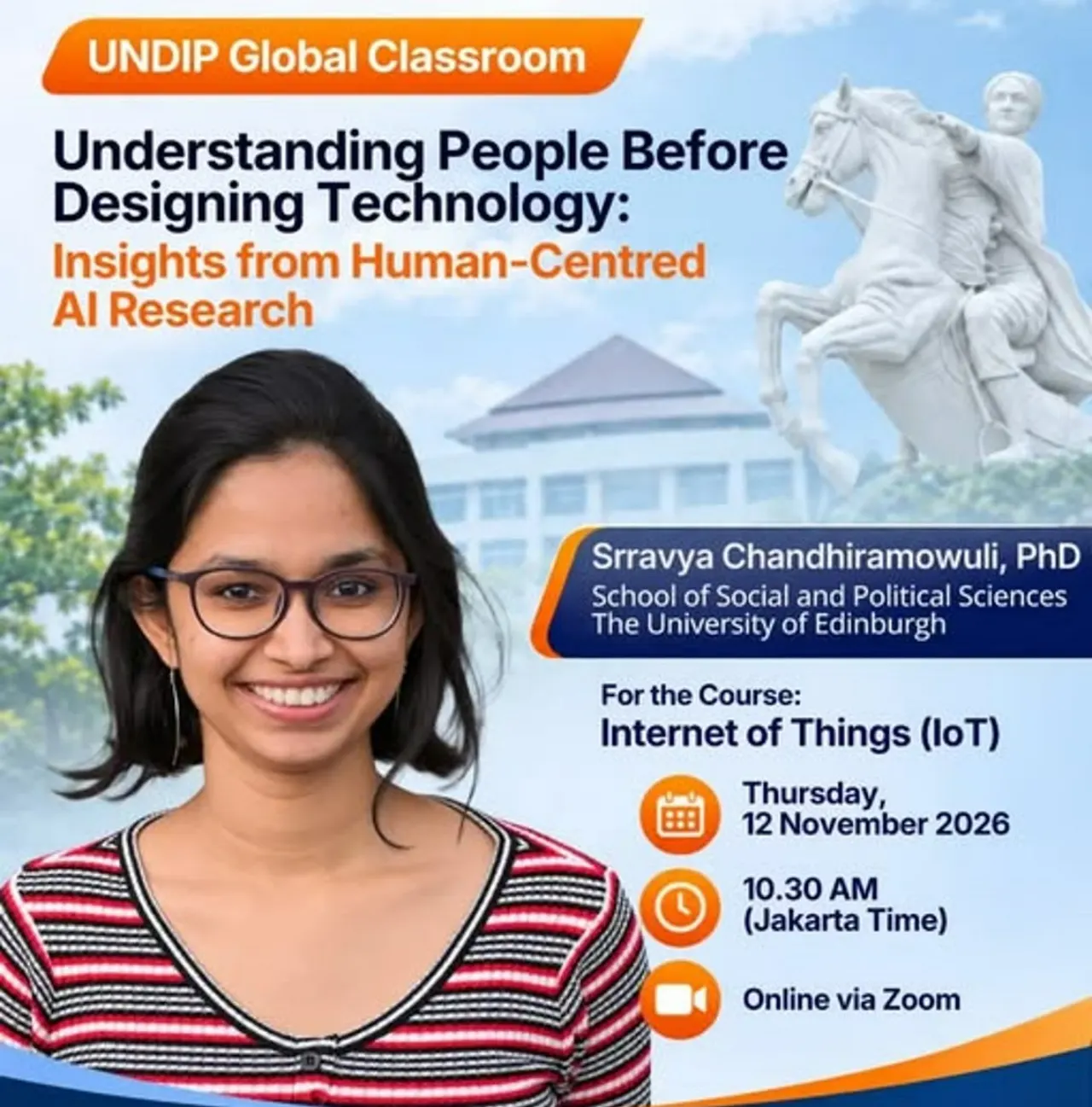
SEMARANG, 12 November 2026 — The Faculty of Social and Political Sciences (FISIP), Universitas Diponegoro (UNDIP), continued its international academic engagement through the UNDIP Global Classroom (UGC) programme, featuring Srravya Chandhiramowuli, PhD, a Postdoctoral Research Fellow from the University of Edinburgh, United Kingdom.
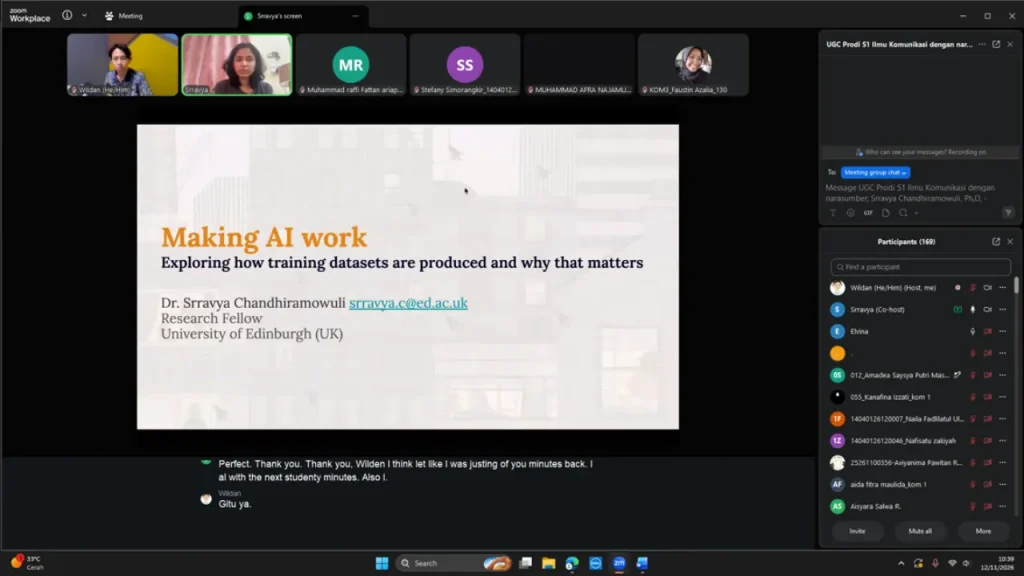
Organised by the Department of Communication Science on Thursday, 12 November 2026, the online guest lecture formed part of the undergraduate Internet of Things (IoT) course.
Under the theme “Understanding People Before Designing Technology: Insights from Human-Centred AI Research”, the session invited students to examine emerging technologies through social, ethical, and human-centred perspectives.
In her presentation, “Making AI Work: Exploring How Training Datasets Are Produced and Why That Matters”, Srravya highlighted the essential yet often overlooked role of human workers in the development of artificial intelligence.
As a Research Fellow and Thematic Lead on Data Work in the Planetary AI project at the University of Edinburgh, Srravya studies the everyday realities of AI dataset production, drawing on Human-Computer Interaction (HCI) and Science and Technology Studies (STS).
She explained how data annotation work is organised through staffing schedules, shift arrangements, productivity targets, and time-based performance measures. Her research demonstrates the importance of examining the human contributions that underpin technologies commonly described as automated.
Students also participated in an interactive data annotation exercise, in which they were invited to identify suspicious behaviour in video clips. The exercise illustrated the importance of human judgement and contextual interpretation in producing data for AI systems.
The lecture further explored initiatives aimed at improving fairness and recognising workers’ expertise, including efforts to strengthen worker participation and collective representation in the data industry.

The question-and-answer session addressed several contemporary challenges, including algorithmic bias, corporate accountability, misinformation on social media, and the evolving relationship between human skills and AI systems.
Srravya emphasised that AI should not be regarded as neutral and that technology companies bear substantial responsibility for addressing the risks and biases associated with the systems they develop.
Facilitated by Wildan Namora Ichsan Setiawan from the Department of Communication Science, the session also complemented students’ IoT projects, which involve developing conceptual technology solutions to problems identified in Indonesia.
Through UNDIP Global Classroom, FISIP UNDIP continues to expand opportunities for international academic exchange while encouraging students to engage critically with the social implications of technological development.
The session reinforced the importance of integrating social understanding, ethical reflection, and human experiences into discussions about emerging technologies and their future development.