

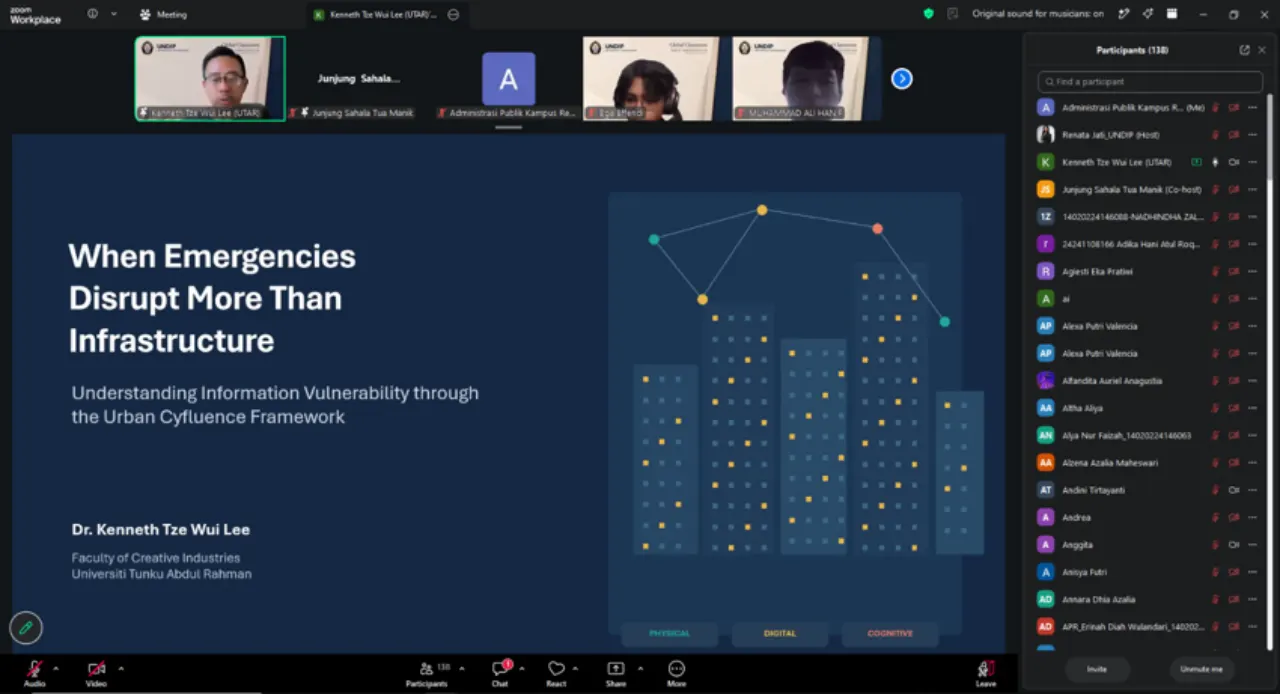
REMBANG, November 6, 2026 – The Undergraduate Program in Public Administration at Universitas Diponegoro (UNDIP) Rembang Campus organized an international academic session under the UNDIP Global Classroom initiative, themed “Understanding Organizational Behaviour in the Public Sector,” on Friday (November 6, 2026). Held virtually via Zoom, the session featured Dr. Kenneth Lee Tze Wui from Universiti Tunku Abdul Rahman (UTAR), Malaysia, as the international guest speaker, focusing on the importance of crisis communication in public sector organizations.
The session brought together students enrolled in Public Sector Organizational Behaviour and Public Sector Human Resource Management courses, along with faculty members. Through this international learning experience, participants explored how government organizations and public servants can develop effective communication competencies, particularly when responding to emergencies and disasters.
Understanding the Six Principles of Crisis and Emergency Risk Communication
During his presentation, Dr. Kenneth introduced the Crisis and Emergency Risk Communication (CERC) framework as an approach to strengthening organizational communication during emergencies and crises.
The framework highlights that effective crisis communication involves more than rapidly distributing information. It also requires accuracy, institutional credibility, empathy, and the ability to establish public trust during uncertain and challenging circumstances.
A central focus of the session was the six core principles of CERC: Be First, Be Right, Be Credible, Express Empathy, Promote Action, and Show Respect.
These principles emphasize the importance of providing timely and accurate information, maintaining institutional trustworthiness, acknowledging public concerns, encouraging appropriate action, and communicating respectfully with affected communities.
Through this framework, students were introduced to the strategic role of communication in helping public organizations manage uncertainty, respond to emergencies, and provide clear guidance to the public.
The discussion also highlighted the relevance of communication competencies for public sector employees. During disasters and other emergencies, the ability to communicate promptly, accurately, and empathetically is an essential component of an organization’s response capacity.
Connecting Organizational Behaviour with Public Sector Human Resource Competencies
Beyond introducing crisis communication principles, the UNDIP Global Classroom session provided an opportunity for students to connect organizational behaviour concepts with human resource management practices in the public sector.
The discussion encouraged students to examine how employee behaviour, communication patterns, and organizational capacity influence the ability of public institutions to respond effectively to complex challenges.
The session took place in an interactive learning environment, allowing participants to engage with international perspectives on organizational communication and public sector management.
For Public Administration students, the topic was particularly relevant to Indonesia’s disaster management challenges, where effective communication and coordination between government institutions and communities are essential.
The international perspective also enriched students’ understanding that public sector organizational effectiveness depends not only on formal structures, regulations, and administrative procedures, but also on the competencies of public employees in communicating information and responding to societal needs.
Strengthening Global Perspectives and Public Administration Competencies
The UNDIP Global Classroom initiative reflects the commitment of the Undergraduate Program in Public Administration at UNDIP Rembang Campus to integrating international perspectives into academic learning.
Through the session, students were encouraged to develop a deeper understanding of communication competencies in public organizations, particularly in emergency situations requiring timely, accurate, and responsible responses.
The introduction of the six CERC principles also provided a conceptual foundation for analyzing government communication strategies, organizational management, and public sector human resource development.
Furthermore, the event contributed to UNDIP’s efforts to strengthen international academic engagement and create learning opportunities that connect theoretical knowledge with contemporary public administration challenges.
By facilitating academic exchanges with scholars from international universities, UNDIP Rembang Campus continues to promote globally oriented learning experiences that support students’ critical thinking, analytical skills, and understanding of public sector governance.
Through initiatives such as UNDIP Global Classroom, Universitas Diponegoro reaffirms its commitment to preparing graduates equipped with international perspectives and relevant competencies to address increasingly complex challenges in public organizations and public service delivery.