

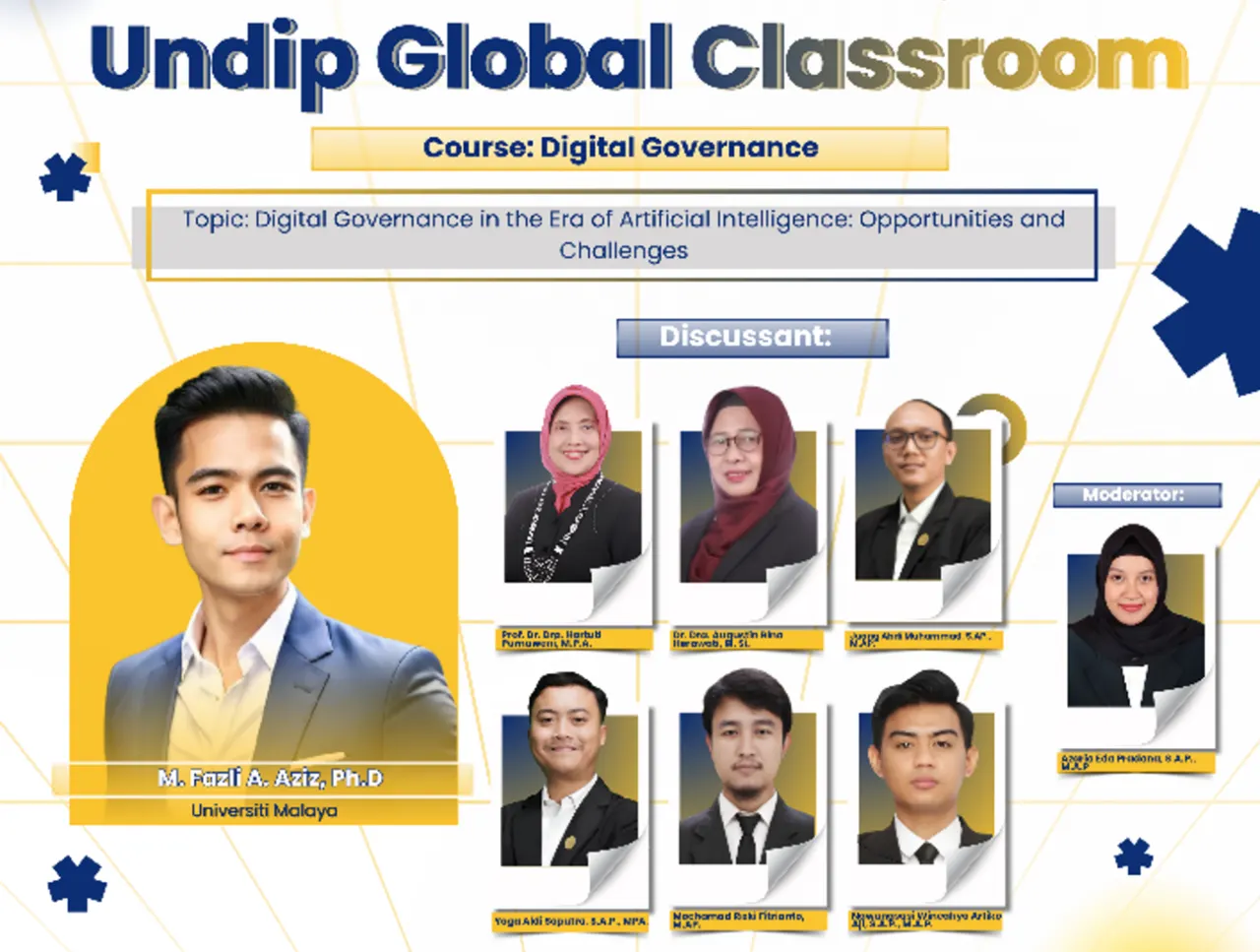
Semarang, November 2, 2026 – The Faculty of Social and Political Sciences, Diponegoro University, through the Department of Public Administration, held an Undip Global Classroom in the Digital Governance course with the theme “Digital Governance in the Era of Artificial Intelligence: Opportunities and Challenges,” on Monday, November 2, 2026, at 9:30 AM WIB online via Zoom.
The activity featured M. Fazli A. Aziz, Ph.D. from Universiti Malaya, Malaysia, as an international academic. In the material presented, he raised the Malaysian public administration perspective in viewing the development of artificial intelligence and its implications for digital government governance.
In his presentation, M. Fazli emphasized that the use of artificial intelligence in government is not merely a matter of technology adoption. AI can help governments process information, support administrative work, and provide input in decision-making processes. However, public decisions ultimately still require human and institutional responsibility. The government cannot transfer public accountability to algorithms.
This discussion is relevant for Public Administration students because the development of AI has brought changes to the way governments provide services, process data, and make decisions. In the context of public services, AI can be utilized, among other things, to answer routine public questions, classify service requests, organize information, and help identify cases that require further attention. Nevertheless, these benefits do not emerge automatically without proper governance design.
The Malaysian perspective was one of the important focuses in this Global Classroom. The material showed that Malaysia is strengthening its agenda toward an AI-enabled public sector through national policy direction and public sector digitalization. Its orientation includes improving the quality of public services, policy-making effectiveness, administrative efficiency, increasing the use of data and AI, as well as strengthening digital capabilities and inter-institutional coordination.
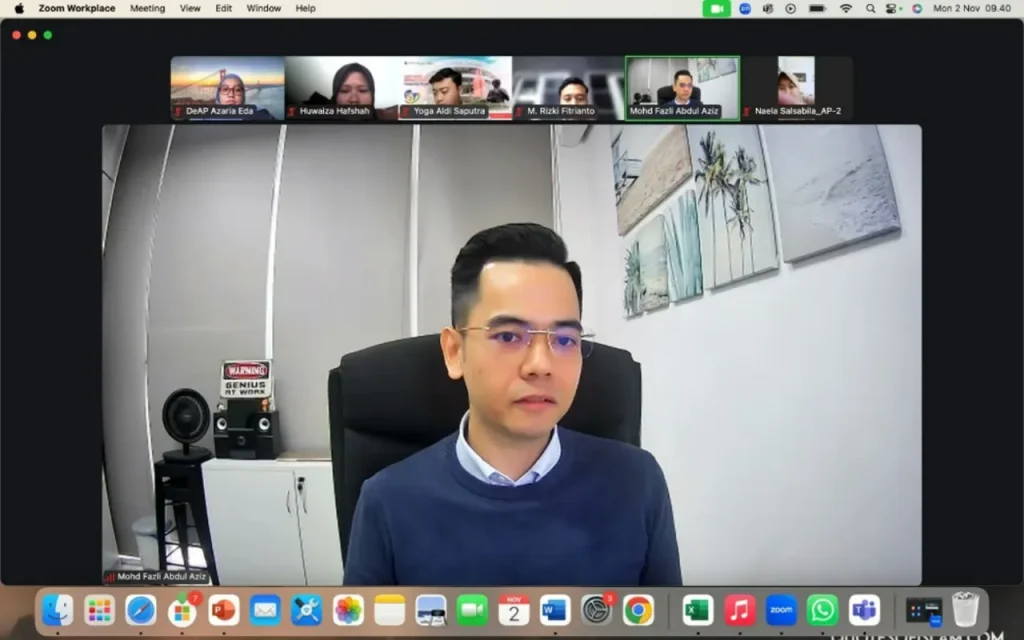
The Global Classroom activity also featured lecturers from the Department of Public Administration at FISIP UNDIP as discussants, including Prof. Dr. Dra. Hartuti Purnaweni, M.P.A.; Dr. Dra. Augustin Rina Herawati, M.Si.; and Juang Abdi Muhammad, S.A.P., M.A.P., along with other lecturers. The activity was moderated by Azaria Eda Pradana, S.A.P., M.A.P. The involvement of lecturers as discussants provided an opportunity to bring together the Malaysian digital governance perspective with the Indonesian public administration context. The forum served as an academic space to discuss not only how AI can be used in government but also how the technology must be managed to maintain accountability, fairness, transparency, and the public interest.
In the closing material, three main messages regarding the future of AI in public administration were emphasized. First, technology opens opportunities to improve services and support decision-making, but its benefits are not automatic. Second, public institutions remain responsible for maintaining professional judgment, fairness, and accountability. Third, public value must remain the primary goal, with attention to efficiency, service outcomes, fair treatment, and public accountability.
The organization of the Undip Global Classroom is part of the commitment of the Undergraduate Program in Public Administration at FISIP UNDIP to strengthen the internationalization of learning and provide global academic experiences to students. The presence of an academic from Universiti Malaya allowed students to learn about the development of digital governance from the perspective of another country while also reflecting on the challenges of digital transformation in Indonesia.