

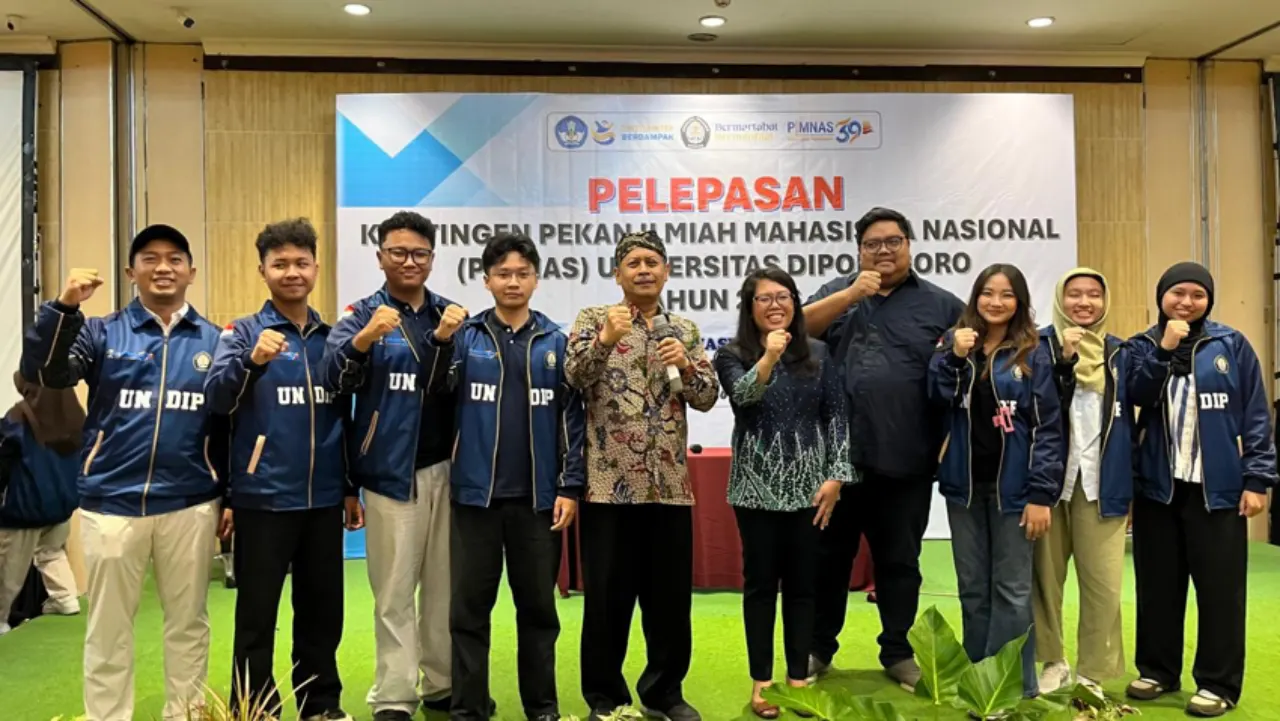
Semarang, November 3, 2026 – The Faculty of Social and Political Sciences, Universitas Diponegoro (FISIP UNDIP), has once again achieved a national-level accomplishment as two of its student teams successfully qualified for the 2026 National Student Scientific Week (Pekan Ilmiah Mahasiswa Nasional/PIMNAS) 39. The event is hosted by Universitas Diponegoro in Semarang from 2–7 November 2026.
The two teams, RECULA and HARMONI, secured funding under the Student Creativity Program (Program Kreativitas Mahasiswa/PKM), specifically the Constructive Idea Video scheme (PKM-VGK), and advanced to the national competition. Both teams address strategic issues related to sustainable development, focusing on circular economy-based waste management and strengthening coastal communities’ preparedness for tidal flooding.
This achievement demonstrates the commitment of FISIP UNDIP students to developing creative and innovative ideas that respond to real-world challenges. Beyond academic development, their projects seek to contribute practical perspectives and potential solutions through social approaches, governance, community participation, and environmental sustainability.
Their participation also reflects the spirit of the 39th PIMNAS, which carries the theme “Realizing an Advanced, Sustainable, and Dignified Indonesia through Adaptive and Impactful Student Innovation.” This theme highlights the importance of students as drivers of innovation who can respond to societal needs and contribute meaningfully to national development.
RECULA: Advancing Circular Economy-Based Waste Management towards Indonesia’s Energy Independence by 2045
The first team, RECULA, presents an innovative proposal entitled “Integrated Waste Processing Area System Innovation Based on Circular Economy and Valorization as a Pathway towards Indonesia’s Energy Independence by 2045.”
The team is supervised by Yohanes Thianika Budiarsa, S.I.Kom., M.G.M.C., and consists of Naurah Safa Labibah, Muhammad Rafly Andika Putra, Aulia Keyla Chairunissa, Faishal Rahman Irawan, and Loisa Margaret Ambarita.
RECULA addresses the persistent challenges of waste management in achieving environmental sustainability. Waste is often perceived merely as material to be disposed of. However, with appropriate management strategies, waste materials can be recovered, reused, and transformed into valuable resources.
Through the principles of circular economy and resource valorization, RECULA proposes an integrated waste processing area system. This approach emphasizes resource optimization, waste reduction, and the enhancement of the economic and functional value of materials through sustainable processing.
Furthermore, the proposal connects integrated waste management with opportunities for resource recovery and energy development, supporting Indonesia’s broader ambition to achieve energy independence by 2045.
RECULA demonstrates how environmental challenges can also create opportunities for economic transformation and improved resource governance. Waste management, therefore, should not be viewed solely as a matter of sanitation, but also as an integral part of sustainable economic development and environmental resilience.
HARMONI: Strengthening Coastal Communities’ Resilience to Tidal Flooding
The second team, HARMONI, presents a proposal entitled “Participatory Sensing-Based Early Warning and Emergency Response System for Building Coastal Communities Resilient to Tidal Flooding.”
The team is supervised by Rendy Ega Pradhana, S.A.B., M.A.B., and consists of Anak Agung Bagus Made Aryasakti Pradaswara, Alfonsus Derryl Chrisandy Putra, Faith Ashira Amadhea Alexandra Nugraha, and Nasywa Ammar Naya.
HARMONI focuses on strengthening coastal communities’ preparedness for tidal flooding through the development of an early warning and emergency response system based on participatory sensing.
Tidal flooding is an environmental and disaster-related challenge that directly affects the livelihoods of coastal communities. In addition to disrupting social and economic activities, it can damage infrastructure, restrict accessibility, and increase communities’ vulnerability to disaster risks.
In response to these challenges, HARMONI positions local communities not merely as recipients of disaster warning information, but as active participants in identifying, monitoring, and reporting potential threats in their surrounding environments.
Through participatory sensing, the initiative emphasizes the integration of local knowledge, citizen engagement, and coordination to develop an early warning and emergency response system that is more responsive to the needs of coastal communities.
HARMONI highlights that community resilience cannot be achieved solely through technological solutions and infrastructure development. Community capacity, collective participation, access to information, and institutional preparedness are equally important in strengthening disaster risk reduction efforts.
Student Innovation for Sustainable Development
The qualification of RECULA and HARMONI for the 39th PIMNAS demonstrates the diversity of contributions made by FISIP UNDIP students in addressing public challenges. Although the two teams focus on different issues, they share a common commitment to developing adaptive, collaborative, and socially impactful innovations.
RECULA offers a perspective on environmental management through circular economy principles and resource optimization, while HARMONI emphasizes strengthening disaster governance through community participation and the utilization of local information. Together, these initiatives demonstrate that addressing development challenges requires not only technical solutions but also an understanding of social dynamics, institutional arrangements, and governance processes.
Both innovations are also relevant to the United Nations Sustainable Development Goals (SDGs). RECULA contributes to SDG 7 (Affordable and Clean Energy) and SDG 12 (Responsible Consumption and Production). Meanwhile, HARMONI aligns with SDG 11 (Sustainable Cities and Communities) and SDG 13 (Climate Action).
Participation in the 39th PIMNAS also provides an important opportunity for FISIP UNDIP students to showcase their academic achievements and expand their engagement in national scientific forums. As the culminating event of the Student Creativity Program, PIMNAS serves not only as a competition platform but also as a space for exchanging ideas, building academic networks, and strengthening students’ capacity to address societal challenges.
Through the achievements of RECULA and HARMONI, FISIP UNDIP continues to foster an academic culture that values creativity, innovation, collaboration, and problem-solving. The success of these two teams is expected to inspire other students to develop their ideas, pursue academic competitions, and create innovations that generate meaningful benefits for society.
From FISIP UNDIP to Indonesia, empowering students to transform ideas into innovation and create meaningful impact for society.