

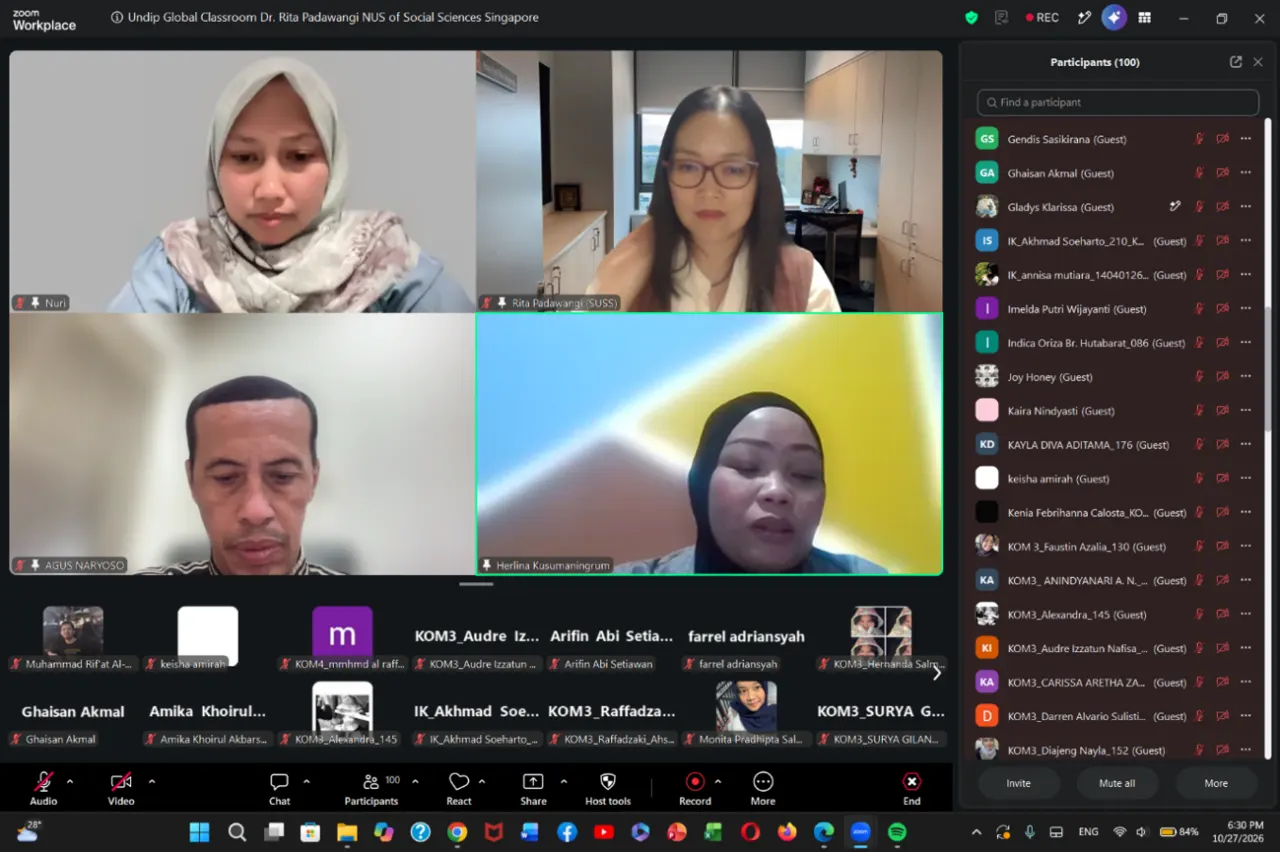
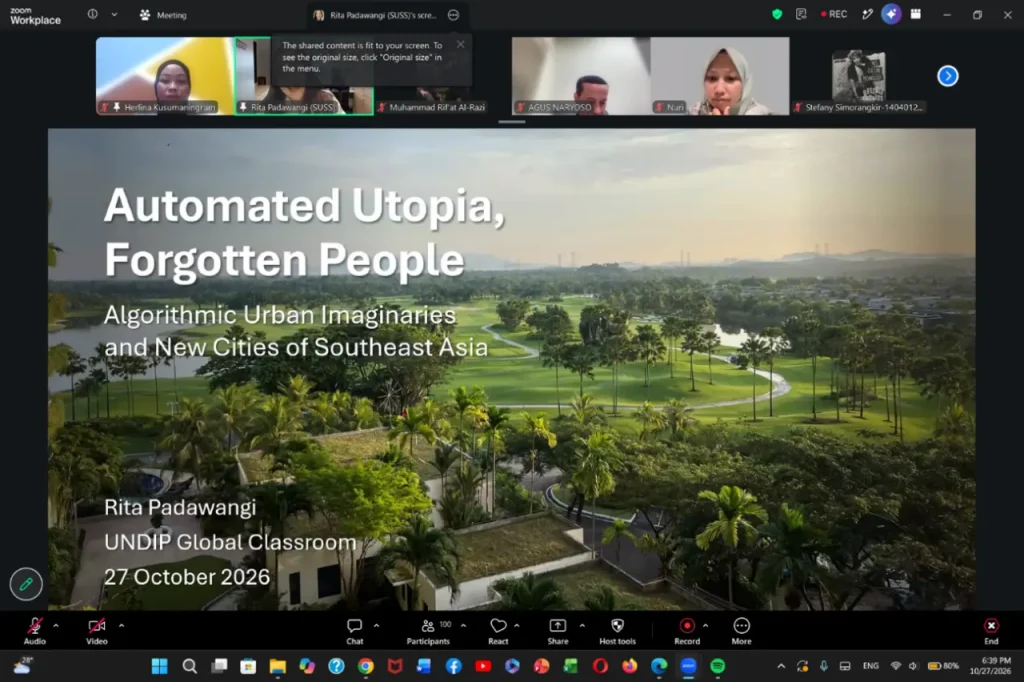
SEMARANG – The Department of Communication Science, Faculty of Social and Political Sciences (FISIP), Universitas Diponegoro, held another Undip Global Classroom session on Tuesday (October 27, 2026), conducted online via Zoom Meeting. Carrying the theme “Automated Utopia, Forgotten People: Algorithmic Urban Imaginaries and New Cities of Southeast Asia,” the event featured Dr. Rita Padawangi from Singapore University of Social Sciences as the guest speaker, with Herlina Kusumaningrum, S.Sos., M.A., a lecturer at FISIP UNDIP, serving as the moderator.
The session opened with remarks from Dr. Agus Naryoso, S.Sos., M.Si., Head of the Department of Communication Science, representing the Dean of FISIP UNDIP. In his remarks, Dr. Agus expressed his appreciation and gratitude to Dr. Rita Padawangi for her participation and willingness to share her knowledge in this international academic forum. He also emphasized that the topic was highly relevant to current developments and urban challenges, particularly concerning the use of technology in urban development and governance.
During her presentation, Dr. Rita Padawangi invited participants to explore how digital technology, algorithms, and artificial intelligence (AI) are increasingly shaping the ways people imagine future cities. The concept of automated utopia discussed in this session refers to the vision of an ideal city that promises efficiency, sustainability, security, and improved quality of life through the integration of automated technologies into urban planning and management.
Furthermore, Dr. Rita explained the concept of algorithmic urbanism, an emerging form of urban management and governance that increasingly relies on algorithms to process vast amounts of data. These technologies can support various aspects of urban life, ranging from transportation systems and public services to energy management, infrastructure, and security. Although this approach offers various conveniences and efficiencies, it also raises important questions concerning social justice, inequality, and who actually benefits from technology-driven development.
To illustrate these issues, Dr. Rita presented several examples of new city developments in Southeast Asia, including New Clark City in the Philippines, Forest City in Malaysia, and Indonesia’s Nusantara Capital City (IKN). These projects demonstrate how the ideas of modern, green, smart, and technology-driven cities are promoted as representations of development and national progress. However, behind these promises of progress lie social challenges that require greater attention, including displacement, community marginalization, unequal access, and environmental impacts.
One of the key points highlighted in the presentation was how digital media and social media algorithms contribute to shaping and circulating public imaginaries of ideal cities. Through appealing visual representations and narratives of technological progress, efficiency, and sustainability, various urban development projects can gain positive visibility in digital spaces. However, these narratives may also obscure the realities experienced by communities affected by development, particularly vulnerable groups and local communities whose voices are often underrepresented in development discourse.
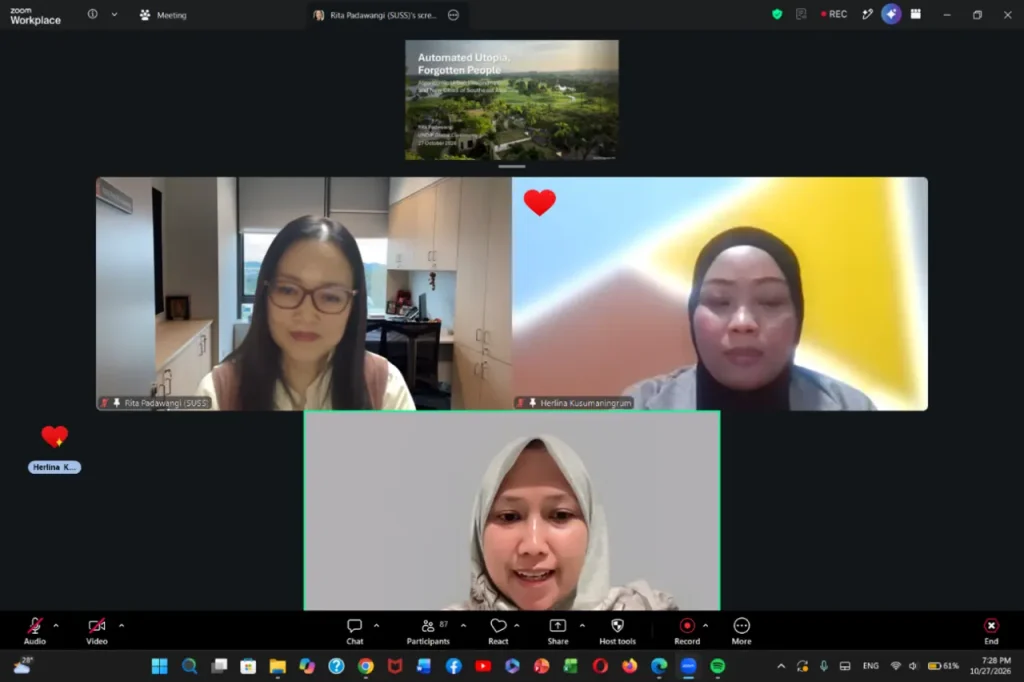
Dr. Rita also emphasized the importance of developing alternative perspectives in imagining future cities. As highlighted in her presentation, the future of cities should not be oriented solely toward technological sophistication and economic interests but must also consider social and environmental justice. Approaches grounded in local communities’ experiences, community solidarity, and citizens’ participation in development processes are essential to creating more inclusive and equitable urban futures.
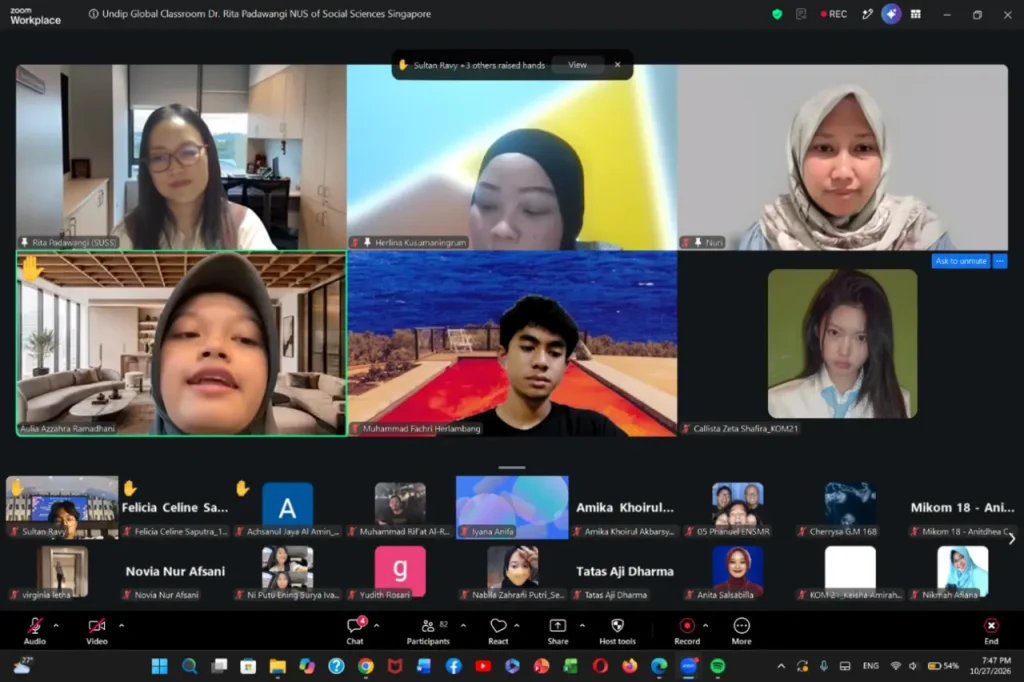
Following the presentation, the event continued with an interactive discussion and question-and-answer session. Students demonstrated considerable enthusiasm by actively raising questions related to the topics presented, particularly the relationship between digital technology, algorithms, social media, and the dynamics of urban development across Southeast Asia. This session provided an academic platform for students to deepen their understanding while developing critical perspectives on contemporary urban issues.
At the conclusion of the event, Dr. Nurul Hasfi, S.Sos., M.Si., Head of the Sociology of Media Research Cluster (KBK Sosiologi Media), Department of Communication Science, FISIP UNDIP, expressed her appreciation and gratitude to Dr. Rita Padawangi for sharing her knowledge and valuable insights. She expressed her hope that the session would serve as a meaningful learning experience for all participants, particularly students, in understanding the interconnectedness of technology, media, society, and urban development.
Through the Undip Global Classroom initiative, the Department of Communication Science, FISIP UNDIP, continues to expand students’ academic perspectives by facilitating direct engagement with scholars and practitioners from international institutions. This initiative also reflects FISIP UNDIP’s commitment to strengthening global academic collaboration, improving the quality of education, and encouraging the development of critical perspectives oriented toward addressing societal challenges at both regional and global levels.