
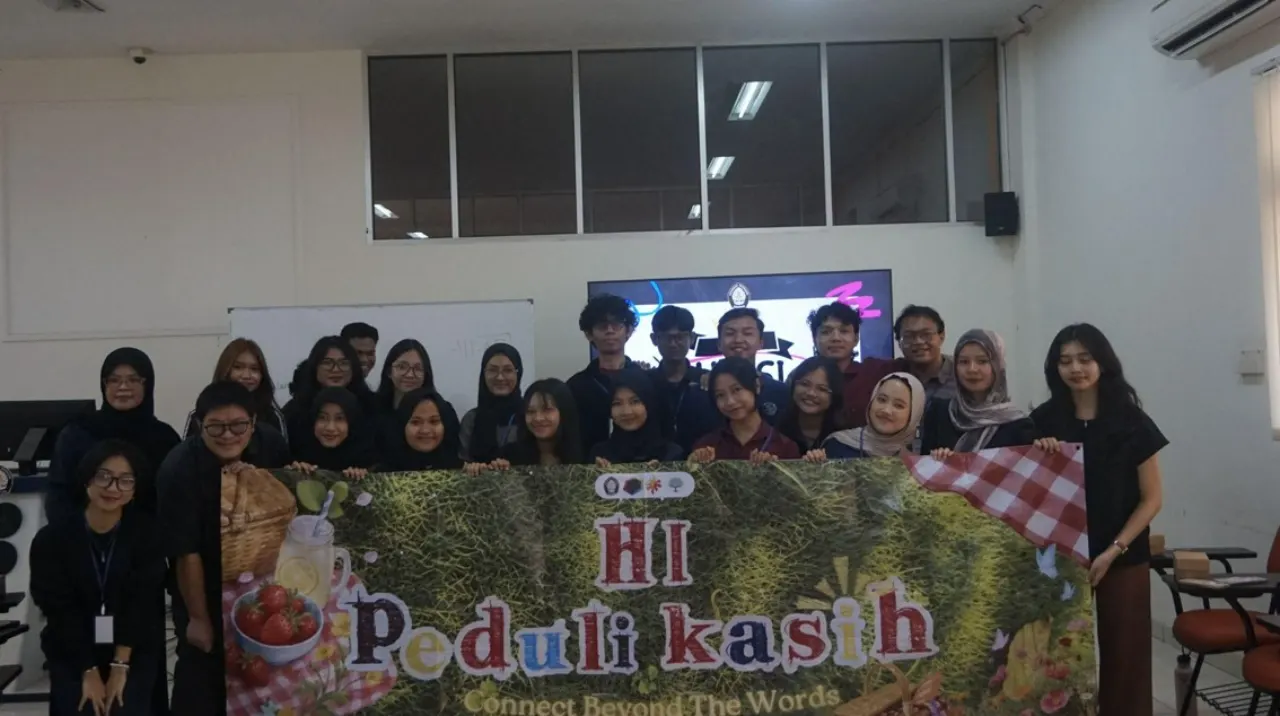
Semarang – The International Relations Student Association (Himpunan Mahasiswa Program Studi Hubungan Internasional / HMPS HI) at Universitas Diponegoro (Undip), through its Community Service Division, has once again organized its flagship initiative, the 2026 HI Peduli Kasih (HIASI). The program serves as a platform for students to deepen their understanding of Deaf culture while learning Indonesian Sign Language (Bahasa Isyarat Indonesia / BISINDO, a means of communication that fosters a more inclusive environment. Through a series of preparatory briefings, learning sessions, and direct interaction with Deaf community members, the 2026 HIASI is expected to cultivate awareness of the importance of respecting diverse forms of communication and to encourage more open and equal interaction.
The 2026 HIASI was carried out in five stages: a preparatory briefing on October 10, 2026; Learning Sessions 1 and 2 on October 17–18, 2026; Learning Sessions 3 and 4 on October 24–25, 2026; and a Sharing Session as the culminating event on November 1, 2026. The series was attended by 20 volunteers, supported by 19 committee members, three representatives of the HMPS HI Executive Board, and two Internal Supervisors (Pengendali Internal / PI). Each stage was designed progressively to provide a foundational understanding of Deaf culture, equip participants with sign language skills, and offer opportunities to apply this knowledge in direct interaction.
The 2026 HIASI series began with a preparatory briefing held on Saturday (10/10/2026) at Warmindo 88. The event was opened by host Yasinta Alicyagrace, followed by remarks from the Chairperson of the 2026 HIASI, the Head of the Community Service Division of 2026 HMPS HI, and the Chairperson of 2026 HMPS HI. Subsequently, the Chairperson of the 2026 HIASI, Jahra Jelita Nadhirestianto, along with the Vice Chairperson of 2026 HIASI, Naflah Raihanah, presented an overview of the program, the flow and schedule of implementation, the requirements to be observed throughout the activities, and the dress code for volunteers. The briefing aimed to ensure that all volunteers understood the series of activities and the responsibilities they needed to fulfill before entering the learning sessions.
The next stage was Learning Session 1 on Saturday (17/10/2026) at Aergia Cafe. In this session, volunteers received materials on Deaf culture and an introduction to Bahasa Isyarat Indonesia (BISINDO), delivered by Abdurrahman Phieter Angdika, with Mako Mira Lysistrata serving as interpreter. The materials covered Deaf identity, the differences between Deaf culture and hearing culture, and the concepts of audism and linguicism as they relate to discrimination based on hearing status and language use. The learning then continued with an introduction to etiquette for interacting with Deaf community members, the five main parameters of sign language, the BISINDO alphabet, how to introduce oneself, greetings based on time of day, and question vocabulary usable in everyday conversation. Through this session, participants were introduced to the importance of understanding language, identity, and Deaf culture as part of efforts to build inclusive communication.
Learning continued with Learning Session 2 on Sunday (18/10/2026) in Room B.102 of the Faculty of Social and Political Sciences at Universitas Diponegoro. The activity began with a reflection on the previous material to reinforce volunteers’ understanding of Deaf culture and the fundamentals of BISINDO. Participants then learned vocabulary related to numbers, days and months, time expressions, locations, and directions. The material was delivered through direct practice so that participants could recognize and practice sign language movements more purposefully. Through this gradual learning approach, volunteers had the opportunity to strengthen their understanding while developing the basic skills needed for communication using BISINDO.
The learning series continued with Learning Session 3, which focused on expanding vocabulary and constructing expressions in BISINDO. The material covered vocabulary related to places, interpersonal and family relationships, the construction of simple sentences, and the frequency of daily activities. Volunteers also practiced understanding question structures in BISINDO so they could use them appropriately according to conversational context. Through direct practice, participants were encouraged to understand the use of vocabulary and sentence structure as preparation for communicating with Deaf community members.
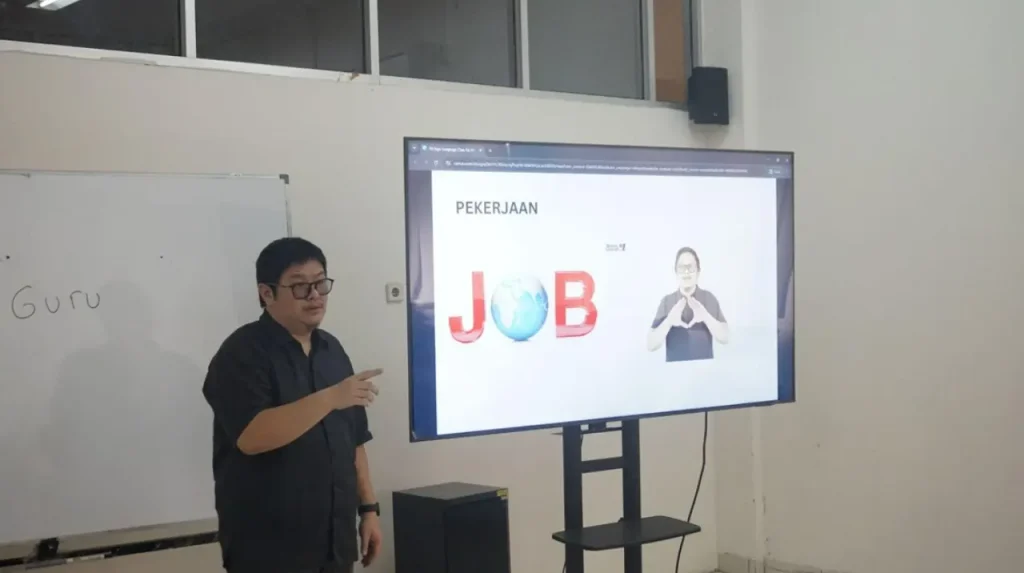
Next, Learning Session 4 was held on Sunday (25/10/2026), focusing on vocabulary related to hobbies and occupations. In addition to learning sign language movements related to these two topics, volunteers also completed a Learning Objective focused on self-introduction. In this session, participants applied the vocabulary they had learned to compose and deliver information about themselves using BISINDO. This activity served as both an application and an evaluation of participants’ understanding throughout the learning series. Through these two advanced sessions, volunteers were expected to become more accustomed to using BISINDO in simple conversations and to be better prepared for direct interaction with Deaf community members.
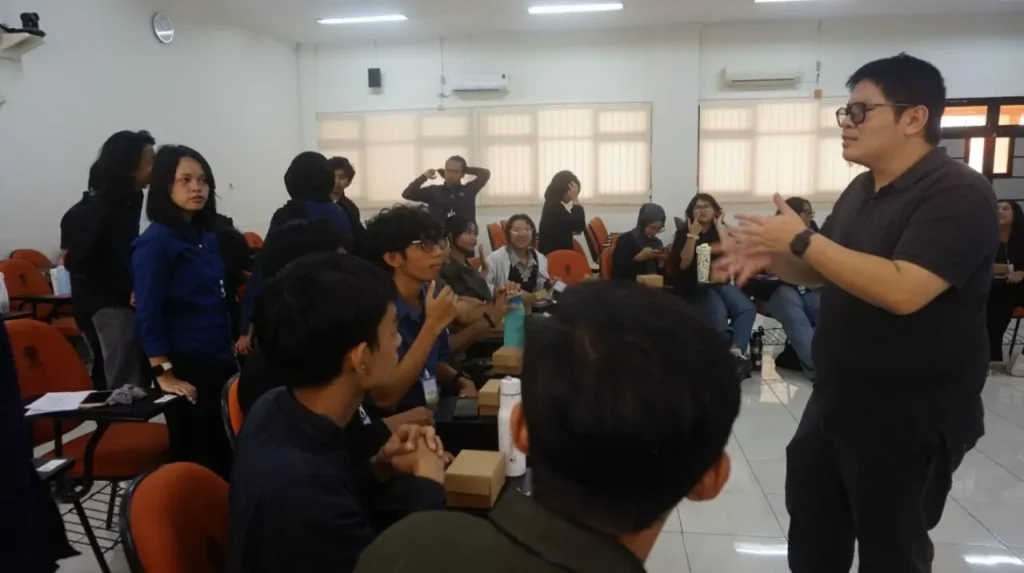
As the culmination of the series, the 2026 HIASI held a Sharing Session on Sunday (1/11/2026). This event provided a space for direct interaction between volunteers and Deaf community members to apply the BISINDO skills acquired during the Learning Sessions. The Sharing Session was conducted over one hour and involved six selected volunteers and six Deaf community members, including the speakers who had previously delivered the training materials. Through a rotation system, each volunteer had the opportunity to interact in turn with Deaf community members, practice communication using sign language, and share experiences in an interactive atmosphere.
The Sharing Session served as a means for volunteers to apply their BISINDO skills while also boosting their confidence and deepening their understanding of the importance of inclusive communication and mutual respect. After the session concluded, the event continued with the presentation of souvenirs to the speakers and interpreter as a token of appreciation for their contributions. The entire 2026 HIASI series was then closed with a joint documentation session involving the committee, volunteers, resource persons, interpreter, and Deaf community members.
Through the 2026 HI Peduli Kasih, HMPS HI Undip seeks to create a learning space that focuses not only on mastering sign language skills but also on developing social awareness and an appreciation for diversity. This series of activities is expected to serve as a first step for volunteers to apply the knowledge gained in everyday interactions, respect Deaf identity and culture, and contribute to building a more inclusive environment. In doing so, the 2026 HIASI stands as one of HMPS HI Undip’s efforts to encourage students to develop social sensitivity and realize more equal communication for all.