

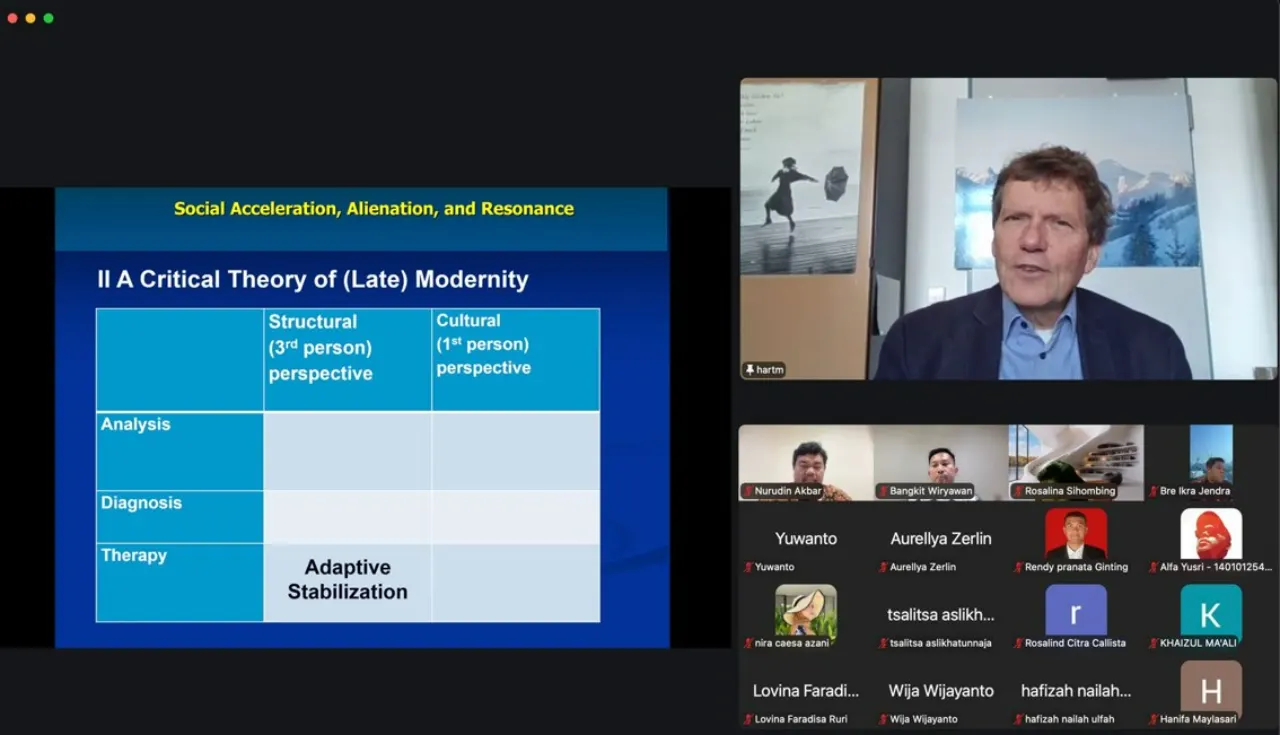
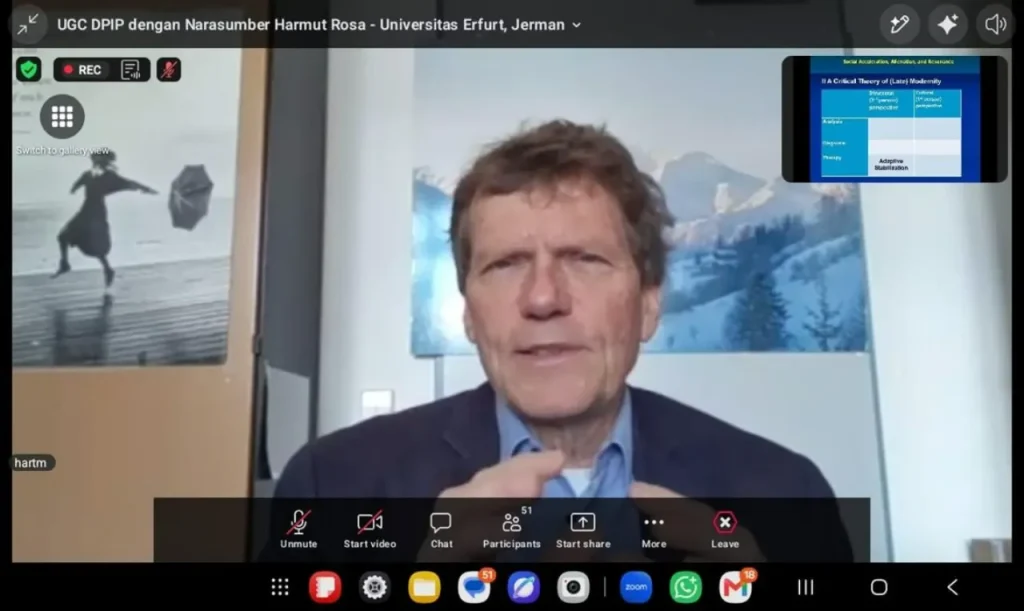
Semarang, October 22, 2026 – The Department of Politics and Government Science, Faculty of Social and Political Sciences (FISIP), Diponegoro University held the UNDIP Global Classroom entitled “Acceleration, Alienation, Resonance.” This event featured Prof. Hartmut Rosa from Friedrich Schiller University, Germany, as the keynote speaker, with opening remarks by Wijayanto, S.IP., M.Si., Ph.D., and Drs. Yuwanto, M.Si., Ph.D., Head of the Political Theory and Democracy Expert Group (KBK). The discussion was moderated by Nuruddin Al Akbar, M.A., from the Department of Politics and Government FISIP UNDIP. This academic forum highlighted critical reflections on the relationship between the acceleration of modern life, human alienation, and the possibility of rebuilding meaningful relationships in democratic societies.
In his discussion, social acceleration indicates that economic progress, technological development, and increased productivity do not automatically lead to a better life. Modern society in fact faces various problems, ranging from the spread of misinformation, unsustainable economic growth, to increasing psychological pressure as a result of ever-accelerating life demands. These conditions give rise to four crises of desynchronization: the ecological crisis, when economic exploitation exceeds nature’s ability to regenerate; the crisis of democracy, when processes of deliberation and political decision-making struggle to keep up with economic and technological changes; the economic crisis, when the dynamics of the financial sector are not in line with developments in the real economy; and the psychological crisis, when individuals find it difficult to adapt to the ever-increasing demands of life. These four crises show that the problem for modern society is not merely the speed of change, but also the inability of various life systems to move in sync.
This problem relates to the concept of alienation, a condition in which humans lose responsive and meaningful relationships with the world around them. Although technology makes the world increasingly accessible and controllable, people do not necessarily feel more connected to their social environment, work, nature, or communal life. As an alternative, Rosa offers the concept of resonance, a reciprocal relationship that allows humans and the world to touch each other, to respond, and to experience transformation. Resonance does not mean harmony without conflict or uniformity of perspective; rather, it is a relationship that is open to difference, new experiences, and change. Thus, meaningful relationships do not always have to end in agreement, but require a willingness to listen to and respond to others.
From the perspective of politics and governance, democracy becomes one of the important spaces for the formation of social resonance. Democracy should not be understood merely as an election procedure or decision-making mechanism, but also as a process that enables citizens to voice aspirations, to listen to each other, and to influence the direction of collective life. Amid the accelerated flow of information and technological change, the quality of democracy also depends on the ability of political institutions to respond to society’s needs and to maintain deliberative spaces open to differences. Resonance also takes place in four spheres of life, including social relationships such as love, friendship, and democracy; material relationships through work and education; existential relationships through religion, nature, art, and history; and relationships with oneself through the body, emotions, and memory.