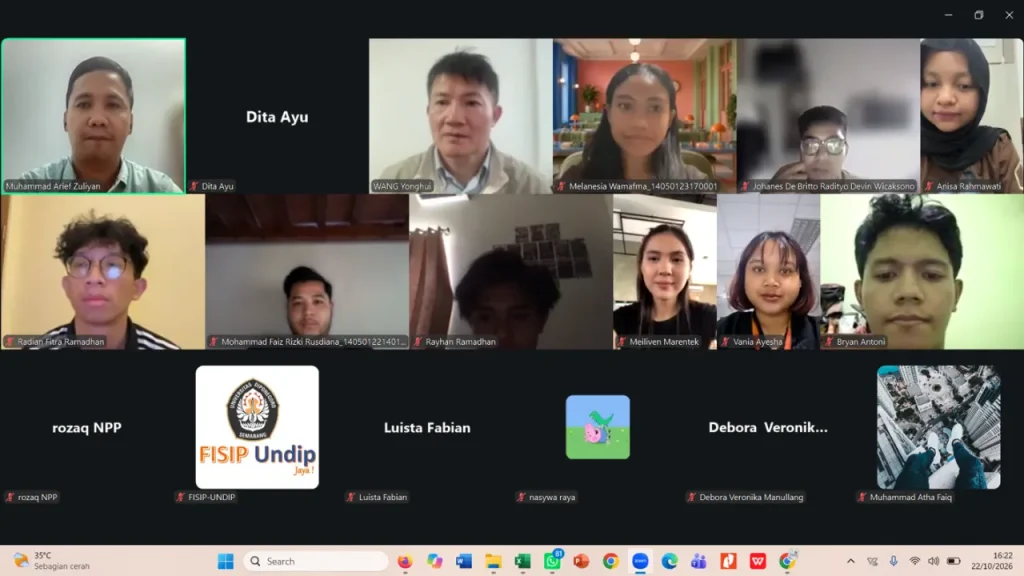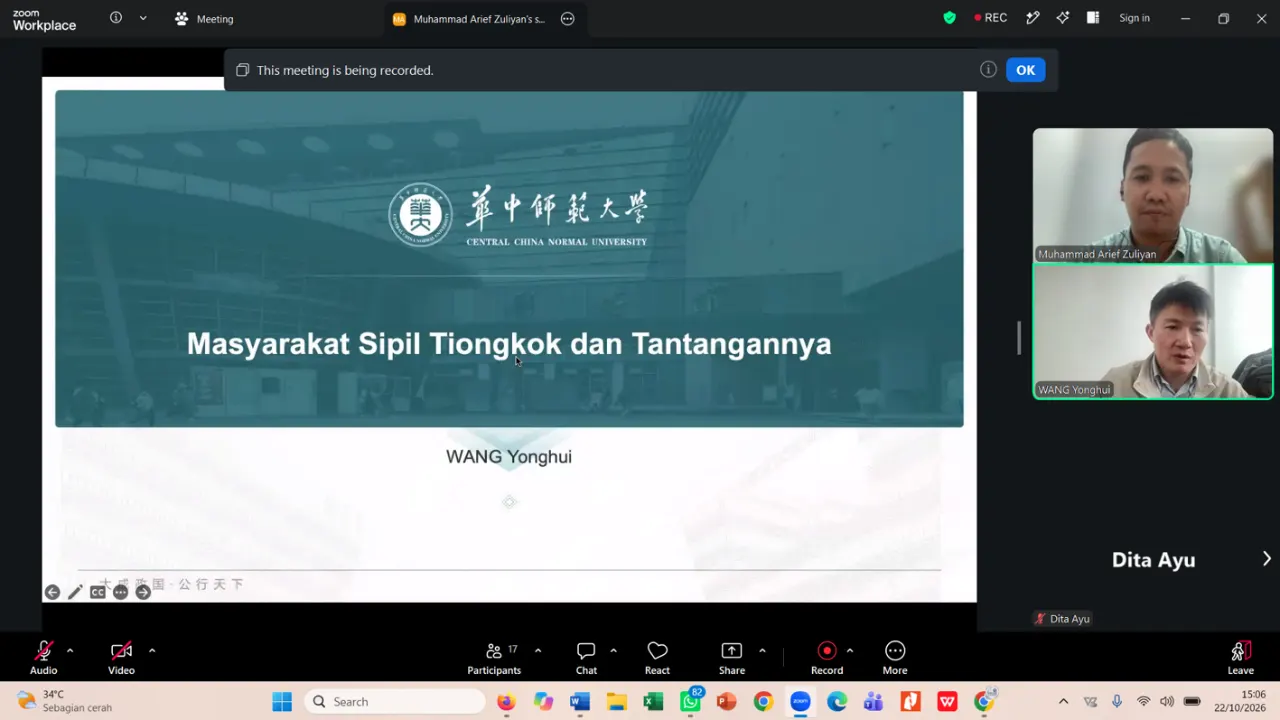
Semarang, 22 October 2026 – The Department of International Relations, Faculty of Social and Political Sciences (FISIP), Diponegoro University (UNDIP), held another session of UNDIP Global Classroom on Thursday (22 October 2026). The event, which commenced at 3:00 p.m. Western Indonesian Time (WIB), featured Prof. Wang Yonghui from Central China Normal University (CCNU), China, as the guest speaker. The session explored the theme “Chinese Civil Society and Its Challenges.”
The event was integrated into the Foreign Policy of China course and formed part of the Department of International Relations FISIP UNDIP’s efforts to broaden students’ understanding of contemporary Chinese political and social dynamics through the perspectives of international academics.
In his presentation, Prof. Wang Yonghui discussed various transformations taking place in Chinese society, ranging from citizens’ everyday lives and rural development to public services, law enforcement, and environmental protection. His presentation provided insights into how China’s development is not solely focused on economic growth and infrastructure, but is also closely linked to social change and improvements in people’s quality of life.
One of the key issues highlighted was the transformation of community life. Prof. Wang discussed the development of community-based mutual assistance initiatives, including the concept of time banks, which enables residents to support one another and accumulate service hours as a form of social support. The development of artificial intelligence (AI) was also addressed, particularly its growing role in everyday life and public services.
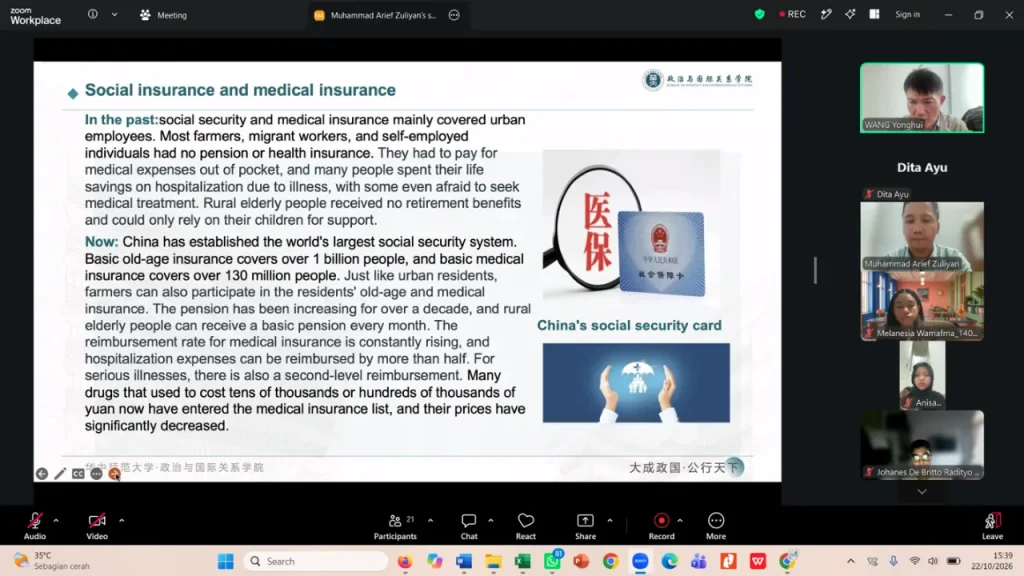
Furthermore, the speaker examined various rural development policies and initiatives, including efforts to improve access to education, protect vulnerable groups, and expand social security coverage. In the area of governance, Prof. Wang discussed the digitalization of public services, the strengthening of the rule of law, and anti-corruption efforts as part of China’s institutional transformation.
Environmental issues also featured prominently in the discussion. The development of renewable energy, particularly solar and wind power, as well as the integration of economic development with environmental restoration, were presented as examples of China’s efforts to pursue sustainable development.
Nevertheless, Prof. Wang emphasized that China continues to face several challenges, including an aging population, economic structural transformation, and the need to ensure that development not only improves material well-being but also enhances people’s happiness.
Through UNDIP Global Classroom, students of International Relations at UNDIP gained the opportunity to develop a more comprehensive understanding of China, moving beyond the perspective of foreign policy to examine the connections between domestic dynamics, development, and China’s position in international relations.
The event also reaffirmed FISIP UNDIP’s commitment to promoting the internationalization of education, expanding global academic networks, and providing learning experiences relevant to contemporary international issues.