

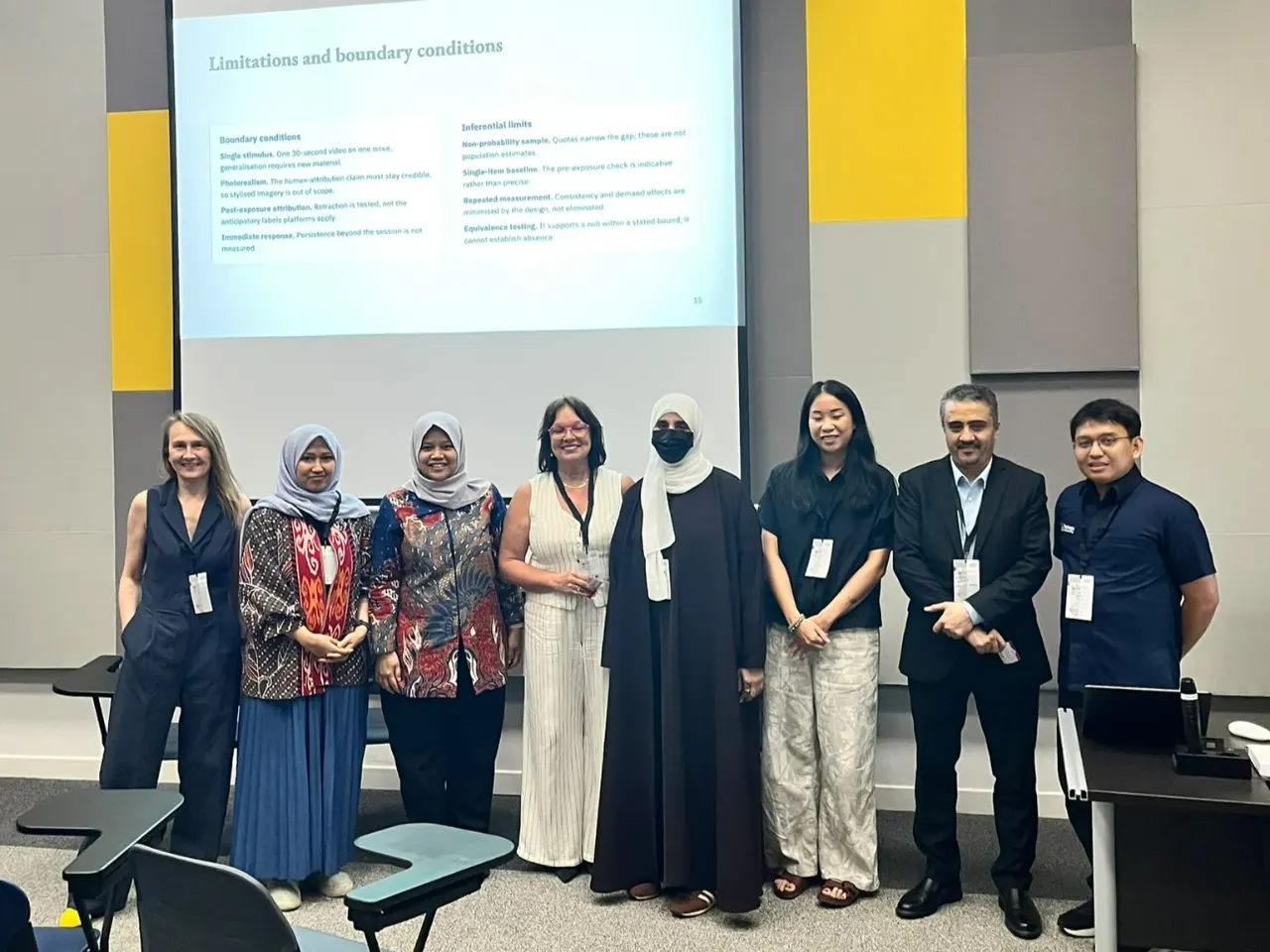
SINGAPORE – The Faculty of Social and Political Sciences, Diponegoro University (FISIP UNDIP), continues to strengthen its contribution to the international academic network through the participation of two lecturers from the Department of Communication Science, Dr. Phil. Nuriyatul Lailiyah, S.Sos., M.I.Kom., and Dr. Nurul Hasfi, S.Sos., M.A., in The Eleventh International Conference on Communication & Media Studies, held on October 1–2, 2026, at Nanyang Technological University (NTU), Singapore.
The presence of FISIP UNDIP academics at the conference holds strategic value, as the event was held at Nanyang Technological University (NTU) Singapore, one of the world’s leading universities, ranked 12th globally. NTU’s position in the global rankings also makes this conference an important space for FISIP UNDIP to expand its academic exposure, introduce research findings to the international academic community, and build networks with universities and researchers from various countries.
The conference is an international academic forum that brings together academics and researchers in the fields of communication and media from various countries to discuss the latest developments in media studies, technology, culture, the media industry, and media literacy. The presence of FISIP UNDIP academics in this forum is part of the effort to expand the visibility of UNDIP research while strengthening the institution’s position in the global academic network.
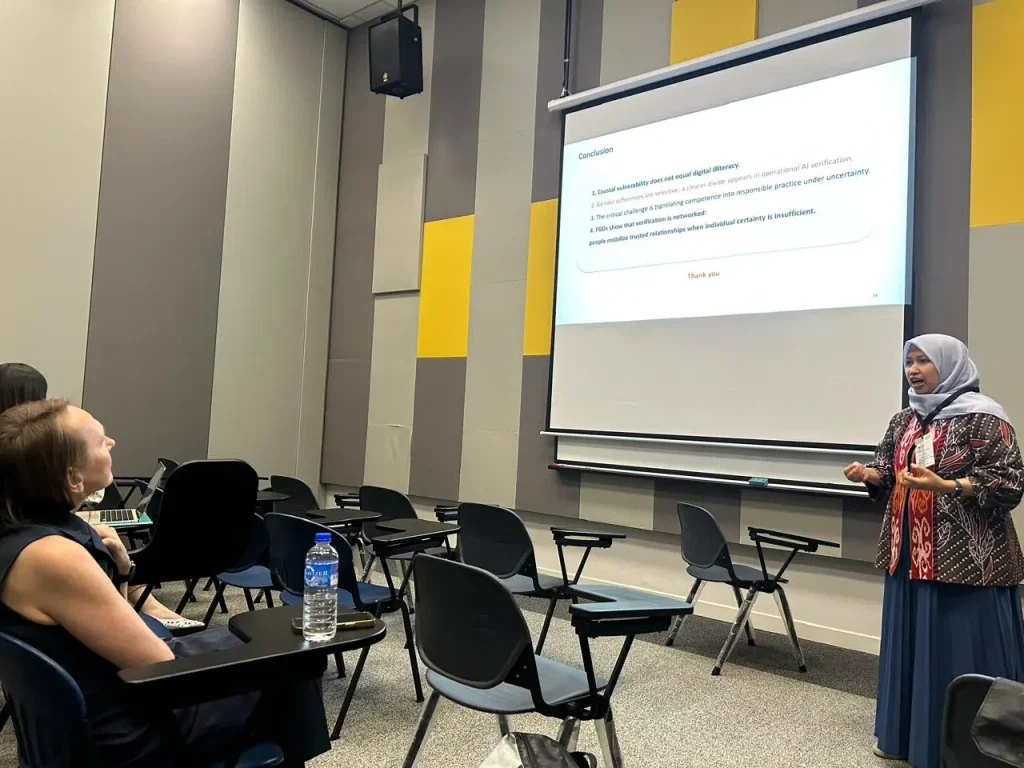
At the conference, Nuriyatul Lailiyah presented research entitled “Digital Literacy in an Urban Coastal Area: Case Study in Central Java.” This study brought the experiences of urban coastal communities in Central Java into the international discussion on digital literacy, particularly how communities build knowledge, skills, and practices in facing technological developments and the flow of digital information.
Meanwhile, Nurul Hasfi presented a paper entitled “Artificial Intelligence in Journalism: A Systematic Review of Research Trajectories, Ethics, and Human–AI Relations (2012–2025).” This research examined the development of artificial intelligence in journalism through a systematic review of 204 Scopus-indexed articles, using longitudinal evidence since 2012 to understand the evolution of the field.
The results of the study indicate that research on AI and journalism has undergone a significant shift. While early studies focused more on technology adoption, recent research increasingly pays attention to the professional practices of journalists, newsroom dynamics, ethics, public trust, algorithmic governance, and human–AI relations.
The research also found a shift in the human–AI relationship from a substitution paradigm toward augmentation, in which AI is increasingly positioned as a technology that supports and complements human work. Nevertheless, these developments continue to raise questions regarding professional autonomy, legitimacy, and the identity of journalism. Overall, the study of AI in journalism is moving toward a “socio-normative turn,” namely a shift in focus from technological aspects toward issues of governance, values, legitimacy, and professional structures.
Both studies demonstrate FISIP UNDIP’s contribution to contemporary communication issues from two complementary perspectives. One study brought the experiences of Indonesian society in facing digital transformation, while the other mapped global changes in the journalism profession due to the development of artificial intelligence.
The benefits of this activity are also directed back to society. The research on digital literacy in the coastal areas of Central Java provides an overview of the community’s ability to understand, evaluate, and use digital information in daily life. These findings can serve as a basis for developing digital literacy programs that better suit the needs of the community, especially in facing misinformation, digital fraud, low information verification skills, and various risks of digital media use.
Meanwhile, the research on artificial intelligence in journalism has direct relevance to the quality of information received by the public. The development of AI in newsrooms concerns not only the efficiency of journalists’ work but also information accuracy, transparency in AI use, journalistic ethics, public trust, and media accountability. This study is important to ensure that the use of AI in journalism continues to place public interest, professional responsibility, and information quality as the main principles.
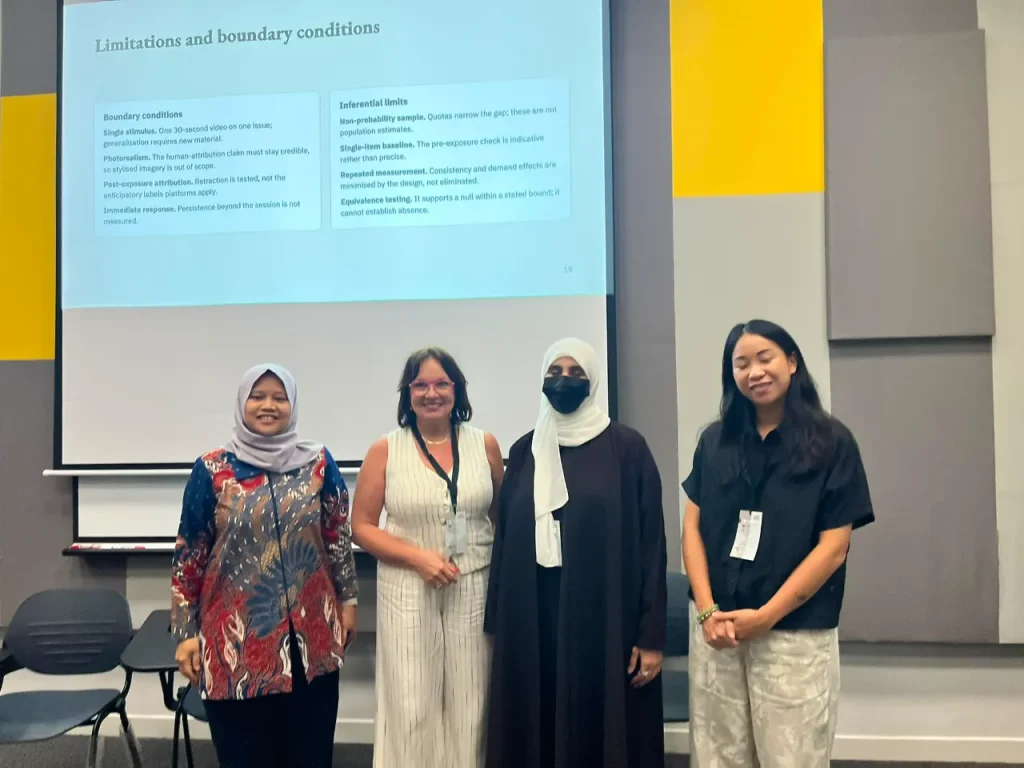
More than just an academic presentation forum, the conference was also utilized to expand FISIP UNDIP’s international network. During the two-day event, Nuriyatul and Nurul built communication with academics from various parts of the world. More than 30 academics met at the forum expressed their willingness to explore future academic collaboration, whether in the form of joint research, joint publication, guest lectures, global classrooms, visiting scholars, academic mobility, or the development of cooperation between study programs and faculties.
One of the strategic outcomes of the networking process was the interest shown by the Chair of the School of Communication at Quest International University, Malaysia, as well as the Dean of the Faculty of Communication at UNIACC, Chile, to learn more about class development at FISIP UNDIP.
This interest opens opportunities for exchanging experiences regarding the management of international programs and serves as an initial gateway for developing institutional relationships with universities abroad. This also shows that the internationalization practices developed by FISIP UNDIP are beginning to attract attention from international academic partners.
Networks were also built with professors and academics from Asia, Europe, America, and Africa. The willingness of more than 30 academics to continue communication and open opportunities for cooperation shows that FISIP UNDIP’s participation in international forums does not stop at institutional visibility but is beginning to produce concrete network capital for the development of cross-country academic collaboration.
Potential follow-ups from these networks include joint research, joint publication, guest lectures, global classrooms, visiting scholars, academic mobility, and the development of cooperation between study programs and faculties.
The international networks obtained from this conference are expected not to stop at collaboration between academics. Knowledge exchange with researchers from various countries can be translated into course materials, joint research, digital literacy training, community service, education on AI and media, as well as programs that help communities become more critical, safe, and empowered in facing changes in the digital information ecosystem.
The presence of two FISIP UNDIP academics in this international forum also shows that Indonesian higher education institutions are not merely recipients of global knowledge developments. Through research on digital literacy in Indonesian society and the development of AI in journalism, FISIP UNDIP is also present as a knowledge contributor in international academic conversations regarding the transformation of communication and media.
Participation in the conference at NTU Singapore is thus part of a broader strategy to integrate international research exposure, academic networking, institutional visibility, and social impact. The contacts and cooperation opportunities that have been formed will subsequently be followed up to develop into concrete academic activities that benefit students, lecturers, the Department of Communication Science, FISIP, Diponegoro University, and the community, which is an important part of the implementation of the Three Pillars of Higher Education.
The conference network will also continue next year. The Twelfth International Conference on Communication & Media Studies is scheduled to take place at Toronto Metropolitan University, Toronto, Canada, in 2027, opening opportunities for the sustainability of FISIP UNDIP’s involvement in the international communication and media academic community.
Thus, the internationalization of FISIP UNDIP is not only interpreted as an increase in networks and institutional visibility. The knowledge, experience, and global collaboration obtained are expected to return benefits to society through higher-quality education, research relevant to public issues, strengthening digital literacy, and more ethical and responsible communication and media practices.
Through the dissemination of research and the development of global networks, FISIP UNDIP strengthens its role not merely as a participant in international forums but as an active partner in the production, exchange, and utilization of communication knowledge for academic and societal interests.