

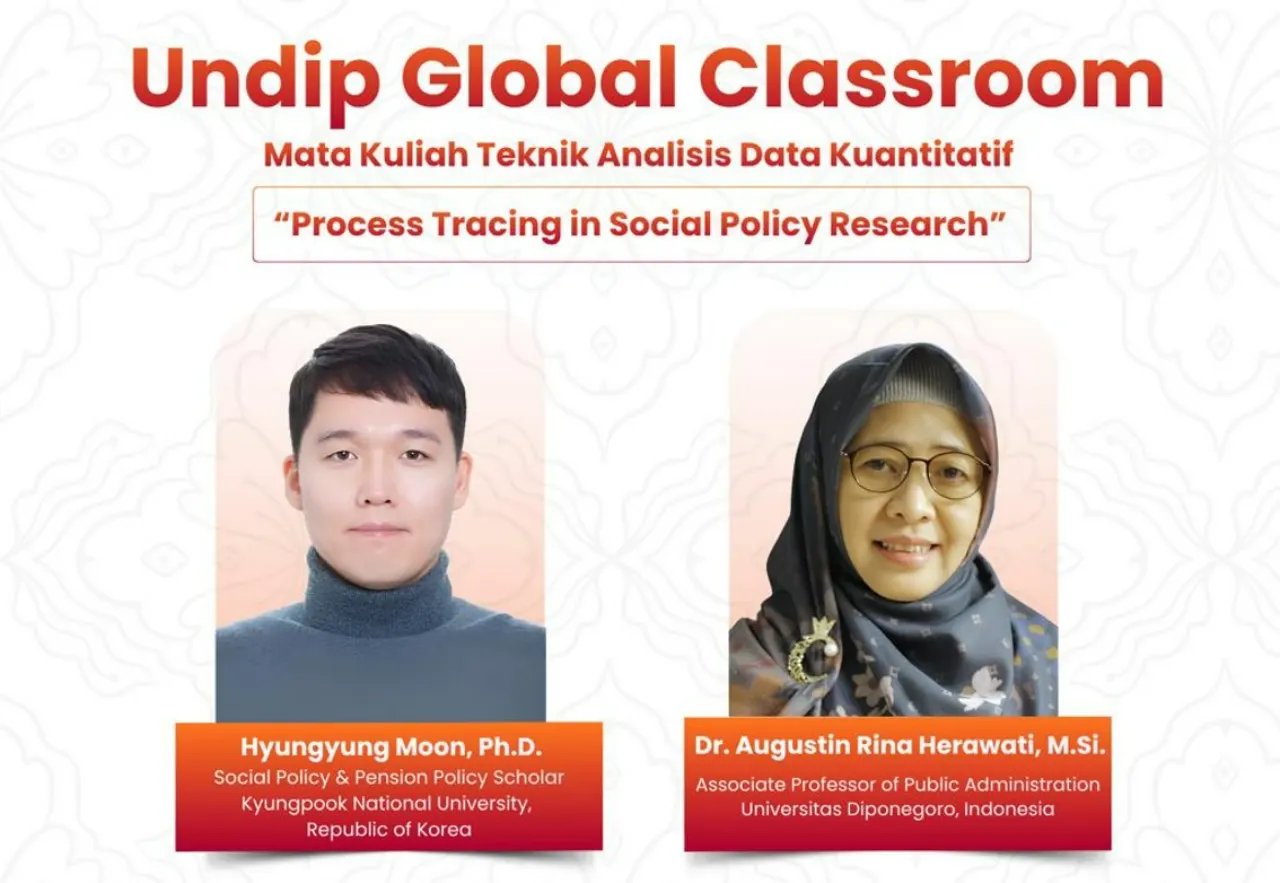
SEMARANG (2/10) – The Doctoral Program (S3) in Public Administration, FISIP Diponegoro University, once again reaffirmed its commitment to strengthening academic reputation and research internationalization through the organization of the Undip Global Classroom (UGC). On this occasion, S3 DAP Undip raised the advanced research methodology topic “Process Tracing in Social Policy Research” in the Quantitative Data Analysis Techniques course, held online via Zoom on Friday, October 2, 2026.
This international collaborative lecture session featured the keynote speaker Hyungyung Moon, Ph.D., a Social Policy & Pension Policy Scholar from Kyungpook National University, Republic of Korea. The learning was co-taught with a co-teacher from S3 DAP Undip, Dr. Augustin Rina Herawati, M.Si., who teaches the Quantitative Research Methods course.
Tracing Causal Mechanisms in Public Policy Analysis
In her presentation, Hyungyung Moon, Ph.D., dissected in depth the use of the process tracing method as a structured quasi-qualitative approach to test, build, and refine theories of public policy and state administration. Unlike mere historical description or linear narrative, process tracing focuses on revealing causal mechanisms—namely the chain of interaction processes between actors, institutions, and actions that trigger a policy change (outcomes).
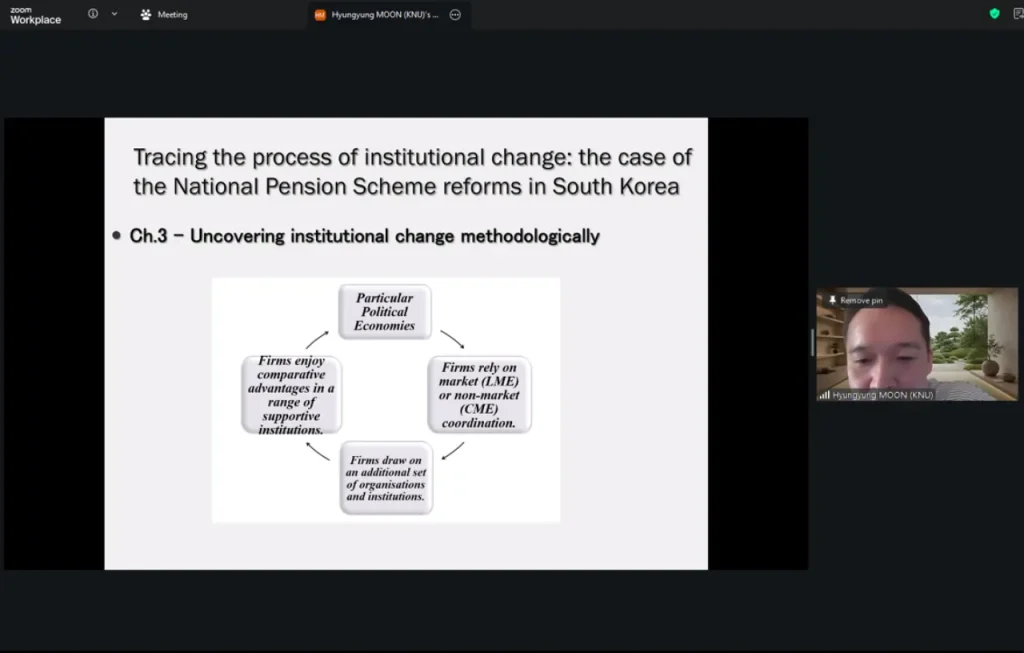
Dr. Moon explained three main foundations in process tracing, namely:
- Realist Ontological and Epistemological Foundations by viewing social reality and causal mechanisms as deep structural relationships that go beyond mere statistical correlation of variables X and Y.
- Empirical Evidence Testing Based on Bayesian Logic by utilizing four types of empirical evidence—Pattern, Sequence, Trace, and Account—tested through various evidence strength tests such as the Hoop test and Smoking gun test.
- Resolving the Equifinality Problem by identifying and comparing various alternative hypotheses to ensure the validity of causal explanations in complex policy cases.
As a concrete case study, Dr. Moon elaborated on the application of process tracing to the reform of the National Pension Scheme in South Korea, which demonstrated how the role of welfare bureaucrats in maintaining institutional structures through negotiation and political legitimacy.
Strengthening International-Standard Doctoral Research Methodology
The Head of the Doctoral Program in Public Administration at Undip, Dr. Amni Zarkasyi Rahman, M.Si., stated that mastery of advanced causality research methods such as process tracing is crucial for doctoral-level students to produce strong theoretical contributions.
*”The organization of the Undip Global Classroom is a fundamental strategy of the S3 DAP Undip Program in sharpening the methodological acuity of our doctoral students. As future doctors and leading researchers in the field of public governance, students must not stop at surface-level correlation analysis or mere descriptive narratives,”* emphasized Dr. Amni Zarkasyi Rahman, M.Si.
Through mastery of the process tracing method, S3 students are invited to open the ‘black box’ in the public policy-making process—understanding precisely how the dynamics of actors, interests, and rules of the game interact to produce policy change. Mastery of this rigorous and internationally standardized methodology becomes the main capital for S3 DAP Undip students to break through publications in globally reputable Q1 journals while also strengthening the positioning of S3 DAP Undip as a center of excellence for public policy analysis in Asia.