

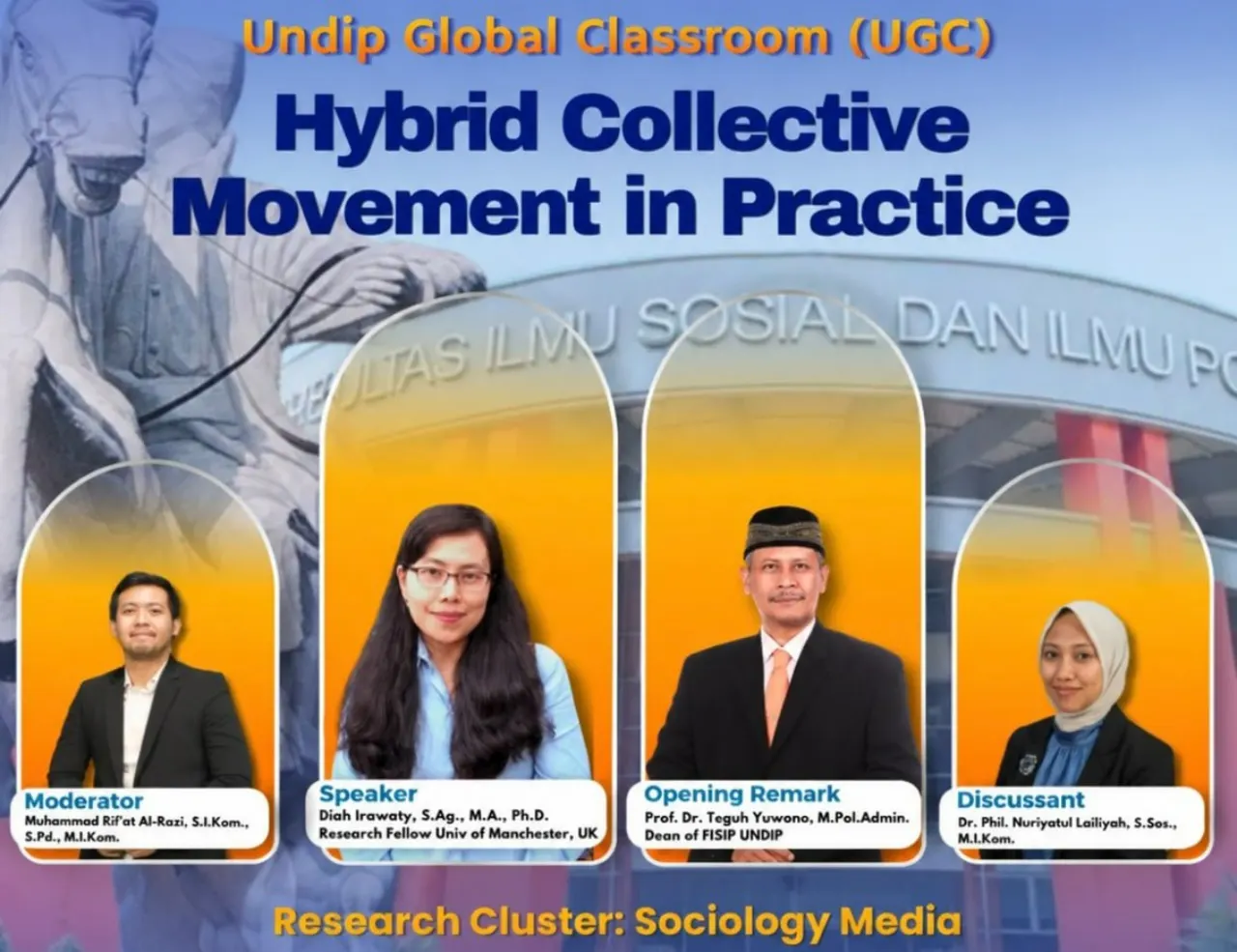
Semarang – The Department of Communication Science, Faculty of Social and Political Sciences (FISIP), Diponegoro University, once again held an Undip Global Classroom (UGC) activity as part of the effort to strengthen international academic collaboration and broaden the horizons of the academic community regarding the development of global communication studies. Raising the theme “Hybrid Collective Movement in Practice,” the activity featured Diah Irawaty, S.Ag., M.A., Ph.D., a Research Fellow from the University of Manchester, United Kingdom, as the speaker. The activity was held online via Zoom Meeting on Friday (30/10/2026).
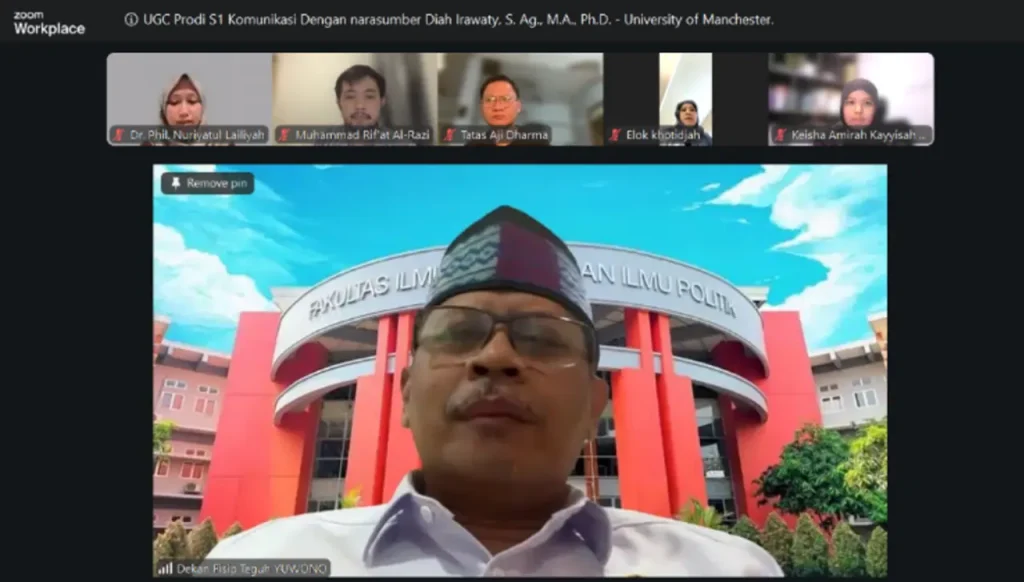
In the opening remarks, the Dean of FISIP UNDIP, Prof. Dr. Teguh Yuwono, M.Pol.Admin., expressed appreciation and gratitude for Diah Irawaty’s willingness to share her knowledge and academic experience with the FISIP UNDIP academic community. The presence of an academic from the University of Manchester was expected to enrich the perspectives of students and lecturers while also strengthening knowledge exchange within an internationally oriented academic environment.
The activity was also attended by the Head of the Department and the Head of the Undergraduate Program in Communication Science at FISIP UNDIP, Dr. Agus Naryoso, S.Sos., M.Si., along with a number of lecturers affiliated with the Media Sociology Expertise Cluster (Research Cluster).
This Undip Global Classroom activity was an initiative of the Media Sociology Research Cluster, chaired by Dr. Nurul Hasfi, S.Sos., M.A. The members of the Media Sociology Research Cluster who also attended included Dr. Yanuar Luqman, S.Sos., M.Si.; Dr. Agus Naryoso, S.Sos., M.Si.; Dr. Phil. Nuriyatul Lailiyah, S.Sos., M.I.Kom.; Muchammad Yuliyanto, S.Sos., M.Si.; Herlina Kusumaningrum, S.Sos., M.A.; and Muhammad Rif’at Al-Razi, S.I.Kom., S.Pd., M.I.Kom.
The activity began with a Discussant Opener delivered by Dr. Phil. Nuriyatul Lailiyah, S.Sos., M.I.Kom. In her introduction, she opened a discussion space regarding the importance of understanding collective movements in the digital ecosystem and how digital media can serve as a space for building discourse, expanding participation, and driving social change. The event was then guided by Muhammad Rif’at Al-Razi, S.I.Kom., S.Pd., M.I.Kom., as the moderator.
In the material presentation session, Diah Irawaty raised the topic “Digital Media for Social Change: Feminist Knowledge Production in Contemporary Indonesia (An Experimentation from LETSS Talk).” The material reviewed how digital media does not only function as a means of communication and information dissemination but also serves as a space for knowledge production, discourse formation, and articulation of social and political movements in contemporary society.
Diah Irawaty explained that the development of the internet and digital culture has brought changes to the way society produces, distributes, and validates knowledge. In the Indonesian context, digital life has been integrated with various aspects of daily life, from aspirations, economic activities, to social practices. However, these developments also present a number of challenges, such as unequal access to information, power relations, social control, and structural injustices that also affect people’s experiences in digital spaces.
Furthermore, Diah Irawaty outlined the perspective of digital feminism as one approach to understanding the relationship between technology, power, and social change. This approach emphasizes the importance of freedom, care, autonomy, inclusivity, and attention to various forms of intersectional injustices. Through this perspective, digital media can be utilized to expand participation spaces, strengthen empowerment, and build more inclusive knowledge production.
In her presentation, Diah Irawaty also discussed the development of feminist knowledge production in Indonesia. While previously the dissemination of feminist knowledge was mostly carried out through training programs, academic studies at universities, campaign media publications, and civil society organization networks, the digital era presents various forms of new practices. Among them are through virtual discussions, podcasts, social media live streams, online communities, digital campaigns, online training, and the publication of articles and research results.
One example raised was LETSS Talk, an initiative that became a space for experimentation in the practice of feminist knowledge production in Indonesia. Through LETSS Talk, digital space is utilized not only as a means of holding webinars but also as a space to bring together activism and academic traditions. This initiative encourages the involvement of various feminist groups and generations, expands access to knowledge, and prioritizes the principles of diversity, inclusivity, intersectionality, and decoloniality.
Diah Irawaty also explained that social media has an important role in mediating feminist political movements, from building public awareness, developing public and voter education, organizing petitions, conducting policy advocacy, to expanding social movement networks. Thus, digital media can become a strategic space for the formation of collective movements capable of driving change at the personal, community, social, and political levels.
The presentation also emphasized that knowledge production is not only the responsibility of academic institutions or certain groups. Every individual has the potential to become a knowledge producer through their experience, participation, and involvement in digital public spaces. The principle of accessibility, including the provision of sign language interpreters, as well as intergenerational connectivity are important parts of building a more open knowledge ecosystem.
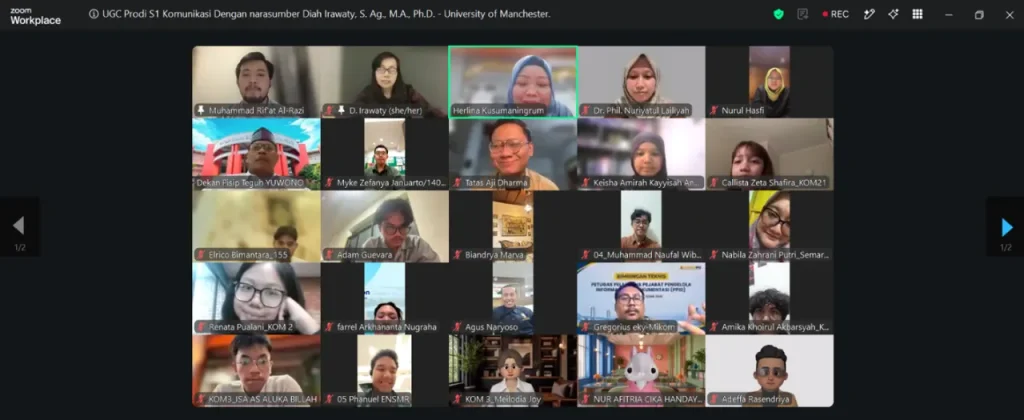
After the material presentation, the activity continued with a discussion and question-and-answer session. Students participating in the activity showed enthusiasm by asking various questions related to the material presented. The interaction served as a space for exchanging ideas as well as an opportunity for students to understand more deeply the relationship between digital media, collective movements, knowledge production, and social change in the Indonesian context.
Through the organization of the Undip Global Classroom, the Department of Communication Science at FISIP UNDIP continues to encourage the strengthening of an academic atmosphere that is open to scholarly developments and global perspectives. The presence of international academics as well as the active involvement of lecturers and students is expected to broaden critical insights, strengthen research collaboration, and encourage the development of communication studies relevant to various contemporary societal issues.
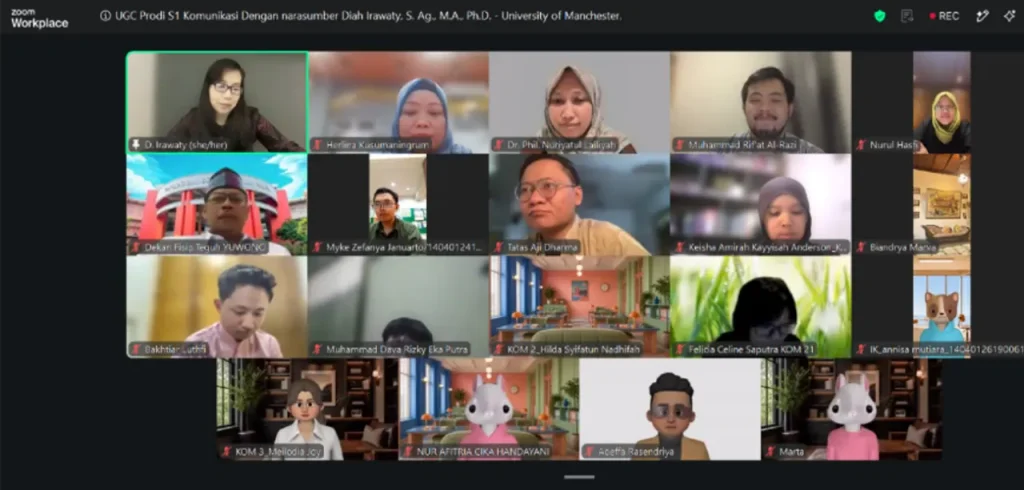
The series of activities concluded with a group photo session with all participants. Through this discussion, students and the academic community are expected to gain valuable learning regarding the utilization of digital media as a space for knowledge production, strengthening collective movements, and as an instrument for driving more inclusive and just social change.