

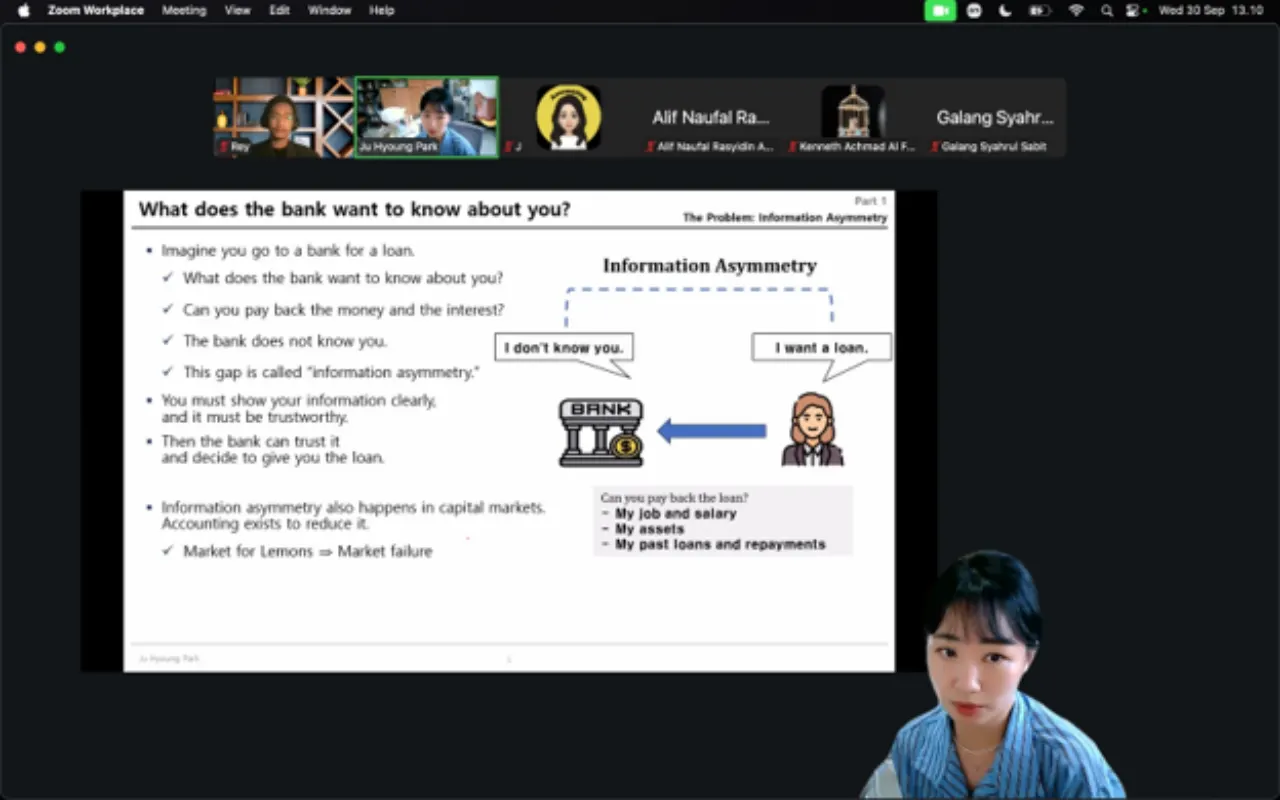
SEMARANG – The Faculty of Social and Political Sciences (FISIP), Universitas Diponegoro (Undip), through its Bachelor of Business Administration Study Program, once again hosted the Undip Global Classroom. The event featured Ju Hyoung Park, Ph.D., an Assistant Professor from the College of Business, Hallym University, Korea, as the guest speaker, presenting the topic “Information Asymmetry, Corporate Disclosure, and Consumer Decision-Making in the Digital Age.”
The learning session took place virtually on Wednesday (Sept 30, 2026) via the Undip Global Classroom platform. Robetmi Jumpakita Pinem, Ph.D., from Universitas Diponegoro served as the discussant for the academic session.
In his presentation, Ju Hyoung Park explained the concept of information asymmetry as a condition where one party possesses more information than the other. He illustrated this through the scenario of an individual applying for a bank loan: the bank needs to assess whether the prospective borrower can repay the principal and interest, yet it lacks the full scope of information regarding the applicant’s true financial condition.
The discussion then touched upon the “Market for Lemons” concept, introduced by George Akerlof in 1970. Using the used car market as an example, he explained how information limitations can make it difficult for buyers to distinguish between high-quality and low-quality products. This situation often drives buyers to offer lower prices, which may ultimately push sellers of high-quality products to leave the market, leading to market failure.
This information asymmetry also manifests in the relationship between companies and consumers. While companies hold detailed information regarding product safety, financial standing, and fund allocation, consumers frequently rely on available advertisements, online reviews, and pricing to make decisions. Consequently, consumers face the risk of receiving products or services that fall short of their expectations.
To bridge this information gap, the session highlighted the roles of accounting and disclosure. Accounting was explained as an information system that delivers meaningful insights to assist stakeholders in decision-making. When a company reveals this data to users, the process is referred to as disclosure.
In this context, accounting information serves a much broader audience than just shareholders and creditors; it is also utilized by governments, consumers, business partners, and managers for various strategic decisions. The presentation emphasized that while companies inherently possess greater information compared to external users, transparent disclosure plays a critical role in closing that divide.
The discussion then moved to financial statements and audit reports. Financial statements provide clarity on a company’s financial position at a given point in time—detailing assets, liabilities, and equity—while summarizing operational performance over a period through revenues and expenses. To ensure accuracy and consistency, these statements must comply with accounting regulations or Generally Accepted Accounting Principles (GAAP).
To enhance credibility in such information, an audit by an external auditor is required. Auditors examine whether the financial statements comply with accounting standards and gather the necessary evidence before issuing an audit report. The auditor’s opinion then provides clarity on the level of reliability of the figures presented in the financial statements.
Ju Hyoung Park also explained the distinction between mandatory disclosure and voluntary disclosure. Mandatory disclosure refers to information that companies are legally required to present, such as financial statements and audit reports. On the other hand, voluntary disclosure includes information that companies choose to disclose, such as sustainability reports and ESG metrics.
In discussing transparency, the session emphasized that trust plays a vital role in disclosure, as it directly addresses information asymmetry. Transparency goes beyond how information is produced; it also concerns whether that information is accessible to the public. Highlighting practice in Korea and Indonesia, the presentation introduced DART and the Indonesia Stock Exchange (IDX) website as official channels for accessing corporate information.
The next session addressed the concept of “Buying a Promise: Reading Mandatory Disclosure.” Consumers in various transactions frequently pay upfront in exchange for a promise to receive benefits in the future—examples include insurance, vehicle and home appliance repair services, prepaid cards, memberships, and e-wallets. Because the benefits are realized later, consumers need to evaluate whether the company is capable of fulfilling those commitments.
To assess a company’s ability to keep its promises, consumers can look at key information within financial statements. For instance, the warranty provision reflects reserves set aside for future repair costs, while the solvency ratio indicates an insurance company’s ability to meet future claims. Additionally, assets, liabilities, cash flow, profit, and the audit opinion serve as critical indicators of the firm’s overall financial health.
The presentation also highlighted the Jiwasraya case as an example of a company failing to fulfill its commitments to customers. In that instance, policyholders had deposited funds expecting future payouts and returns. The session demonstrated how solvency ratios and audit opinions could have served as vital information for consumers to identify potential risks.
Beyond financial metrics, the discussion highlighted the growing importance of ESG disclosure. Financial statements have inherent limitations, as they only reflect matters that can be quantified in monetary terms. Meanwhile, risks such as product safety, environmental pollution, and labor practices may not be immediately visible through numbers alone. ESG disclosures provide valuable insights into Environment, Social, and Governance dimensions, uncovering non-financial risks that aren’t directly captured in traditional financial reports.
To illustrate this, the presentation touched upon the humidifier disinfectant tragedy in Korea. Humidifier disinfectant products had been on the market for years, with Oxy—one of the products causing the greatest impact—being introduced in 2000. It was explained that the product was sold without proper inhalation safety testing, leaving consumers unaware of the associated hazards. This case underscores how severe information asymmetry can stem from risks that financial statements cannot capture directly.
The discussion then moved to the concept of greenwashing—a situation where a company presents itself as more environmentally friendly than it actually is. As voluntary disclosures follow a more flexible format, companies can selectively choose which information to showcase. Consequently, consumers are encouraged to look beyond surface-level claims in reports and examine concrete actions and supporting data.
In the final part, Ju Hyoung Park presented “A Smart Consumer’s Checklist” to summarize the session. Consumers can evaluate debt, cash, and solvency ratios when assessing a company’s ability to return funds; check warranty provisions and profits to gauge the capacity for fulfilling repair promises; review audit opinions to judge the credibility of reported figures; examine contingent liabilities to spot hidden risks; and consult ESG or sustainability reports to evaluate environmental, social, and governance aspects.
The core message conveyed during the session was the distinction between information shared through advertising and data that companies are legally mandated to report. The presentation underscored that while advertising tells consumers what a company wants to say, financial reporting delivers what a company must declare.
The participation of Ju Hyoung Park, Ph.D. from Hallym University in the Undip Global Classroom offered an international perspective on information asymmetry, corporate disclosure, accounting, ESG disclosure, and consumer decision-making. Through conceptual explanations, case studies, and a practical consumer checklist, students gained a deeper understanding of the need to critically evaluate corporate information before making decisions.
Furthermore, this activity reinforces global-perspective learning within FISIP Undip by engaging international academics and addressing relevant business issues in today’s digital era.