

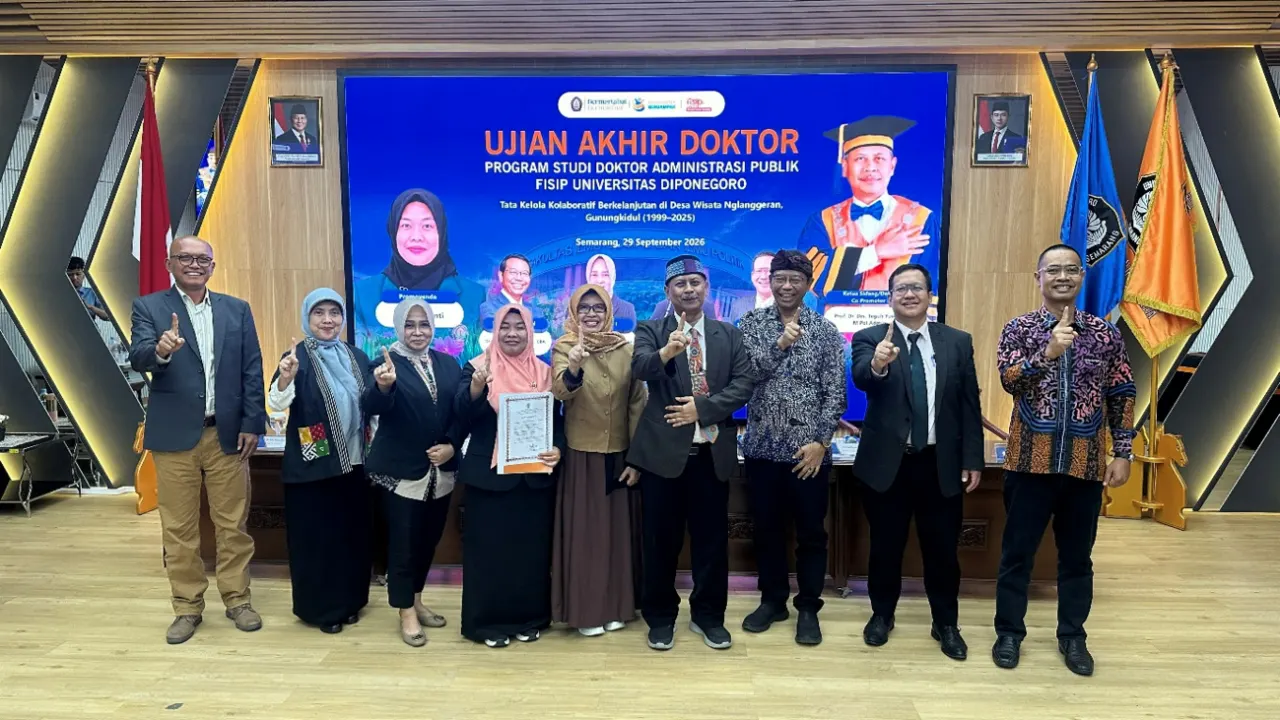
SEMARANG (29/9) The phenomenon of tourism village growth across the country often faces its own paradox: flourishing at the outset but fragile when confronted with the test of leadership turnover and crises. Driven by concern over the reality of thousands of tourism villages that struggle to develop independently, Dwi Kristanti successfully defended her dissertation in the Final Dissertation Examination of the Doctoral Program in Public Administration (DAP), Faculty of Social and Political Sciences (FISIP), Diponegoro University (Undip), held on Tuesday (29/9/2026) from 1:00 PM WIB until completion in the Theater Room of FISIP Undip, Tembalang Campus, Semarang.
Before the board of examiners and invited guests, Dwi presented the results of her in-depth study entitled “Sustainable Collaborative Governance in Nglanggeran Tourism Village, Gunungkidul (1999–2025).” This longitudinal research, spanning more than two decades, traced the metamorphosis of the Nglanggeran area—beginning from the environmental crisis of the late 1990s when the Ancient Volcano hills were still barren and residents suffered from water scarcity, to its rise as a world model village and its attainment of the Best Tourism Villages title from the United Nations World Tourism Organization (UNWTO) in 2021.
The examination proceeded dynamically and was led directly by the Dean of FISIP Undip, Prof. Dr. Drs. Teguh Yuwono, M.Pol.Admin., who also served as Co-Promotor II. The team of supervisors and examiners was further strengthened by Prof. Dr. Dra. Hartuti Purnaweni, MPA, as Promotor, Dr. Ida Hayu Dwimawanti, M.M., as Co-Promotor I, and Dr. Amni Zarkasyi Rahman, M.Si., who served as Secretary of the Examination, Head of the Doctoral Program in Public Administration at Undip, and also as a member of the board of examiners. This academic examination gained further depth with the presence of a renowned Indonesian public policy expert, Dr. Riant Nugroho, M.Si., who acted as an external examiner to test the criticality of the methodology as well as the practical contribution of the dissertation’s findings.
The theater room appeared lively and solemn with approximately 65 participants in attendance, including the core leadership of the Faculty of Law, Social, and Political Sciences of Universitas Terbuka (FHISIP UT). Present in person to provide moral support were, among others, the Dean of FHISIP UT, Dr. Meita Istianda, S.I.P., M.Si., the Vice Dean for Resources and General Affairs, Yanti Hermawati, S.Sos.I., M.Si., the Vice Dean for Student Affairs, Learning Services, and Cooperation, Anto Hidayat, S.IP., M.Si., as well as the Head of the Public Administration Study Program at UT, Dr. Eha Saleha, S.A.N., M.Si. Also present to witness this procession were the Director of UT Semarang, Dr. Iqbal Miftakhul Mujtahid, S.IP., M.Si., along with the Director of UT Surakarta, Dr. Agus Joko Purwanto, M.Si.
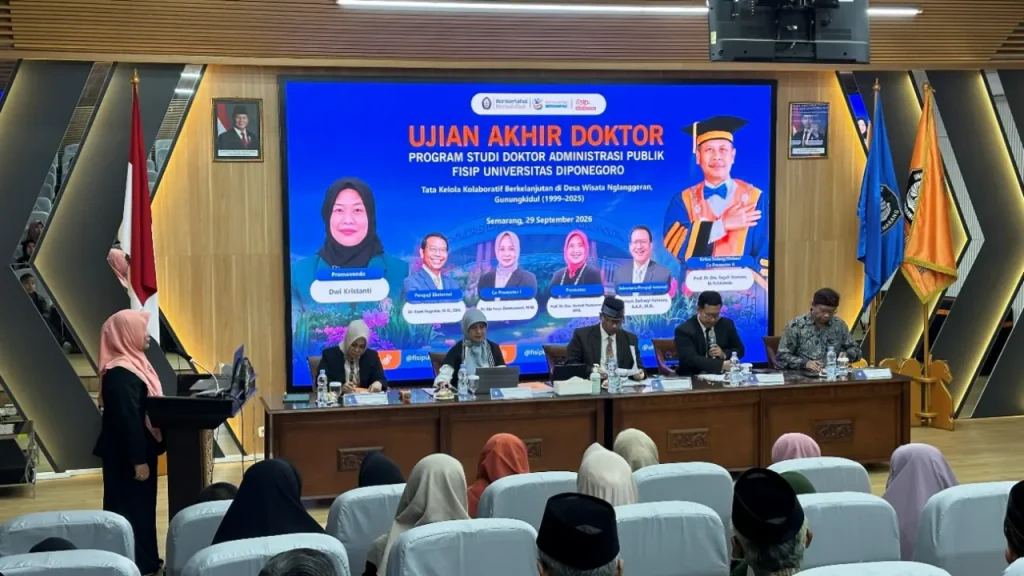
Using the process tracing method and a scientifically tested collaborative framework, Dwi successfully formulated a conceptual novelty that she named the “Tumpang Sari Governance Model.” This model adopts the philosophy of agrarian local wisdom, in which the success of community collaboration is not built instantly through formal rules on paper alone, but is nurtured through servant leadership, trust among residents based on performance evidence, layered deliberation, and sustainable cross-generational regeneration of administrators. This concept simultaneously addresses the weaknesses of governance in pioneering tourism villages that have thus far been trapped in the formality of pseudo-institutions.
Met after the examination, the Head of the Doctoral Program in Public Administration at FISIP Undip and also a public governance expert, Dr. Amni Zarkasyi Rahman, M.Si., emphasized that this dissertation work is a tangible reflection of the quality and research climate consistently built at DAP Undip. Dr. Amni emphasized that choosing the Doctoral Program in Public Administration at Undip is a strategic step because the curriculum offered does not merely dwell on theoretical maturity but is sharply designed to respond to and dissect the dynamics of public governance, transformative leadership, and contemporary policy in the field. Supported by a high-standard academic ecosystem, direct guidance from leading experts, and extensive research collaboration networks, the Doctoral Program in Public Administration at Undip continues to solidify its position as Indonesia’s leading crucible for academics and practitioners determined to make tangible contributions to the reform of the nation’s governance.
Welcoming the enthusiasm of prospective students wishing to pursue doctoral studies, registration for new students of the Doctoral Program in Public Administration is currently officially open through the Independent Examination (UM) pathway for Postgraduate Studies at Undip. To accommodate the diverse profile needs of prospective students, the study program offers two lecture pathway schemes: the by research class and the by course class. The admission process is opened in two waves, with Wave 1 running from September 1 to November 4, 2026, followed by Wave 2, which opens from November 5, 2026, to January 12, 2027. Complete information regarding requirements, registration procedures, and selection schedules can be accessed directly through the official portal at https://pmb.undip.ac.id/pascasarjana/jalur-um/