

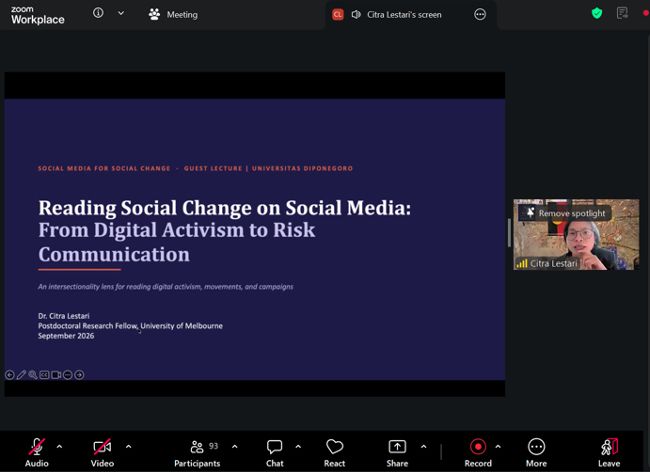
Semarang – The Media, Culture, and Gender Research Cluster (KBK Media, Budaya dan Gender), Faculty of Social and Political Sciences, Universitas Diponegoro (FISIP UNDIP), held an UNDIP Global Classroom (UGC) session entitled “Reading Social Change on Social Media: From Digital Activism to Risk Communication” on Tuesday, 29 September 2026. The session featured Dr. Citra Lestari, Postdoctoral Research Fellow at the University of Melbourne, Australia, as the guest speaker.
The opening remarks were delivered by S. Rouli Manalu, PhD, Vice Dean for Academic and Student Affairs of FISIP UNDIP, on behalf of the Dean of FISIP UNDIP, Prof. Dr. Drs. Teguh Yuwono, M.Pol.Admin. In her remarks, Rouli encouraged students to actively participate throughout the session and to use the opportunity to gain new perspectives on social and communication phenomena in digital spaces.
Citra opened the discussion with a fundamental question: what is social change? The question immediately prompted a variety of responses from the participants. Building on their answers, she then took the discussion further by asking who the actors behind social change are, how their networks are formed, and how social relations and structures of power shape processes of change.
Rather than treating social media merely as a tool for running social change campaigns, the session invited students to read social media conversations through an intersectionality lens—asking what can be discussed, questioned, and learned from the conversations, debates, and public responses that emerge online.
To introduce this perspective, Citra presented a case involving public responses to social-issue content posted by a public figure. The case became an entry point for discussing how a person’s social position may influence both the production of a message and the way it is received by the public. Students were encouraged to ask whose voices dominate a conversation, whose voices are missing, why some forms of activism receive greater support than others, and who ultimately has the power to determine whether a campaign is considered right or wrong.
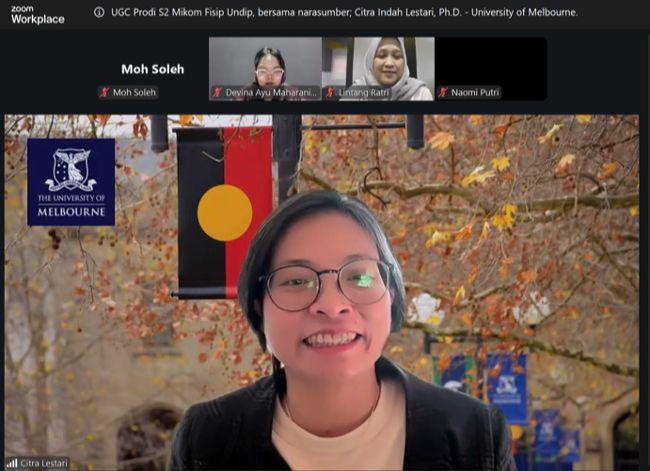
The discussion was then deepened through intersectionality as an analytical tool. This perspective understands social experience as being shaped not by a single factor, but by the intersection of various social positions and structures, including gender, class, race, and power relations. In applying intersectionality analytically, Citra highlighted four key themes: social inequality, power, relationality, and social context.
The same perspective was then used to examine other cases, including COVID-19 health protocol campaigns. Citra demonstrated that seemingly universal messages—such as staying at home or always wearing a mask—could not necessarily be followed in the same way by everyone. Informal workers dependent on daily income, women carrying unpaid care responsibilities, and people living in densely populated housing faced different structural conditions in responding to risk.
From there, the discussion moved from digital activism to risk communication. Drawing on her research on risk communication during the pandemic, Citra highlighted the limitations of behavioural change approaches that focus too heavily on individual responsibility. Such approaches may overlook structural barriers and the lived realities of people experiencing intersecting vulnerabilities.
The presentation prompted students to connect the analytical framework with phenomena they encounter in everyday life. Several participants asked how a social change perspective could be used to examine contemporary cases on social media, including cancel culture and public reactions to statements made by celebrities and other public figures.
The interaction also extended into research-related discussions. One student, for example, not only raised a question but also shared a research idea currently being developed. Citra then helped the student explore possible perspectives and analytical questions that could be used to approach the topic.
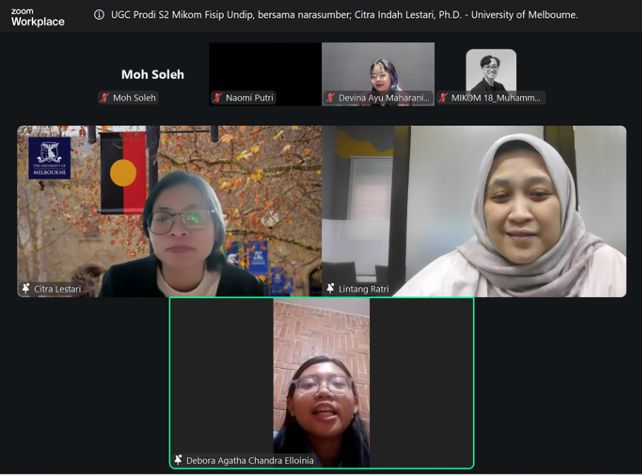
The session remained highly interactive, as the lecture was not conducted as a one-way presentation. Participants actively connected everyday experiences, social media cases, and academic projects they were working on with the concepts discussed during the session. Dr. Lintang Ratri Rahmiaji, S.Sos., M.Si., as moderator, helped guide the discussion and connect participants’ questions with the themes developed by the speaker. From the beginning of the event, the participants’ enthusiasm was also built by Devina Ayu Maharani, an undergraduate student of Communication Studies at FISIP UNDIP, who served as the master of ceremonies.
Toward the end of the session, Citra emphasized the importance of moving beyond binary ways of thinking, such as rational versus emotional or compliant versus non-compliant. Through intersectionality, students were encouraged to understand that people’s decisions are always situated within particular social contexts and shaped by power relations that influence how they perceive, interpret, and respond to an issue.
Through this UNDIP Global Classroom, the Media, Culture, and Gender Research Cluster of FISIP UNDIP provided a learning space that brought together discussions on digital media, social change, intersectionality, and risk communication, while also giving students the opportunity to apply these concepts to issues they encounter in everyday life and in their own academic work.