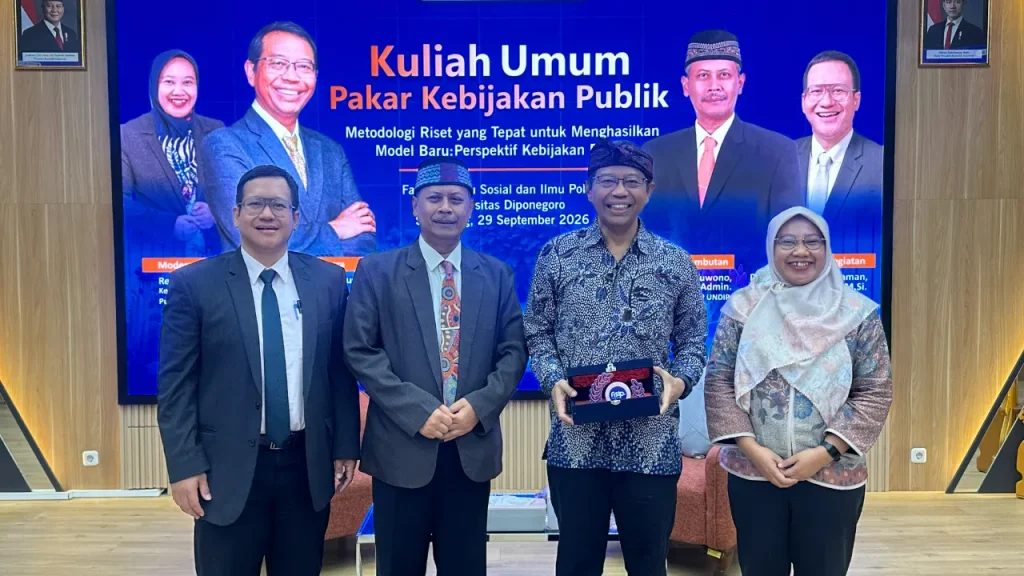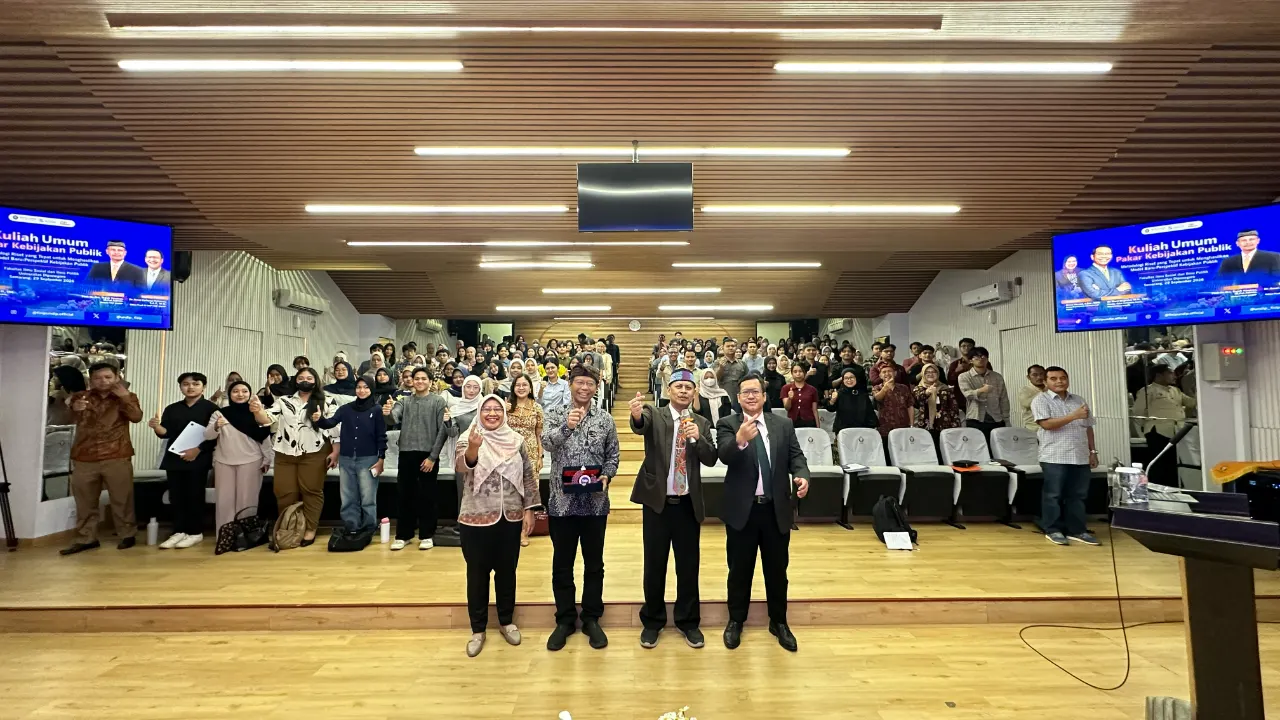
Semarang, September 29, 2026 – The Faculty of Social and Political Sciences, Diponegoro University, through the Doctoral Program in Public Administration, held a Public Lecture by a Public Policy Expert with the theme “The Right Research Methodology to Produce New Models: A Public Policy Perspective” on Tuesday, September 29, 2026. The event took place from 9:00 AM to 12:00 PM WIB at the Theater Room of the Faculty of Social and Political Sciences, Diponegoro University.
The public lecture featured Dr. Riant Nugroho, M.Si., an author, public policy expert, and Chairman of the Indonesian Public Policy Society (MAKPI), as the keynote speaker. The presence of a public policy expert in this academic forum provided a space for students, lecturers, and researchers to deepen their understanding of the relationship between research methodology and the development of new knowledge in public policy studies.
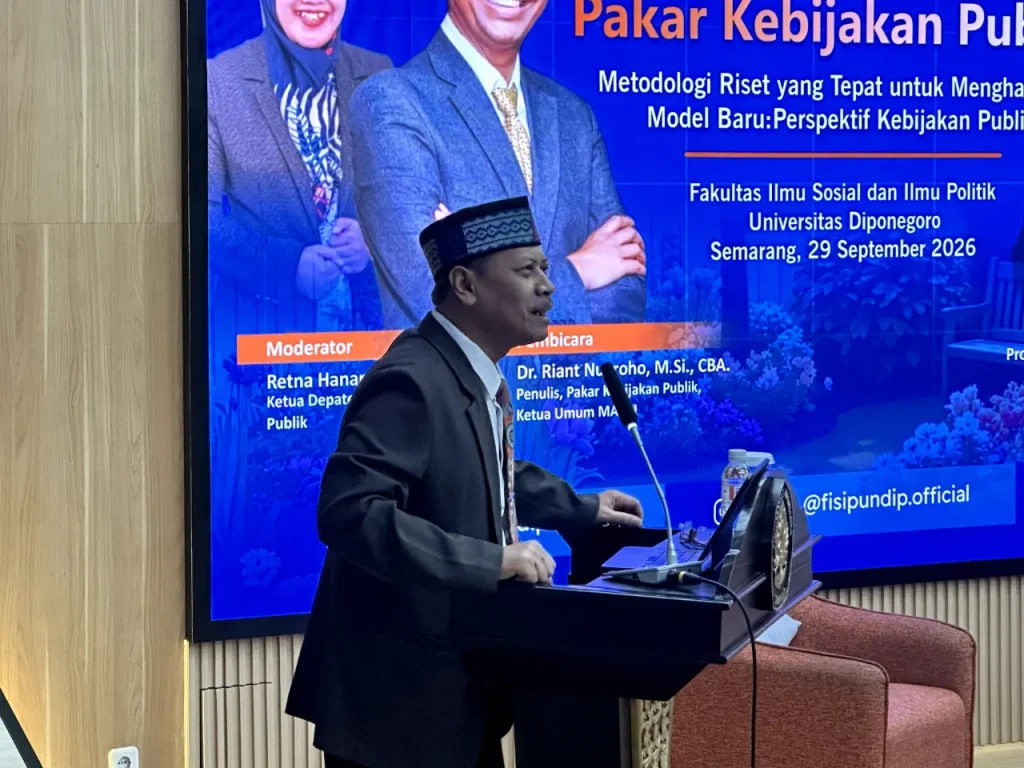
The event was opened by Prof. Dr. Drs. Teguh Yuwono, M.Pol.Admin., Dean of FISIP UNDIP. The activity report was delivered by Dr. Amni Zarkasyi Rahman, S.A.P., M.Si., Head of the Doctoral Program in Public Administration at FISIP UNDIP, while the discussion was moderated by Retna Hanani, S.Sos., MPP, Head of the Department of Public Administration at FISIP UNDIP.
The theme of the public lecture positioned research methodology as an important part of the development of administrative science and public policy. Research does not stop at the activity of collecting and processing data; it must be built upon strong research questions, appropriate conceptual frameworks, and methodological strategies capable of explaining policy phenomena systematically.
In the context of doctoral education, the ability to design research that produces theoretical contributions is one of the important aspects of developing students’ academic capacity. Research at the doctoral level is expected not merely to repeat the use of existing concepts or models but also to be able to test, refine, develop, or offer new conceptual constructions based on research findings that can be scientifically accounted for.
This public lecture served as a forum to strengthen understanding of how methodological choices must be aligned with the research problem and the scientific objectives to be achieved. In public policy research, methodological accuracy holds a strategic position because policy issues generally involve complex relationships between institutions, actors, interests, decision-making processes, implementation, and the impact of policies on society.

Through this activity, the Doctoral Program in Public Administration at FISIP UNDIP continues to encourage the development of an academic tradition that places depth of analysis, methodological accuracy, and scientific contribution as important parts of the research process. This orientation is necessary to produce public administration research that not only meets academic standards but is also relevant to issues of governance and public policy.
This activity is also part of FISIP UNDIP’s effort to bring the academic environment together with experts and scholarly practitioners at the national level. This kind of exchange of ideas is expected to broaden students’ perspectives while strengthening academic networks in the development of public administration and public policy knowledge.
For FISIP UNDIP, strengthening research quality is an important part of supporting the achievement of academic performance and institutional reputation. Higher education institutions are not only required to produce publications but also knowledge that possesses novelty, relevance, and contribution to the development of science as well as the resolution of public problems.
Through the organization of this Public Lecture by a Public Policy Expert, FISIP UNDIP reaffirms its commitment to continuously building a postgraduate education ecosystem that is critical, methodological, and productive. Strengthening the research capacity of students and lecturers is expected to support FISIP UNDIP’s vision as a faculty that is Dignified and Beneficial, while also becoming increasingly competitive in the development of social and political sciences at both national and global levels.