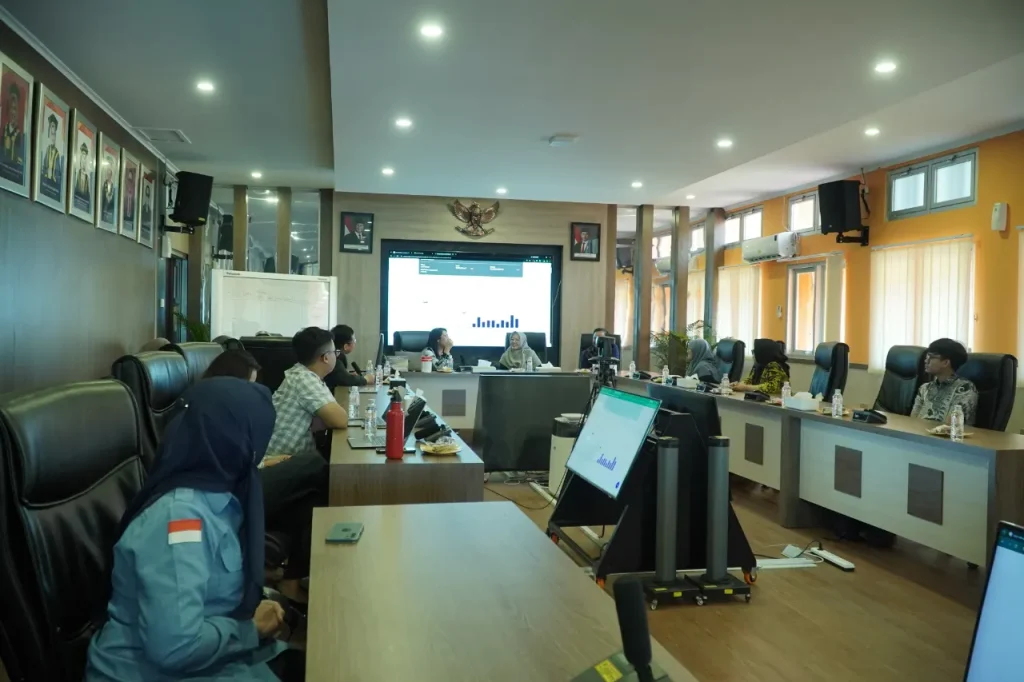
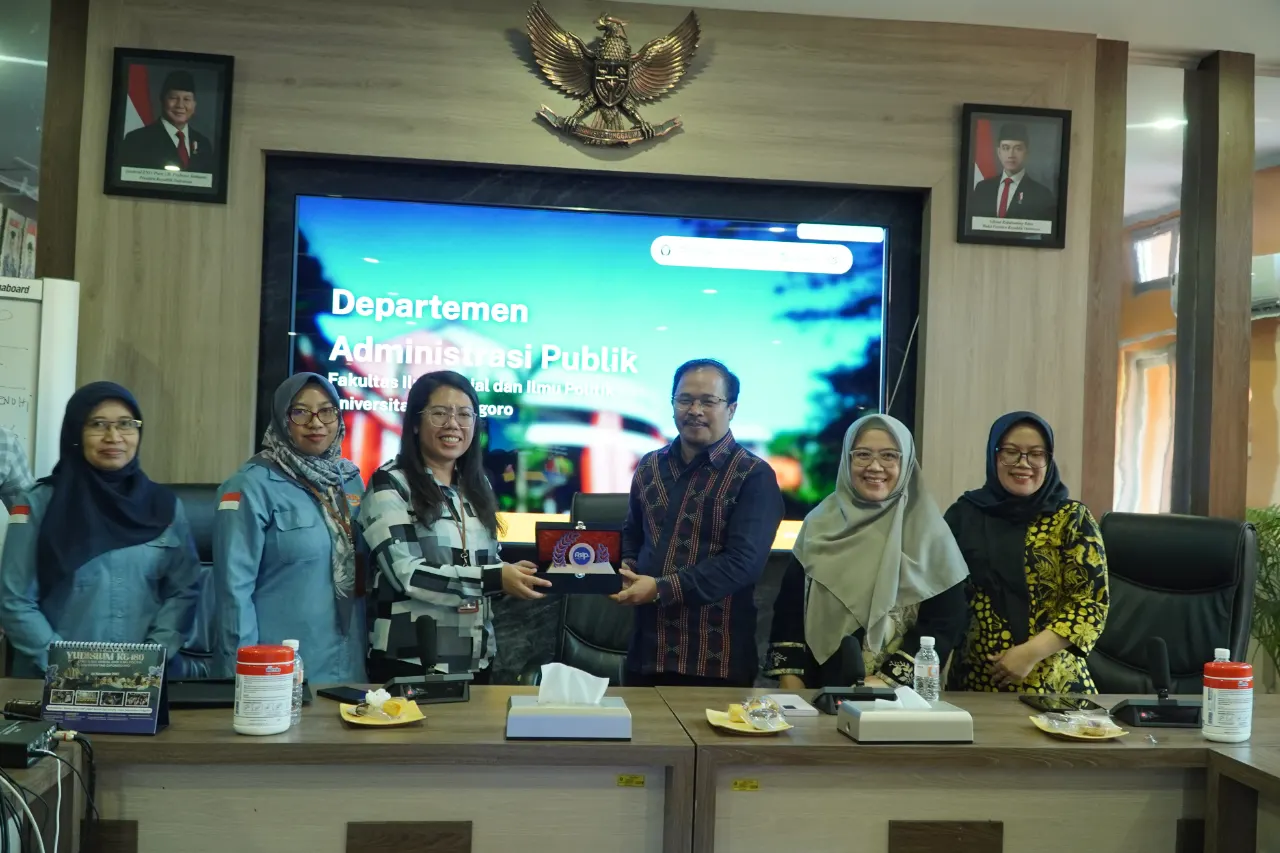
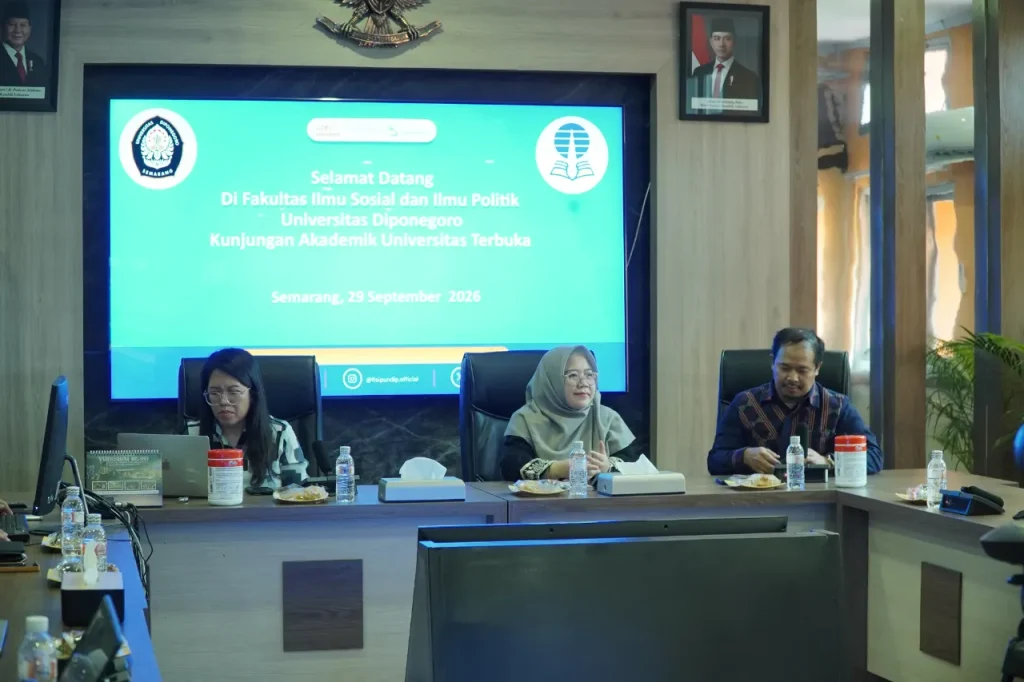
Semarang, September 29, 2026 – The Faculty of Social and Political Sciences (FISIP), Diponegoro University (Undip), received a benchmarking visit from the Undergraduate Public Administration Study Program of Universitas Terbuka (UT) on Tuesday, September 29, 2026. This activity is part of the effort to strengthen academic networks and open space for the exchange of experiences between higher education institutions in the development of higher education in the field of Public Administration.
As one of the academic institutions that continues to develop excellence in education, research, and community service, FISIP Undip, through the Department of Public Administration, actively builds networks and collaboration with various higher education institutions. The Department of Public Administration at FISIP Undip itself holds recognition through national accreditation of “Excellent” (Unggul) from BAN-PT as well as international accreditation from FIBAA, while also developing a scholarly orientation that places publicness, collaboration, and sustainability as the foundation in the implementation of education, research, and community service.
The benchmarking activity was opened by Mrs. S. Rouli Manalu, S.Sos., M.Comm.St., Ph.D., as Vice Dean I for Academic and Student Affairs at FISIP Undip. In her opening remarks, benchmarking was viewed as an important momentum to strengthen institutional relationships and the exchange of experiences between campuses, particularly in the development of education and the management of the Public Administration Study Program.
The visit was also attended by Dr. Amni Zarkasyi Rahman, S.A.P., M.Si., as the Head of the Doctoral Program in Public Administration at FISIP Undip, as well as lecturers from the Department of Public Administration at FISIP Undip. The presence of faculty leadership, study program managers, and lecturers demonstrates the importance of benchmarking activities as a space for academic dialogue that is not only related to administrative aspects but also touches on scholarly development and the strategic direction of Public Administration education.
In the profile presentation session, the Department of Public Administration at FISIP Undip introduced the department’s development, the structure of its fields of expertise, its vision and scholarly orientation, as well as the implementation of its Public Administration education programs. The Department of Public Administration at FISIP Undip currently oversees six Academic Expertise Clusters (KBK): the Public Sector Collaboration KBK, Public Governance KBK, Development Administration KBK, Public Policy KBK, Bureaucratic Reform KBK, and Public Service Management KBK. These six KBKs serve as the basis for scholarly development while strengthening the relationship between education, research, and community service.
At the undergraduate level, the Undergraduate Public Administration Study Program at FISIP Undip provides education that integrates theoretical foundations with practical application through case studies and project-based learning. The study program also has a Regular Program and an International Undergraduate Program (IUP) as part of its orientation toward the internationalization of education. The Undergraduate Public Administration curriculum comprises 145 credits with a combination of compulsory and elective courses, as well as the application of various learning methods such as project-based learning, simulations, seminars, and internships in public institutions.
In addition to discussing the implementation of undergraduate education, the benchmarking also provided space to introduce the academic ecosystem of Public Administration at FISIP Undip at broader levels of education. The Department of Public Administration at FISIP Undip provides education at the undergraduate, Master of Public Administration, and Doctoral levels, so that the scholarly development of Public Administration is built within a sustainable academic ecosystem from undergraduate to doctoral education. The Doctoral Program in Public Administration, for instance, develops two educational pathways: By Course and By Research, with an emphasis on developing competencies in research, analysis, and leadership in public governance.
In the context of internationalization, the Department of Public Administration at FISIP Undip also continues to develop various forms of academic cooperation through online and offline visiting professors, international research groups, staff exchanges, joint publications, adjunct professors, and various other international collaboration programs. These developments are part of the effort to build an academic ecosystem that is increasingly open to the exchange of knowledge and experiences across institutions and across countries.
The benchmarking between the Undergraduate Public Administration Study Program of Universitas Terbuka and the Undergraduate Public Administration Study Program of FISIP Undip then served as a space to exchange information regarding the implementation of education, curriculum development, study program governance, strengthening academic capacity, and developing institutional networks. This activity is also in line with the purpose of Universitas Terbuka’s visit, which was conducted to explore cooperation between the Undergraduate Public Administration Study Program of Universitas Terbuka and the Undergraduate Public Administration Study Program of Diponegoro University.
Through this activity, FISIP Undip and the Department of Public Administration reaffirm their commitment to continuously building collaboration and academic networks as part of strengthening the institution’s position in the development of Public Administration science. The meeting with Universitas Terbuka is expected to open opportunities for sustainable cooperation in the fields of education, research, community service, and academic capacity development, while also strengthening FISIP Undip’s role as a higher education institution that contributes to the development of innovative, collaborative, and sustainable public governance.