

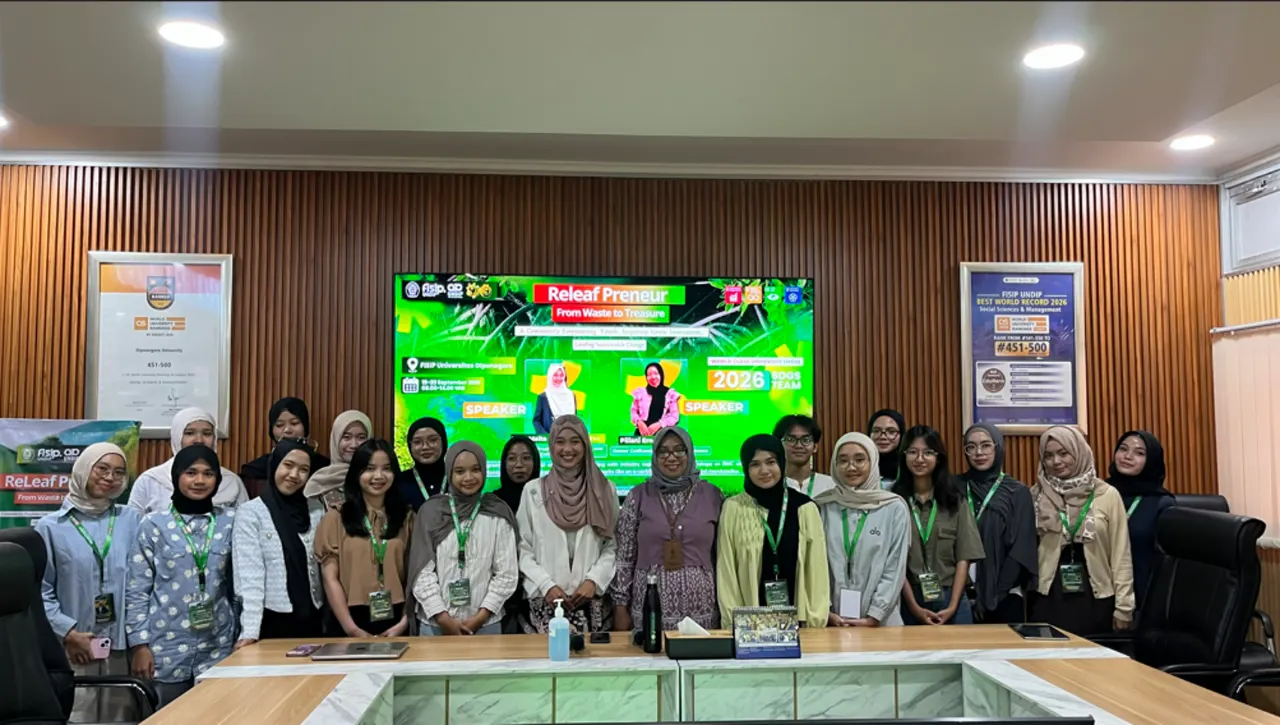
Semarang — The transformation toward a World Class University (WCU) is not only built through academic reputation and international networks but also through the ability of higher education institutions to translate global agendas into concrete action at the local level. This spirit is manifested by FISIP Diponegoro University and the Department of Public Administration through strengthening student involvement in the Sustainable Development Goals (SDGs) agenda, one of which is through the ReLeaf Preneur 2026 activity, which invites students to transform waste issues into spaces for innovation, entrepreneurship, and the creation of economic value.
Carrying the theme “From Waste to Treasure,” this activity—initiated by the Student SDGs Community of the Department of Public Administration, FISIP Diponegoro University—encourages students to view waste not merely as an environmental problem but also as an opportunity to create productive and sustainable solutions. The program integrates SDG 8: Decent Work and Economic Growth, SDG 12: Responsible Consumption and Production, and SDG 13: Climate Action.
Through this theme, ReLeaf Preneur demonstrates that environmental awareness and entrepreneurship are not two separate agendas. Both can be brought together through ecopreneurship, an entrepreneurial approach that combines the creation of economic value with the resolution of environmental problems. The activity, held over two days on September 19–20, 2026, served as a space for students to gain knowledge as well as experience in developing sustainability-based business ideas.
On September 19, 2026, the activity began with an Ecopreneur Talk featuring Putri Melta Sari, S.Sos., CML., Co-Founder of Trash Ranger. This session built participants’ understanding of the importance of sustainable entrepreneurship, particularly in seeing the potential of waste to be processed into products with practical and economic value. The series then continued with a Business Model Canvas (BMC) Workshop delivered by Piliani Ernawati, A.Md., Owner of Craftonesia. Through this session, participants were equipped with an understanding of systematically developing a business model using the Business Model Canvas approach. The first day’s activities concluded with a Focus Group Discussion (FGD) in groups to discuss and develop the BMC assignment that had been given.
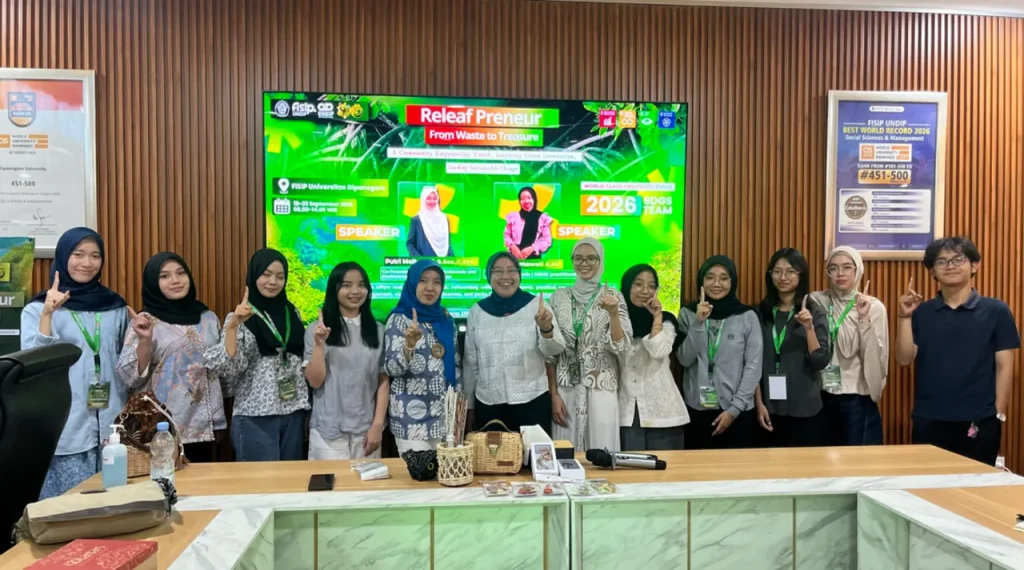
On the second day, September 20, 2026, participants attended a Project Management Workshop, again guided by Piliani Ernawati, A.Md. This material equipped participants with an understanding of managing the implementation process, so that business development does not stop at ideas and business models but also pays attention to the execution process. The series of activities then concluded with a Creative Day Workshop, which provided participants with hands-on experience in processing newspaper waste into keychains. This activity was part of ReLeaf Preneur’s effort to bring together knowledge of sustainable entrepreneurship with the practice of utilizing waste into valuable products.
More than just a student entrepreneurship activity, ReLeaf Preneur is part of the commitment of FISIP Diponegoro University and the Department of Public Administration to build an academic ecosystem that is increasingly connected to the global development agenda. Strengthening the SDGs at the student level also supports Undip’s orientation toward becoming a World Class University, as the internationalization of higher education is not only determined by networks and global recognition but also by the tangible contributions of the academic community in addressing sustainability challenges.
Through initiatives such as ReLeaf Preneur, the Department of Public Administration encourages students not to stop as learners in the classroom but to develop into problem solvers capable of connecting knowledge, innovation, entrepreneurship, and environmental awareness. From waste that is often regarded as worthless, students learn that the change toward a more sustainable future can begin with simple ideas that are transformed into concrete action. This is a form of local contribution that strengthens FISIP Undip’s global vision: building world-class education that remains grounded in solving societal problems, the principles of publicness, and the achievement of the Sustainable Development Goals.