

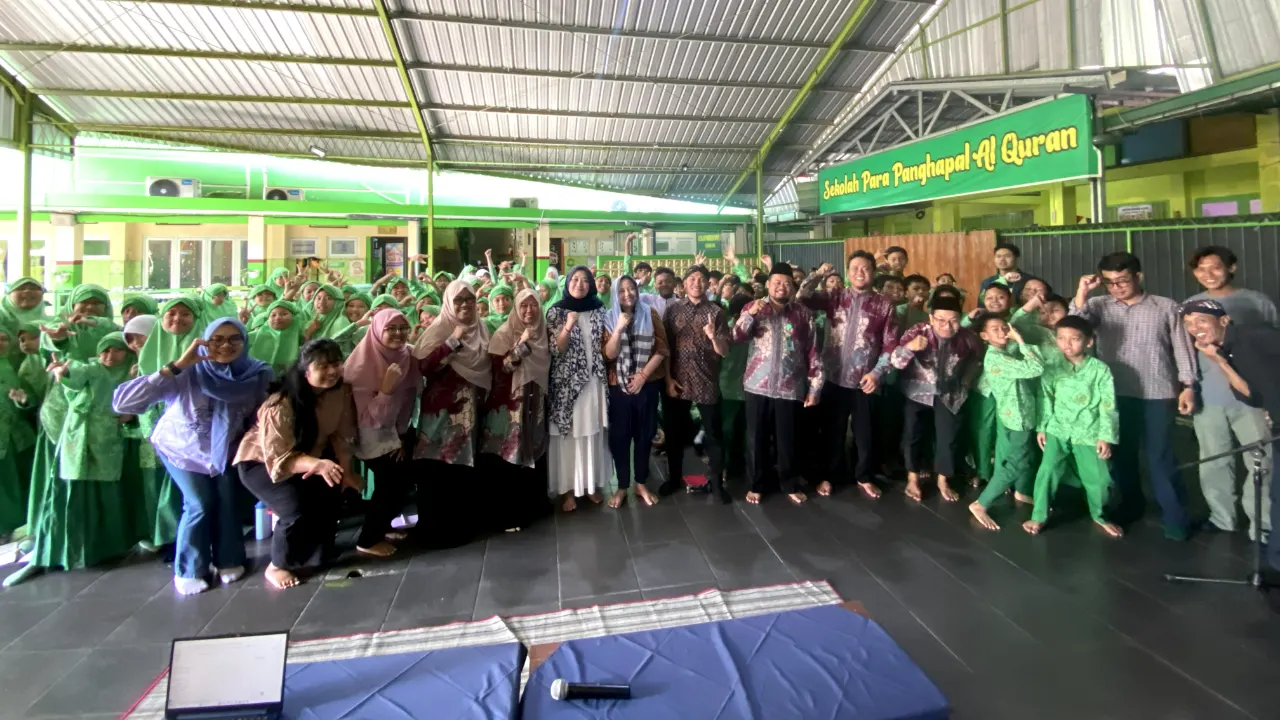
SEMARANG, September 23, 2026 – The increasingly close relationship between children and device usage has prompted the Media, Culture, and Gender Expertise Cluster (KBK) of the Department of Communication Science, Faculty of Social and Political Sciences (FISIP), Diponegoro University (Undip), to provide digital literacy education for students of SD Islam (SDI) Pangeran Diponegoro Semarang on Wednesday (23/9). Through a storytelling approach, students were invited to understand the importance of limiting screen time, preventing cyberbullying, and applying the principle of “filter before sharing” in digital activities.
The Community Service activity entitled “Literacy on Limiting Screen Time through Storytelling for Elementary School Students in Semarang City” took place from 7:30 AM to 9:30 AM WIB. Unlike conventional material delivery, the education was packaged through stories close to children’s lives so that messages about technology use could be received in a more enjoyable and easily understandable way.
The activity began with an opening by the Principal of SD Islam Pangeran Diponegoro Semarang, Ust. Khoiril Basyar, S.HI., S.Pd., as well as remarks from representatives of the community service team. After that, students participated in a storytelling session delivered by the Lanang Wadon team. Through storylines and characters close to children’s daily lives, students were introduced to the impacts of excessive device use as well as various situations that could potentially occur when interacting in digital spaces.
Not stopping at the delivery of the story, students were then invited to discuss through a question-and-answer session with Undip academics, Dr. Lintang Ratri Rahmiaji and M. Bayu Widagdo, M.I.Kom. This session became a space for students to reinforce their understanding of device usage limits, recognize cyberbullying, and understand the importance of thinking before uploading or sharing information on social media.
The students’ enthusiasm was evident throughout the activity. A number of students responded to questions and engaged in the interactions provided during the session. This interactive approach is an important part of delivering digital literacy to children, considering that understanding of digital spaces is not only related to the ability to use technology but also to how to use it safely and responsibly.
Through this activity, the Department of Communication Science at FISIP Undip strives to provide digital literacy education that suits children’s characteristics while also encouraging the formation of healthier digital habits from elementary school age.