

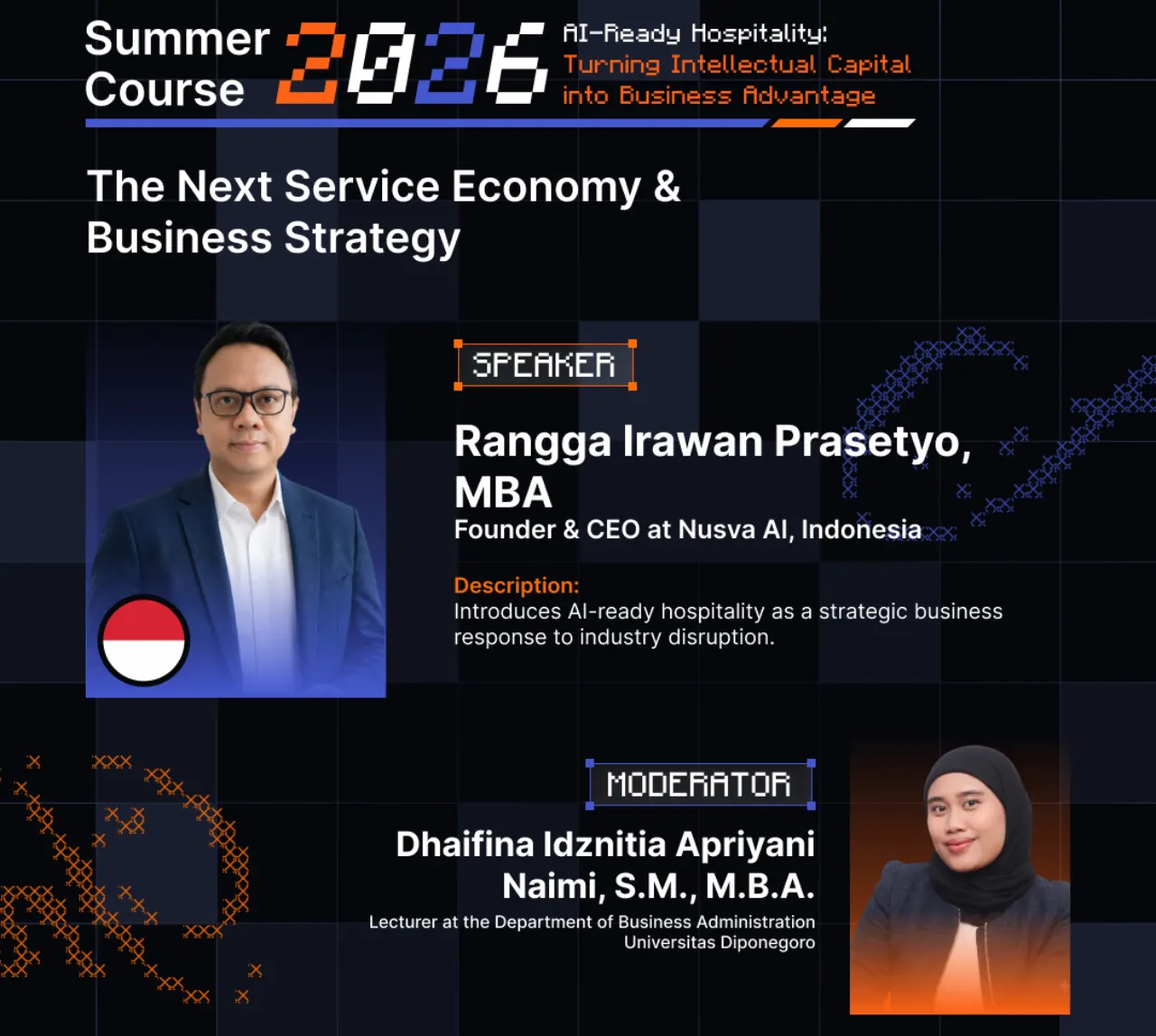
Semarang, September 22, 2026 – The Department of Business Administration, FISIP Universitas Diponegoro, continued its Summer Course 2026 series on Tuesday, September 22, 2026. Under the overarching theme “AI-Ready Hospitality: Turning Intellectual Capital into Business Advantage,” the fifth day focused on the topic “The Next Service Economy & Business Strategy.” The session featured Rangga Irawan Prasetyo, MBA, Founder & CEO of Nusva AI, Indonesia, as the keynote speaker.
The session served as part of a learning series bringing together domestic and international participants to examine AI-ready hospitality as a strategic business response to industrial disruption.
The session was moderated by Dhaifina Idznitia Apriyani Naimi, S.M., M.B.A., a lecturer in Business Administration at Universitas Diponegoro. Speaker Rangga Irawan Prasetyo, MBA, introduced himself as someone addressing the issue from three key perspectives: a former HR Director and IT lead at a hotel management operator overseeing 7 properties across 6 Indonesian cities; a cum laude MBA graduate from SBM ITB whose 2019 thesis focused on AI design within hotel operator HRMS; and the Founder and CEO of Nusva AI, building an AI-based workforce ecosystem. He is also the author of books on organizational design and leadership.
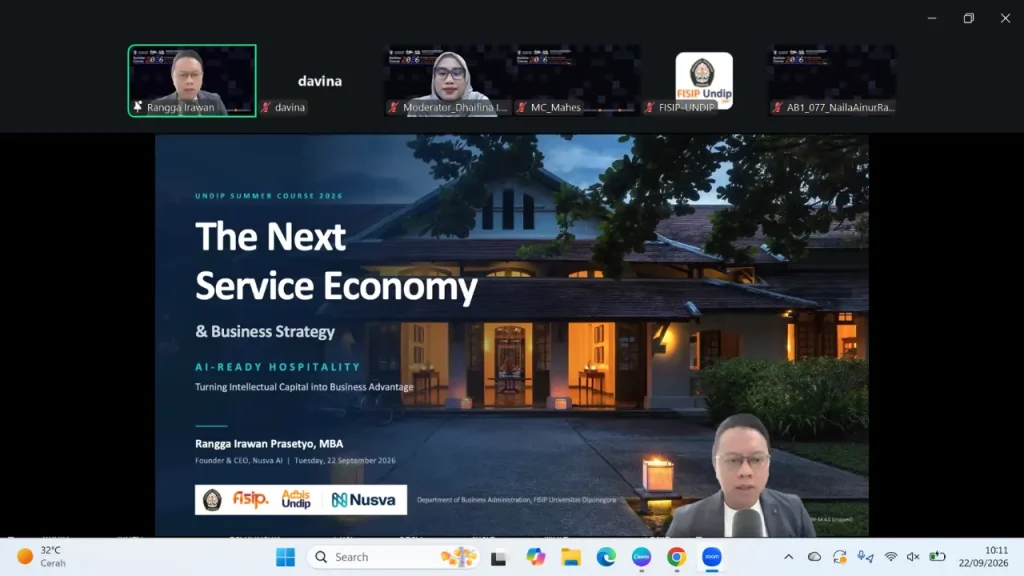
He opened his presentation by contrasting place and people: extraordinary places attract guests to arrive, but how they are welcomed inspires them to return. For centuries, hospitality has relied on direct connection between host and guest; today, however, AI introduces a new layer that responds, recommends, and increasingly handles bookings. Through a thought experiment involving two hotels with identical locations, pricing, booking engines, and AI systems, he asserted that if two competing hotels purchase the exact same AI, technology alone cannot serve as the reason guests choose one over the other. Tools that competitors can acquire tomorrow do not constitute a strategy. He then structured the session around Richard Rumelt’s strategic framework, focusing on diagnosis, guiding policy, and coherent action.
Through the session titled “The Next Service Economy & Business Strategy,” participants gained actionable insights into designing business strategies that go beyond merely adopting AI to building sustainable advantages rooted in an organization’s intellectual capital. This discussion further reinforced the central theme of Summer Course 2026 regarding the vital role of optimizing intellectual capital to navigate industry transformations.