

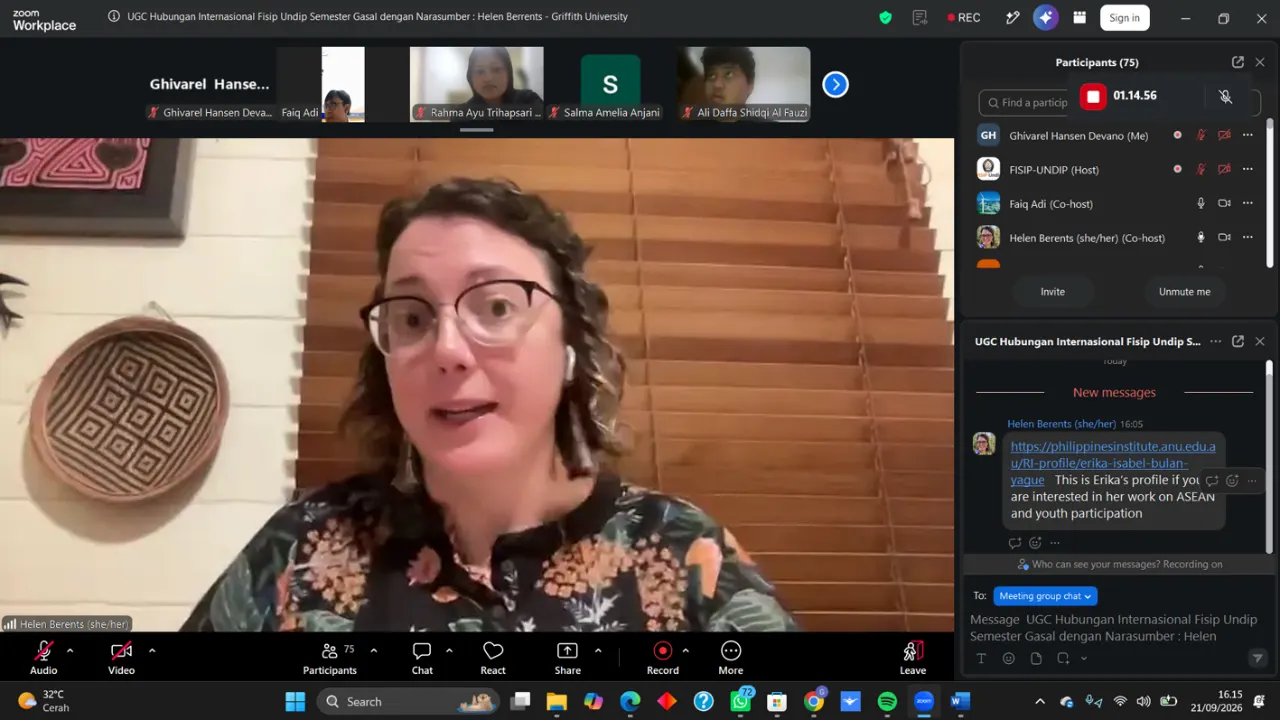
Semarang, September 21, 2026 — The Department of International Relations, Faculty of Social and Political Sciences, Diponegoro University (FISIP UNDIP), once again held the UNDIP Global Classroom, featuring Dr. Helen Berents from Griffith University, Australia. The activity, which took place within the War Crimes course, was moderated by Muhammad Faiq, a lecturer from the Department of International Relations at UNDIP.
In the session entitled “Youth-inclusive Peace & Mutually Reinforcing Peace Agendas,” Dr. Berents discussed the importance of viewing youth not only as a group affected by conflict but also as actors who possess experience, knowledge, and capacity in building peace. Much of the discussion drew from research she has developed in recent years, including through the Australian Research Council DECRA Fellowship on youth leadership and inclusion in the global Youth, Peace and Security agenda.
The session was interactive, involving students’ reflections on their own experiences as young people. Students were invited to discuss situations in which they felt they had not been fully involved, heard, or given space in decision-making processes. Dr. Berents welcomed these reflections enthusiastically, as students’ everyday experiences show that the issue of youth inclusion does not only arise in conflict contexts but also in various social and institutional spaces. This discussion helped connect the Youth, Peace and Security agenda with experiences closer to students’ lives.
Dr. Berents’ presence was also part of the continuously growing academic network between academics at Griffith University and Diponegoro University. This relationship has also been strengthened through research collaboration between Dr. Nadia Farabi and Prof. Ika Riswanti Putranti with Dr. Berents on social cohesion in Indonesia, particularly by examining the experiences and roles of young people in building and maintaining social cohesion. Through the UNDIP Global Classroom, the Department of International Relations at FISIP UNDIP continues to bring learning activities together with international research networks and collaborations. This activity is expected to provide space for students to interact directly with international academics while also seeing how peace issues discussed globally can also be reflected through their own experiences.