

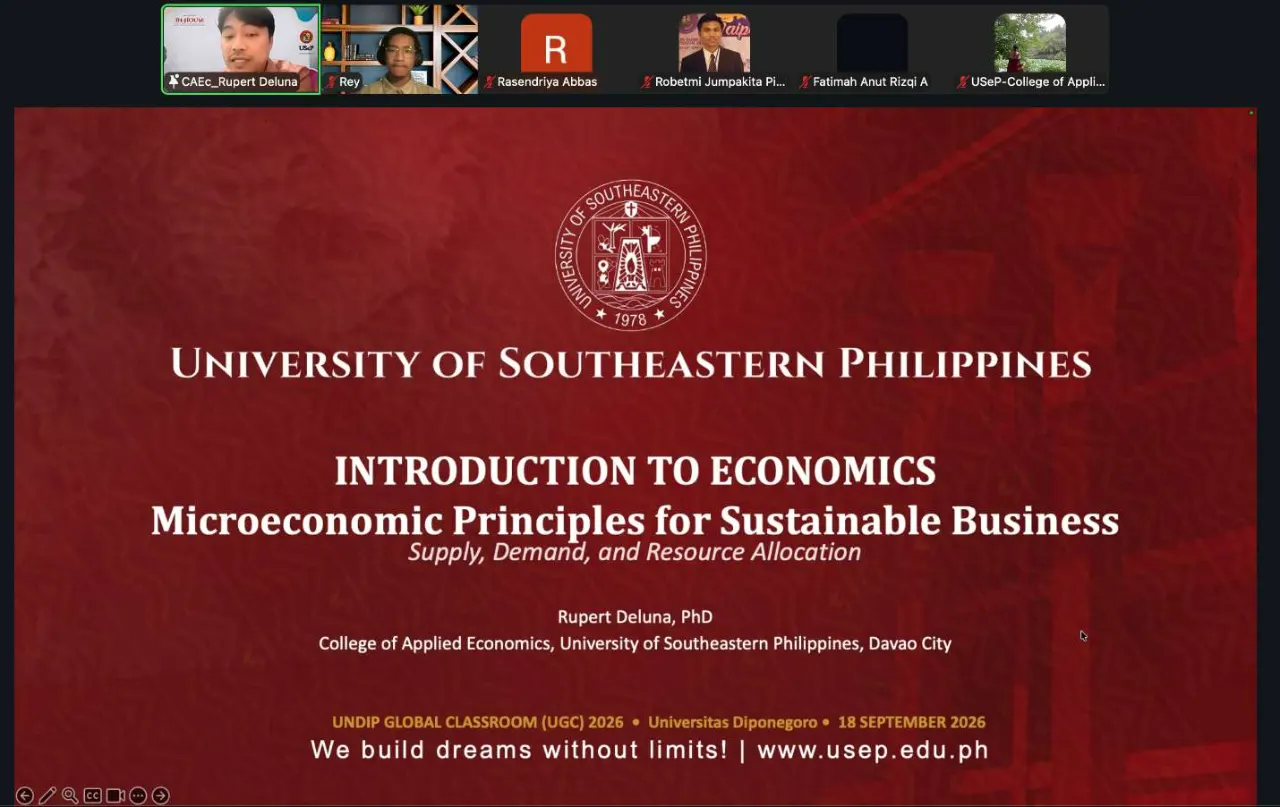
SEMARANG – The Faculty of Social and Political Sciences (FISIP) at Universitas Diponegoro (Undip), through its Bachelor of Business Administration Study Program, once again organized the Undip Global Classroom (UGC) 2026. Held online via Zoom on Monday (September 21, 2026), the event raised the topic “Microeconomic Principles for Sustainable Business: Supply, Demand, and Resource Allocation.”
The session, which formed part of the Introduction to Economics course, featured Dr. Roberto S. Deluna Jr. from the University of Southeastern Philippines as the speaker. Meanwhile, Robetmi Jumpakita Pinem, Ph.D., from Universitas Diponegoro served as the discussant for the academic session.
The lecture covered fundamental microeconomic principles relevant to sustainable business practices, focusing on demand, supply, market equilibrium, and resource allocation. The discussion aimed to help students understand how market mechanisms and changing economic conditions influence business decision-making.
In the session on demand, students explored the concept of the quantity of goods that consumers are willing and able to purchase at a given price level. The discussion also covered factors capable of shifting the demand curve, such as income, prices of related goods, consumer preferences, expectations, and the number of buyers. Furthermore, the material highlighted how shifting consumer preferences toward eco-friendly products drive demand in sustainable markets.
In addition to demand, the session addressed supply principles and the various factors influencing producers’ ability to supply goods or services. Fluctuations in input prices, technology, natural conditions, market expectations, and government policies were highlighted as key factors affecting supply.
The discussion then proceeded to market equilibrium—the condition where the quantity demanded equals the quantity supplied. Students were also introduced to the concepts of surplus and shortage, as well as how price adjustments drive the market toward equilibrium.
The sustainability dimension formed an integral part of the lesson through discussions on resource scarcity and market failure. The presentation detailed how issues such as pollution act as negative externalities when the costs imposed on third parties are not reflected in market prices.
Additionally, the session introduced several sustainable business frameworks, including carbon pricing, Extended Producer Responsibility (EPR), and the circular economy. These approaches were examined in relation to how economic policies and mechanisms can reshape cost structures and guide corporate decision-making.
Through the Undip Global Classroom, Bachelor of Business Administration students gained valuable exposure to an international academic perspective. The presence of Dr. Roberto S. Deluna Jr. from the University of Southeastern Philippines provided students with an enriching opportunity to expand their understanding of microeconomic concepts within the context of business and sustainability.
In the concluding section, the presentation emphasized that understanding demand, supply, pricing, and resource allocation is essential for business students to navigate shifting business environments. Students were also encouraged to examine sustainability through an economic lens, particularly regarding how price shifts, policy changes, and technological advancements impact business operations.
The event concluded with an interactive discussion and Q&A session moderated by Robetmi Jumpakita Pinem, Ph.D., as the discussant. This forum provided an engaging space for participants to deliberate on the key takeaways and connect them to broader business perspectives and real-world economic conditions.
The execution of the Undip Global Classroom 2026 is part of FISIP Undip’s ongoing commitment to enhancing internationalization in education and offering students a global academic experience. By featuring academics from international universities, students gain valuable opportunities to explore economic and business issues through a cross-border perspective.