

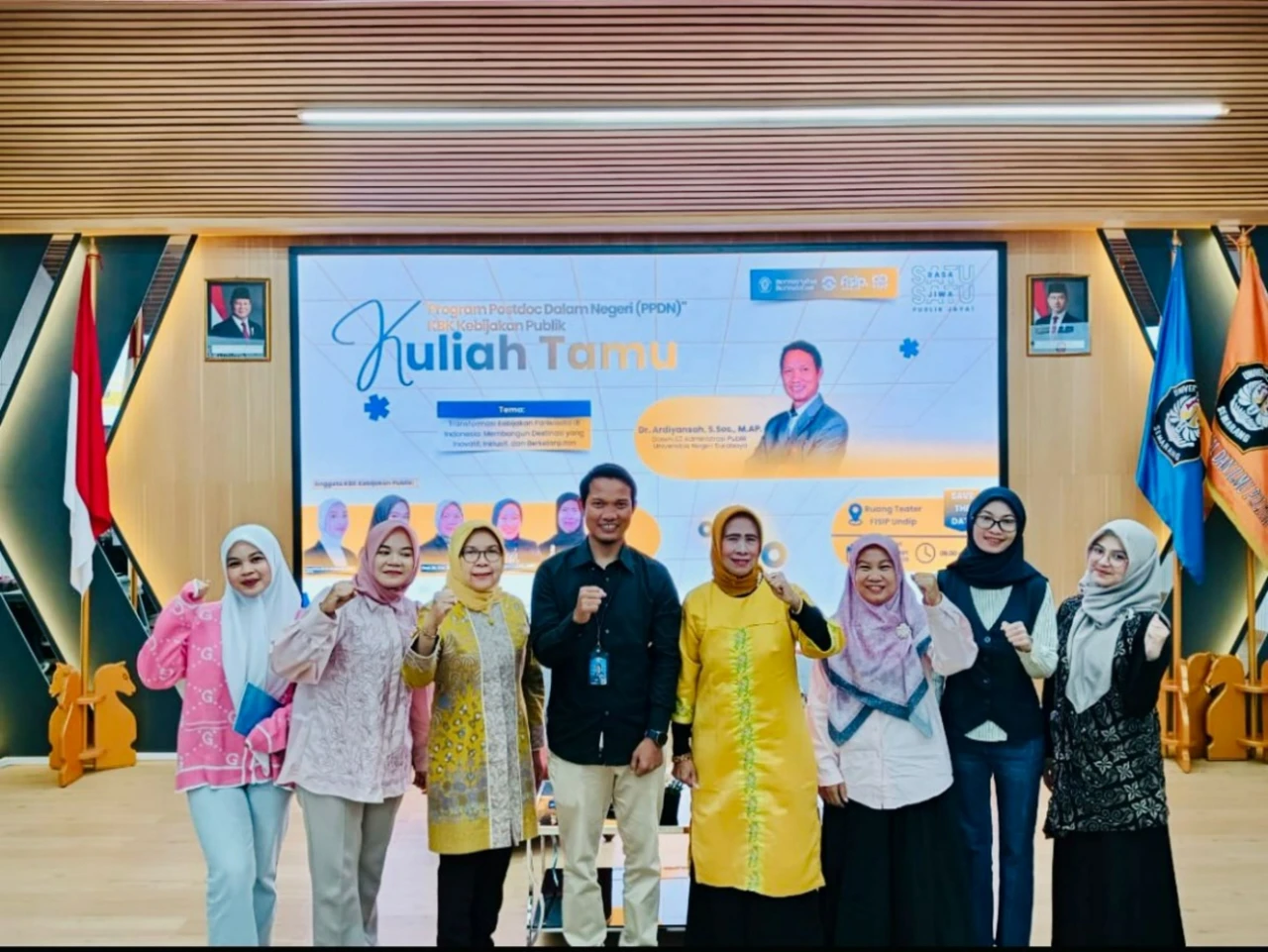
Semarang, September 4, 2026 — The Public Policy Academic Expertise Cluster (KBK), Department of Public Administration, Faculty of Social and Political Sciences, Universitas Diponegoro (FISIP UNDIP), organized a Guest Lecture entitled “Transforming Tourism Policy in Indonesia: Building Innovative, Inclusive, and Sustainable Destinations” on Friday, September 4, 2026. The event was held at the FISIP Theater Room, Universitas Diponegoro.
The activity was part of the implementation of the World Class University (WCU) program through the Domestic Postdoctoral Program (Program Postdoc Dalam Negeri/PPDN), which aims to strengthen the academic environment, foster inter-institutional collaboration, and broaden the perspectives of students and academic community members on strategic issues in public policy.
The guest lecture featured Dr. Ardiyansah, S.Sos., M.AP., a lecturer in the Master’s Program in Public Administration at Universitas Negeri Surabaya (UNESA), as the main speaker. In his presentation, Dr. Ardiyansah discussed the dynamics of tourism policy transformation in Indonesia, particularly the importance of policy innovation, inclusivity in destination management, and sustainability-oriented approaches to tourism development.
The transformation of the tourism sector can no longer be viewed merely as an effort to increase tourist arrivals. Tourism policies need to be directed toward creating destination governance that generates economic benefits while also addressing social, cultural, and environmental considerations and ensuring the sustainability of local communities.
In this context, tourism destination development requires increasingly adaptive and collaborative policy approaches. Government cannot work alone; instead, it needs to build synergies with local communities, businesses, academics, community organizations, and other relevant stakeholders.
Through the guest lecture, participants were encouraged to understand that innovation in tourism policy is not necessarily limited to the use of technology. It also encompasses institutional innovation, collaborative governance models, tourism service development, community empowerment, and the formulation of policies capable of responding to changing tourist needs and local characteristics.
Inclusivity was also highlighted as an important consideration. Tourism development should provide broad opportunities for local community participation and ensure that the benefits of destination development are distributed more equitably. Local communities should not merely be positioned as objects of tourism development, but as important actors in the planning, management, and evaluation of tourism policies.
At the same time, the principle of sustainability has become increasingly relevant amid growing environmental challenges, climate change, pressure on natural resources, and the expansion of tourism activities across various regions. Tourism policies need to maintain a balance between economic growth, environmental protection, local cultural preservation, and improvements in community welfare.
The guest lecture also provided a space for academic discussion, enabling students to critically examine the relationship between public policy and tourism development. Issues related to destination governance, stakeholder collaboration, service innovation, community engagement, and sustainability formed important parts of the discussion.
For Public Administration students, the topic is particularly relevant because tourism development is fundamentally part of a governance process involving multiple actors, interests, resources, and public decision-making processes. Therefore, understanding the transformation of tourism policy can enrich students’ perspectives in analyzing development policies at both the national and local levels.
The organization of this event also reflects the commitment of the Department of Public Administration, FISIP UNDIP, to continuously strengthen the learning process through academic engagement with experts and scholars from various higher education institutions. The WCU PPDN program serves as a strategic platform for expanding scholarly networks, facilitating the exchange of ideas, and enhancing the quality of education, research, and academic collaboration.
Through the Guest Lecture “Transforming Tourism Policy in Indonesia: Building Innovative, Inclusive, and Sustainable Destinations,” students are expected not only to gain a conceptual understanding of tourism policy but also to critically examine the challenges of policy implementation and formulate alternative innovations in destination governance in Indonesia.
The activity is expected to contribute to FISIP UNDIP’s ongoing efforts to prepare students with broad public policy perspectives, adaptability to change, and the capacity to contribute to the development of Indonesian tourism that is innovative, inclusive, competitive, and sustainable.