

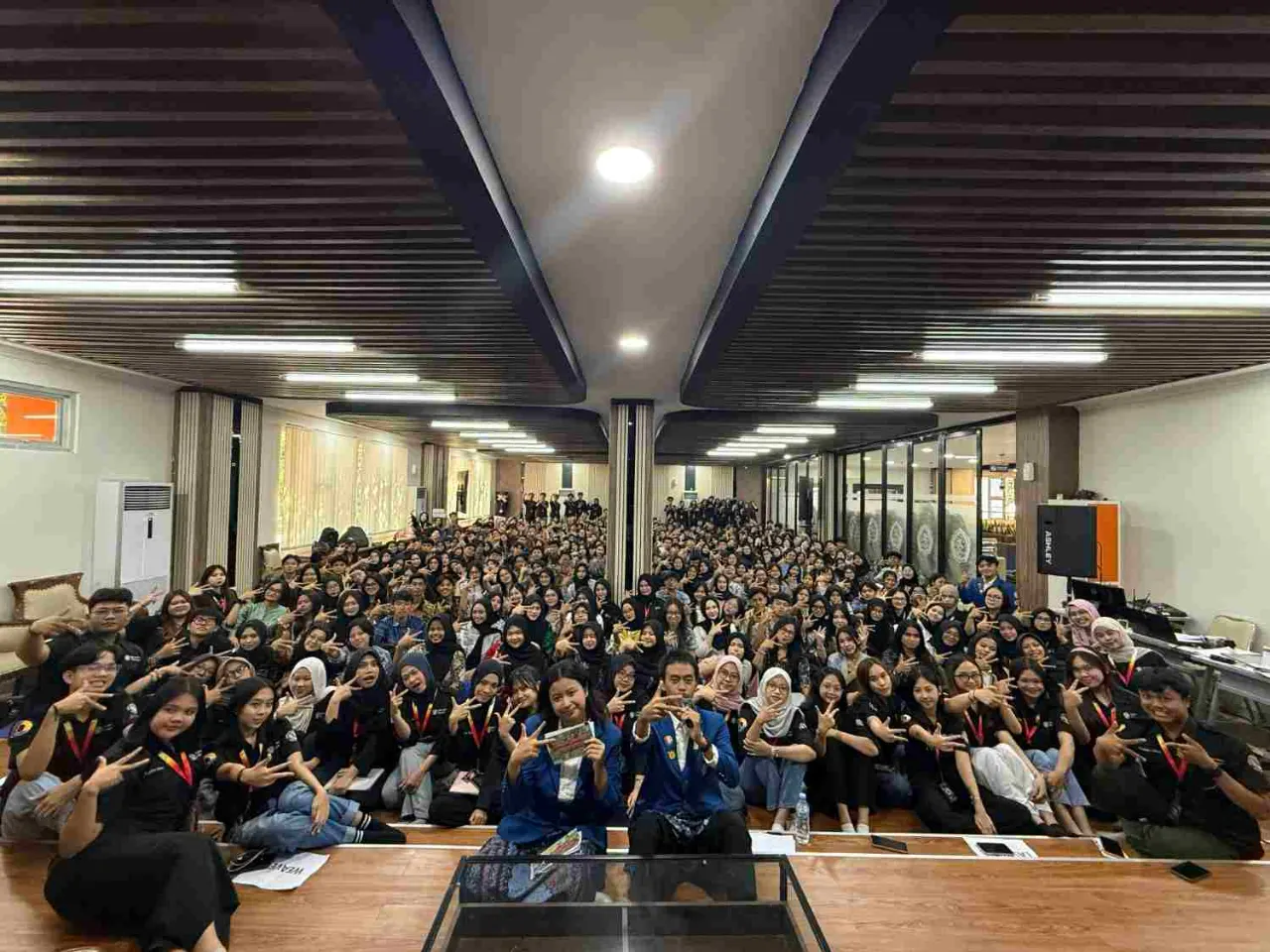
Communication Science Student Association (HMPS Ilkom) at Universitas Diponegoro (Undip) hosted the 2026 Research School on Saturday, August 29, at the PKM Diponegoro Muda Hall, Faculty of Social and Political Sciences (FISIP), Universitas Diponegoro. Running from 06:30 to 15:45 GMT+7, the event was designed specifically for first-year Communication Science students, serving as an introductory platform for research engagement, academic competition, and student development. Embracing the spirit of “Rise with intellect, move with meaning,” the Research School 2026 introduced four foundational pillars of research: the Science & Technology Pillar, the Research & Innovation Pillar, the Language & Literacy Pillar, and the Scientific Writing Pillar. The program also showcased various competition opportunities relevant to the field of Communication Science. Through this initiative, students are expected to apply their acquired knowledge and actively participate in academic endeavors and competitions, thereby supporting Undip’s vision of becoming a leading research university.
The event commenced with an opening ceremony, the singing of Indonesia Raya and the Universitas Diponegoro anthem, followed by welcoming remarks from the Chairperson of the Research School 2026, the chair of HMPS Ilkom, and the Faculty Advisor for HMPS Ilkom, Citra Safira, M.I.Kom., who represented the Head of the Undergraduate Communication Science Program. In her address, Citra emphasized the importance of the Research School as a gateway for students to explore research opportunities and understand the benefits of participating in the Student Creativity Program (Program Kreativitas Mahasiswa / PKM).
The first session was delivered by Rafly Perdana Kusumah, an Industrial Engineering student at Undip, under the theme “Dare to Think, Dare to Create: Introducing PKM as a Space for Student Ideas.” Rafly presented PKM as a platform for students to cultivate creativity through problem-based ideation. He underscored the significance of novelty, which can be achieved by reviewing prior studies and identifying unresolved gaps. He also shared four practical steps to initiating a PKM project: generating ideas, consulting with faculty advisors, forming a team, and executing the plan. According to Rafly, a solid team requires complementary skills and a shared vision and mission. Participants engaged in lively discussions on team formation, assessment criteria, and strategies for identifying research gaps.
The PKM segment continued with Clarissa Wijaya, a student from the Faculty of Psychology, who presented “Integrating Creativity, Entrepreneurship, and Community Service through PKM Humanities for Impact-Driven Students.” Clarissa shared her firsthand experience in the socio-humanities PKM track and introduced the principle of start with a problem, not a title. She explained that ideas should be developed by identifying a problem, gathering evidence, formulating a solution, and evaluating its potential impact. She also stressed the importance of commitment, competence, and chemistry in building a strong team, while encouraging students to thoroughly study PKM guidelines and maintain active communication with their supervising lecturers. The session concluded with a Q&A segment covering the implementation of PKM-PM (Community Service) and strategies for collaborating with senior students.
Following an ice-breaking session, participants attended a debate workshop led by Albert Ong, a Psychology student at Undip, with the theme “Strengthening Critical Reasoning and Argumentative Skills in Academic Competitions.” The session began with a lighthearted debate on whether porridge should be stirred or not—serving as an engaging introduction to perspective-taking and argumentation. Albert then introduced the Asian Parliamentary (AP) and British Parliamentary (BP) debate formats, as well as techniques for constructing motions with balanced burdens of proof. For argument development, he introduced the ABC formula: Premise, Process, and Impact. He also shared his personal competition experiences and emphasized the value of consistent practice and resilience in facing failure. The participants showed great enthusiasm, posing questions on debate ethics, managing nervousness, and countering strong opposing arguments.
The series of sessions concluded with a presentation on Outstanding Student Achievement (Mawapres) delivered by Ainun Rahimah Iskandar from the Communication Science Program, under the title “Unlock Your Excellence: Becoming a Distinguished and Competitive Student.” Ainun introduced the Mawapres program as a recognition of students who excel academically, demonstrate social impact, and exhibit leadership qualities. She outlined various supporting factors for student success, including academic performance, research, publications, organizational involvement, competitions, community service, entrepreneurship, and soft skills. She also introduced the Rule of Three principle: one primary academic focus, one meaningful organizational role, and one priority competition target. Participants were encouraged to seize opportunities early in their academic journey while maintaining a healthy balance among studies, organizational activities, and personal development. The Q&A session addressed topics such as overthinking, time management, consistency, and the fear of missing out (FOMO).
Beyond lectures and discussions, the event included a post-test, ice-breaking activities, a Quizizz session, and the completion of interest and talent forms. The program concluded with the presentation of awards to the most active participants—Sultan Ravy and Angela Dewi Hadung Namang—followed by a group photo session. Supported by a dedicated committee of approximately 60 members, the Research School 2026 received overwhelmingly positive feedback from new students. Many participants described the event as enjoyable, insightful, and substantive in content. The lineup of speakers was particularly appreciated for delivering relevant and inspiring knowledge tailored to the needs of first-year Communication Science students.
Through the Research School 2026, first-year Communication Science students are expected not only to understand the landscape of research and competition opportunities but also to translate that knowledge into concrete action—developing their potential and achieving excellence from the very start of their academic journey. This initiative serves as a strategic step toward fostering student contributions in realizing Undip’s vision as a preeminent research university.