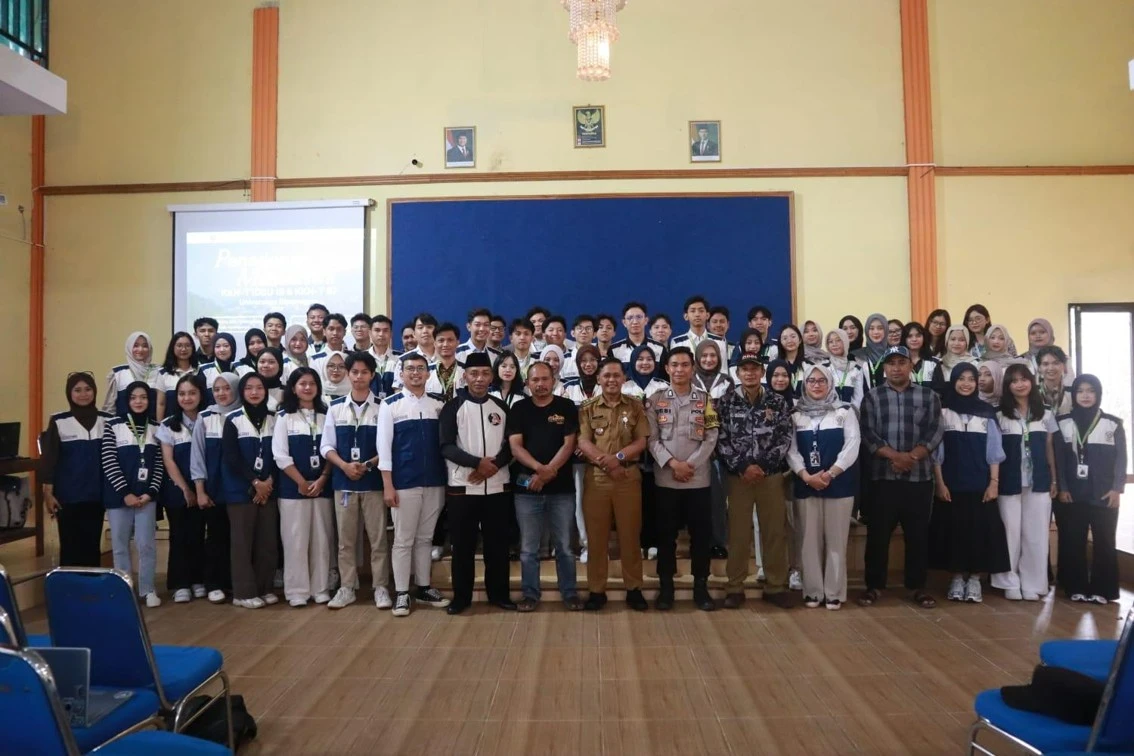
Karanganyar, June 22, 2026 – Students of Universitas Diponegoro (Undip) under the Thematic Community Service Program (KKN-T) for the Development of Undip-Assisted Villages (IDBU), Group 19, were officially deployed in Kalisoro Village, Tawangmangu District, Karanganyar Regency, on Monday (June 22, 2026). Comprising 30 students—14 from the Faculty of Social and Political Sciences (Business Administration and Communication Studies), 8 from the Faculty of Economics and Business (Economics, Management, and Accounting), 3 from the Faculty of Law, 3 from the Faculty of Engineering (Mechanical Engineering and Industrial Engineering), and 2 from the Faculty of Animal and Agricultural Sciences (Agroecotechnology)—the team will implement a household waste management and segregation program. This initiative aims to address a sharp increase in waste volume, which has surged from approximately 30–40 tons to 90 tons per month over the past three years. Through educational campaigns, community outreach, and hands-on mentoring, the program aspires to cultivate a culture of independent waste management at the household level, thereby reducing waste generation while fostering a cleaner and more sustainable environment.
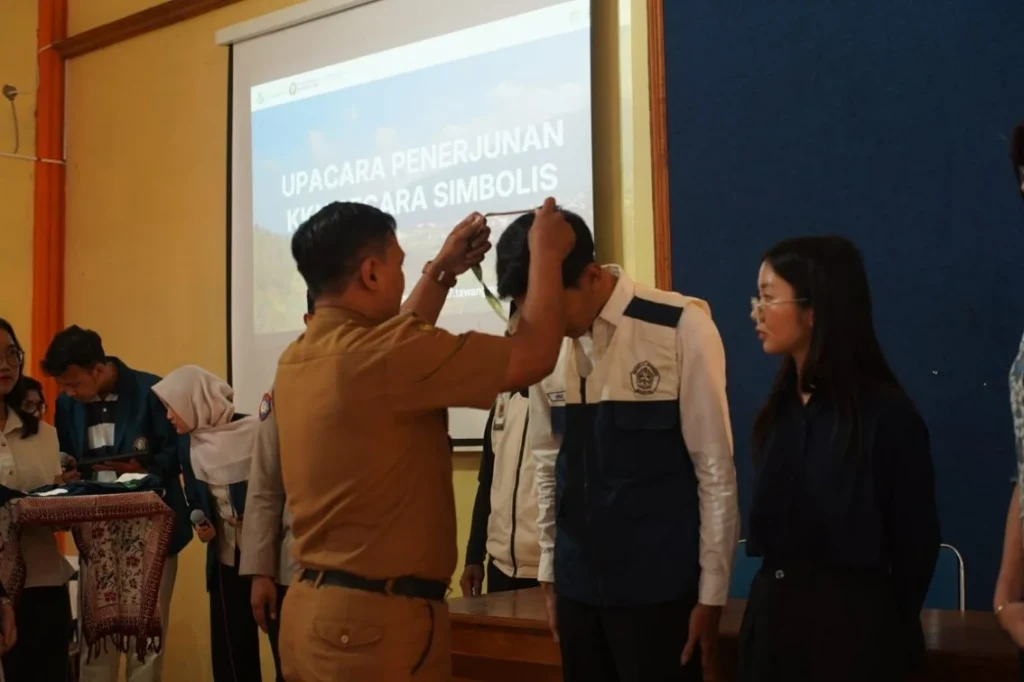
The deployment coincided with the KKN-T 87 team, which is carrying out programs in the strawberry plantation sector, making the reception ceremony at the Kalisoro Village Office a joint affair attended by both student groups. The Field Supervisor (Dosen Pembimbing Lapangan / DPL) from Undip’s Faculty of Social and Political Sciences (FISIP), Wildan Avian Pratama, S.AB., M.A.B., emphasized that KKN serves as a pivotal moment for students to apply their academic knowledge and make tangible contributions to society. The IDBU-19 team is mentored by three faculty members from Undip’s Business Administration Program: Dr. Reni Shinta Dewi, S.Sos., M.Si., Dhaifina Idznitia Apriyani Naimi, S.M., M.B.A., and Wildan Avian Pratama, S.AB., M.A.B.
“We hope this program does not conclude with the end of KKN but instead acts as a catalyst for lasting behavioral change in waste segregation practices within the community. The synergy between students from diverse disciplines and the residents of Kalisoro is essential to ensuring that this initiative delivers genuine benefits—both environmentally and economically,” stated Dr. Reni Shinta Dewi, S.Sos., M.Si., as Chair of the IDBU-19 Team.
In his address, the representative of the Chair of the Kalisoro community unit, Khamidin Tri Saputro, acknowledged that waste management has become a critical challenge in the area. Household waste alone currently reaches approximately 25 tons per month, while waste from tourist attractions and villas contributes an additional 65 tons per month, placing immense pressure on the local Community Self-Help Group (Kelompok Swadaya Masyarakat / KSM) responsible for waste handling. He expressed hope that the presence of the students would instill a culture of waste segregation from the household level and revitalize the dormant waste bank initiative that had previously been established but ceased operations.
“Our aspiration is that waste segregation begins at home—even starting from the student homestays—and gradually expands to community units (dasawisma) and eventually across the community units 3 and 4. Waste that retains market value can be collected and serve as the seed for a waste bank, ensuring that no waste is discarded without purpose,” he remarked. He also highlighted residents’ concerns regarding organic waste, which still emits strong odors during decomposition. He asserted that a more disciplined and scheduled approach to waste segregation could mitigate environmental pollution while advancing the goal of more autonomous and sustainable waste governance in Kalisoro.
Based on the team’s preliminary mapping, several core challenges have been identified: the absence of waste segregation at the household level, suboptimal KSM management due to limited equipment and funding, and the unrealized potential of a waste bank despite significant economic opportunities from inorganic waste and used cooking oil. On the other hand, the village possesses strong social networks—such as dasawisma meetings and neighborhood unit (RT)-level social gatherings—that can be leveraged as channels for public education, alongside active waste collectors already purchasing inorganic waste from residents.
In response to these conditions, the KKN-T IDBU-19 team has designed a work plan with the primary objective of fostering awareness and habitual waste segregation at the household level. The program focuses on five of the twelve RTs in Kalisoro, specifically targeting RT 1, 2, and 3 in RW 3 and RT 2 and 3 in RW 4, with at least one RT serving as a pilot project before expansion to other areas. Education will be delivered through two channels: dasawisma meetings for hands-on segregation practice and RT social gatherings for broader program dissemination to household heads.
To support the conversion of organic waste into compost, the team has engaged Dr. Ir. Cahya Setya Utama, S.Pt., M.Si., IPM., a faculty member from Undip’s Faculty of Animal and Agricultural Sciences (FPP), who will provide direct training to residents. Meanwhile, inorganic waste with economic value—such as plastics, paper, and cardboard—will be collected at waste banks managed at the dasawisma level before being channeled to active collectors operating in the area.
Throughout the KKN period, the 30 students will also conduct behavioral observations of residents regarding waste segregation habits, the results of which will inform the development of a Standard Operating Procedure (SOP) for waste segregation and a sustainability framework. Program outputs are structured into four primary forms: educational and literacy materials on waste management, a mapping of the segregation system complete with SOPs and waste bin label designs, prototypes of economically valuable products such as compost and upcycled crafts, and documentation and dissemination through social media and campus channels.
The series of KKN-T IDBU-19 activities in Kalisoro is scheduled to run until early August 2026, with regular meetings held on the 5th of each month for dasawisma-level practice and on the 16th of each month for RT social gathering outreach. A monitoring and evaluation session with supervising faculty and village officials is planned for July 18, 2026. Through this initiative, Undip students aim to assist Sekipan Village, Kalisoro Sub-district, in establishing a more organized and sustainable waste management system while creating new economic opportunities for residents from waste segregation activities. This program aligns with the pursuit of the Sustainable Development Goals (SDGs), particularly SDG 11: Sustainable Cities and Communities through improved urban waste management, and SDG 12: Responsible Consumption and Production through waste reduction and the valorization of economically valuable waste.
Writer: KKN-T IDBU-19 Undip 2026 Team