

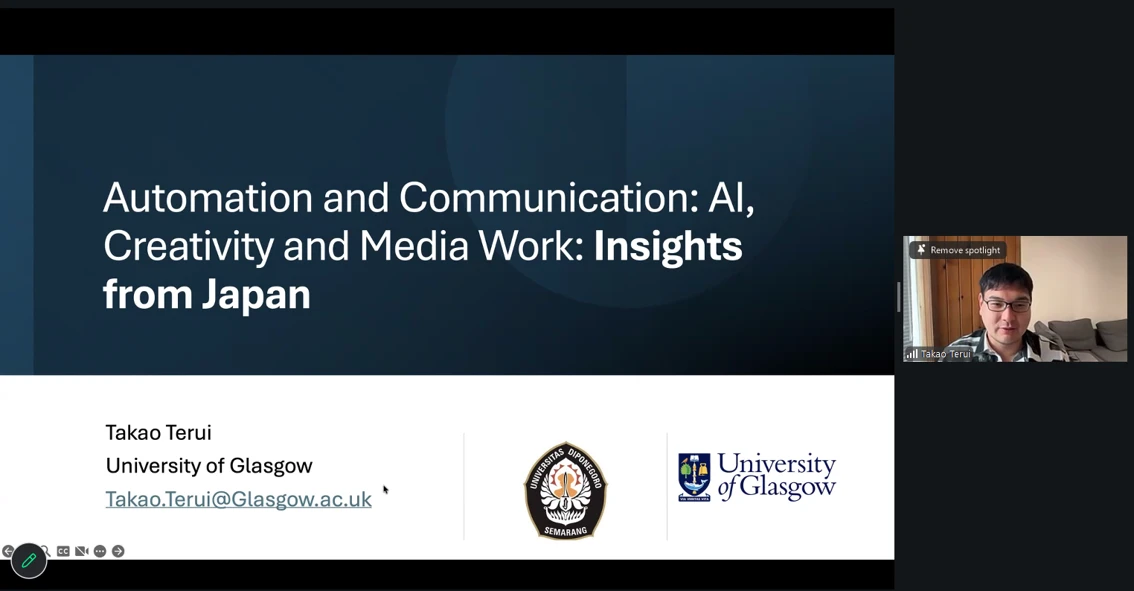
Semarang, 14 July 2026 — The Department of Communication Science, Faculty of Social and Political Sciences, Universitas Diponegoro, continued its International Short Course 2026 under the theme “Automation and Communication: AI, Creativity, and Media Work.” This session featured Takao Terui, PhD from the University of Glasgow as the invited speaker, who delivered a lecture titled “Generative AI, Cultural Labour, and Creative Industries.”
In his presentation, Dr. Terui discussed how generative AI is shaping creative industries and cultural policy in Japan. He emphasized that AI should not be understood merely as a technological issue, but also as a social, cultural, economic, and policy issue involving complex relations among creators, audiences, platforms, and the state.
Drawing from the Japanese context, Dr. Terui highlighted the tension between government efforts to promote AI adoption for productivity and industrial competitiveness, and critical responses from fan communities, creators, and local platforms. In several cases, the use or suspected use of AI in creative works has triggered public resistance, particularly in relation to authenticity, copyright, creator reputation, and the value of human creativity.
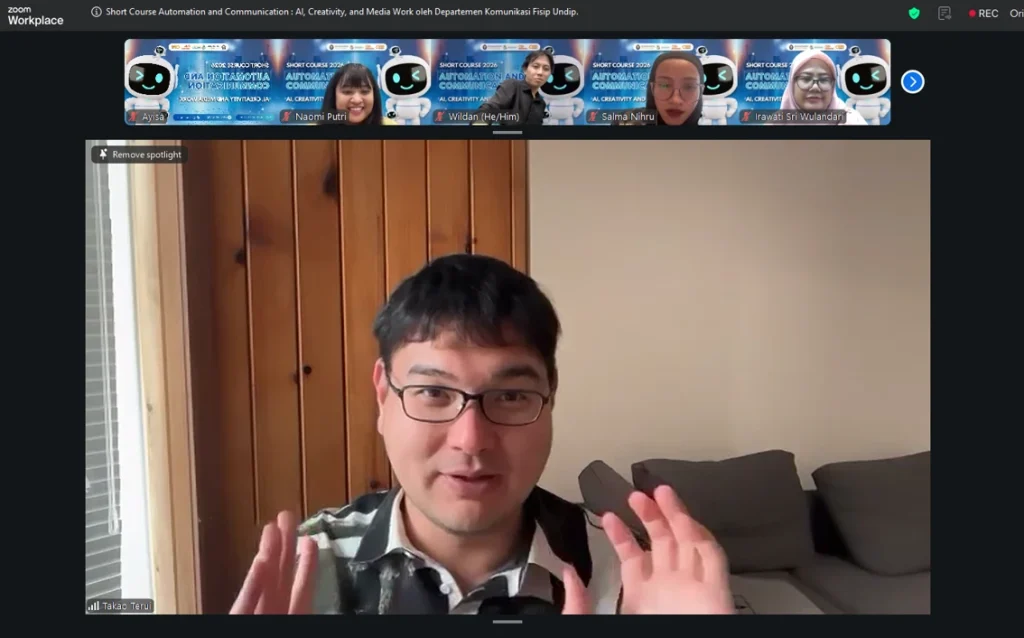
The session also explored how Japanese content platforms respond to generative AI through various mechanisms, including AI-content labelling, distribution restrictions, separate categorization of AI-generated works, and measures to protect creators’ works from machine learning practices. These examples show that AI governance is not only carried out by the state, but also by platforms, creative communities, and audiences.
Dr. Terui further explained that media workers and creators in Japan do not necessarily reject AI entirely. Many creators use AI cautiously as an assistive tool for research, brainstorming, editing, or creative experimentation. However, they tend to avoid using AI as the main producer of creative content due to reputational risks, audience reactions, and copyright concerns. (WNIS)
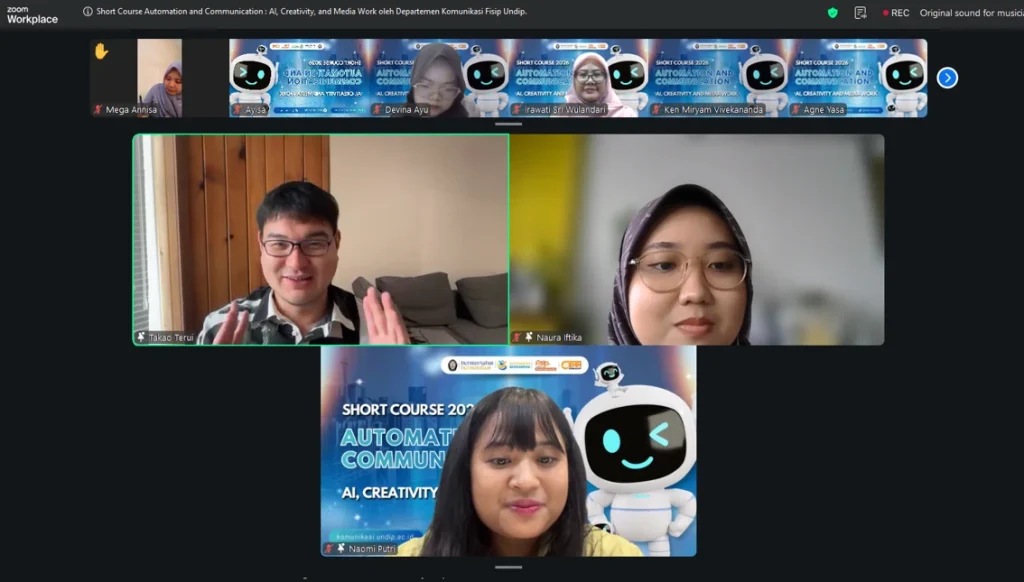
The discussion was lively and actively moderated by Naomi Putri Bahari Simeon, M.I.Kom., a lecturer in Communication Science at FISIP UNDIP. Participants raised various questions, ranging from the differences in public responses to AI in Japan and Indonesia, the role of government in promoting AI adoption, the power of platforms in regulating digital content, to how creative industries can balance technological innovation with the protection of creators and cultural workers. This session with Takao was guided by the master of ceremony, Devina Ayu Maharani, a student of Communication Science, Faculty of Social and Political Sciences, Universitas Diponegoro.
Through this session, participants were invited to understand the development of AI in creative industries contextually. The Japanese experience demonstrates that debates on AI, creativity, and cultural labour cannot be generalized from one country to another, as they are shaped by local culture, industrial structures, platform regulations, and the relationship between creators and their audience communities.
International Short Course 2026 continues to serve as a cross-national and interdisciplinary learning space for discussing the transformation of communication, creativity, and media work in the age of automation and artificial intelligence. Through the session with Dr. Takao Terui, participants gained important insights into how generative AI is reshaping creative industries, cultural policy, and the future of human creativity in the Asian context, particularly in Japan. (WNIS)