
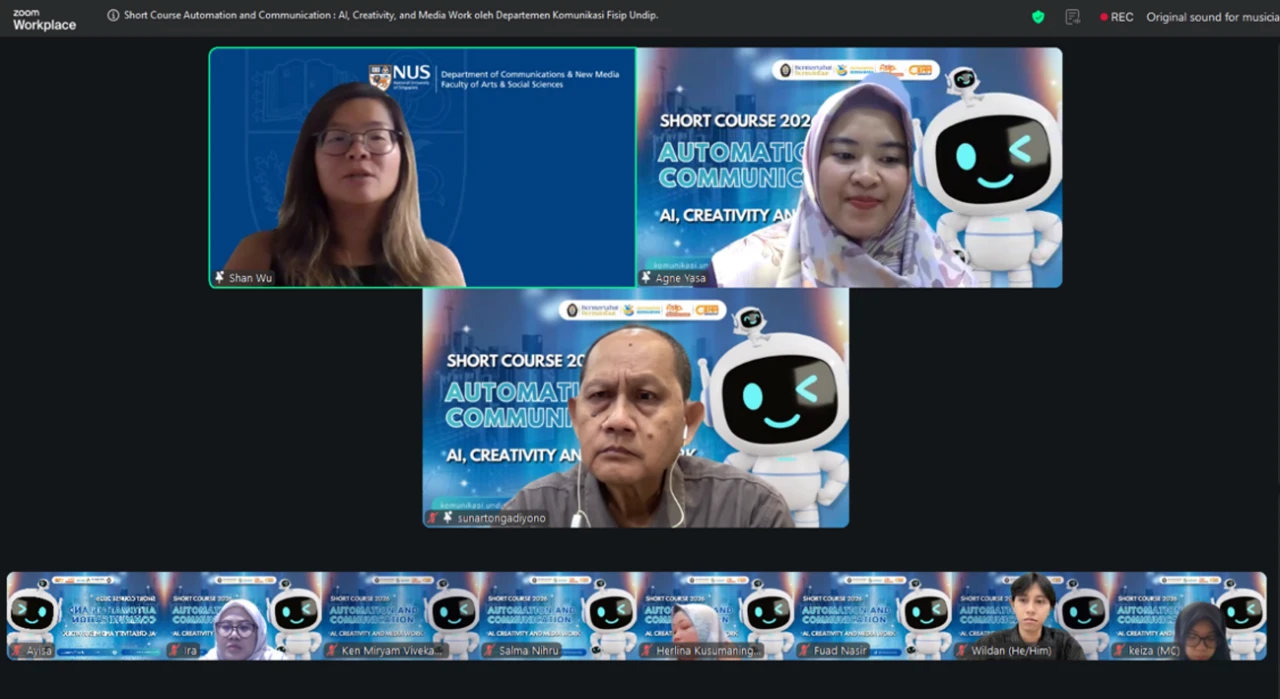
Semarang, 7 July 2026 — The Department of Communication Science, Faculty of Social and Political Sciences, Universitas Diponegoro, continued its International Short Course 2026 under the theme “Automation and Communication: AI, Creativity, and Media Work.” This session featured two speakers, Dr. Sunarto from Universitas Diponegoro and Shangyuan Wu, PhD from the National University of Singapore, under the broader topic “Journalism in the Automation Age: Human-Machine Relations, Newsroom Transformation, and the Future of Media Work.”
The session was guided by Keiza Aqilah, a Communication Science student, as the master of ceremony, and moderated by Agne Yasa, a lecturer in Communication Science. In the session introduction, the moderator highlighted that automation and artificial intelligence are increasingly shaping how news is produced, distributed, verified, and consumed. These changes affect not only journalistic routines, but also editorial decision-making, newsroom organization, professional authority, and the relationship between humans and machines in media work.
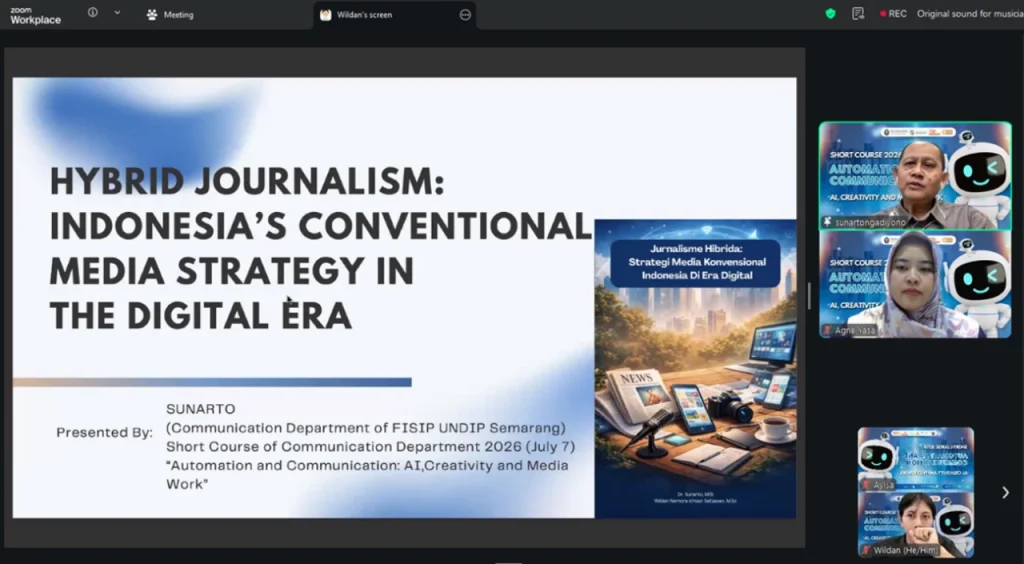
In the first presentation, Dr. Sunarto delivered a lecture titled “Hybrid Journalism: Indonesia’s Conventional Media Strategy in the Digital Era.” Drawing from the case of conventional media in Indonesia, particularly Harian Kompas, Dr. Sunarto explained that the hybrid media system has become an important strategy for conventional media to adapt to digital disruption. This strategy involves the convergence of print and digital platforms, hybrid journalism practices, and hybrid business models that allow media organizations to remain relevant and sustainable in the digital era.
Dr. Sunarto further emphasized that technological adaptation is a necessity for media organizations in the digital age. In this context, conventional media are not merely shifting from print to digital platforms, but also reorganizing editorial practices, audience relations, and internal communication processes while maintaining the principles of quality journalism.

In the second presentation, Shangyuan Wu, PhD from the National University of Singapore presented her lecture titled “Journalists as Individual Users of Artificial Intelligence: Exploring their Practices, Perceptions, and Literacies Within and Without the Newsroom.” She explained that the use of AI in journalism does not always take place through formal organizational policies. Many journalists are already using AI personally across different stages of news production, both with and without direct newsroom oversight.
Dr. Wu discussed how journalists use AI for news gathering, writing, editing, news promotion, headline writing, and social media content. However, she also emphasized the importance of verification, editing, and critical engagement with AI-generated outputs to ensure that core journalistic values such as truthfulness, accuracy, transparency, balance, and integrity are not compromised.
She also highlighted the importance of digital literacies for contemporary journalists, including news literacy, data literacy, algorithmic literacy, and AI literacy. These literacies are crucial not only for using technology effectively, but also for understanding its limitations, biases, and risks in journalistic practice.
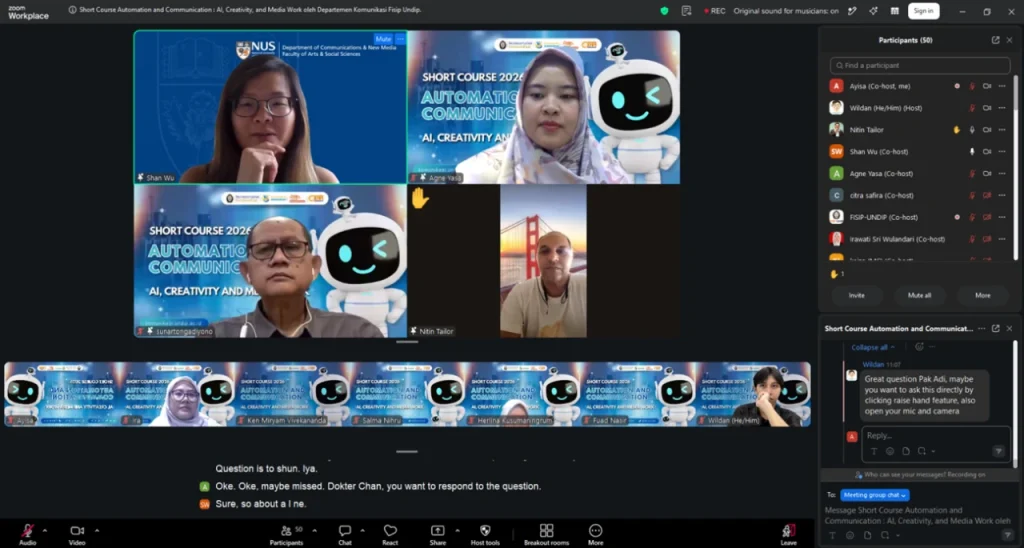
The discussion session was highly active. Participants raised questions on topics such as “Gen Z-style journalism,” the consumption of news through TikTok, the use of AI-generated hooks and leads in news articles, the need for labelling AI-generated content in mainstream media, the reliability of AI detection tools, the future of AI-powered news anchors, and how journalism education should adapt as AI continues to develop.
After the presentations and Q&A session, the program continued with a Group Discussion Session in breakout rooms. During this session, participants exchanged ideas, reflected on the lectures, and connected the issues of journalism, AI, and newsroom transformation with their own academic, professional, and cultural contexts.
Through this session, the International Short Course 2026 provided participants with a critical understanding of journalism’s transformation in the age of automation. The session with Dr. Sunarto and Dr. Shangyuan Wu demonstrated that the future of journalism is shaped not only by technological change, but also by the capacity of media institutions, journalists, and the public to maintain information quality, journalistic ethics, and digital literacy in an evolving media ecosystem.
The International Short Course 2026 continues to serve as a cross-national and interdisciplinary learning space for discussing the transformation of communication, creativity, and media work in the age of automation and artificial intelligence. (WNIS)