

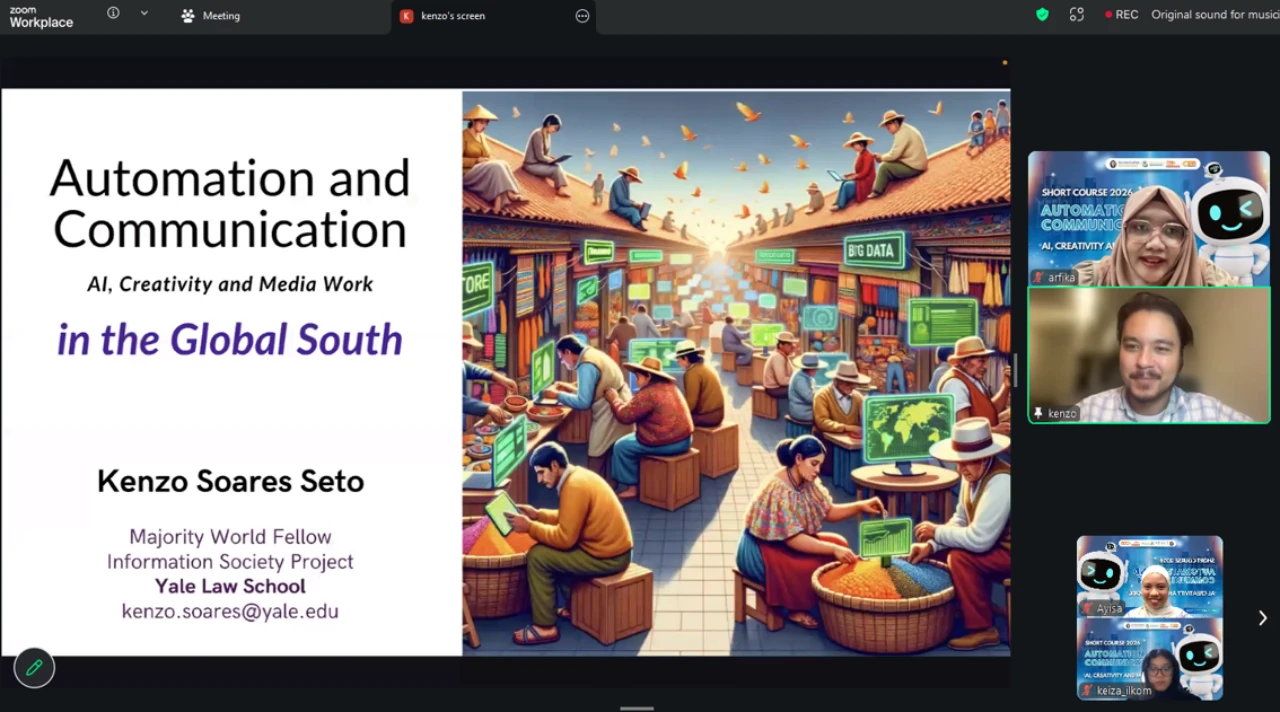
Semarang, 3 July 2026 — The Department of Communication Science, Faculty of Social and Political Sciences, Universitas Diponegoro, continued its International Short Course 2026 under the theme “Automation and Communication: AI, Creativity, and Media Work.” The second academic session featured Kenzo Soares Seto, PhD, from Yale University, with a lecture titled “Automated Communication, Digital Labor, and Platform Power.”
The session was guided by Keiza Aqilah, a Communication Science student, as the master of ceremony, and moderated by Arfika Pertiwi Putri, M.I.Kom., a lecturer in Communication Science at FISIP UNDIP.
In his presentation, Dr. Kenzo discussed how artificial intelligence, automation, and platform infrastructures are transforming communication practices, media industries, creative work, and digital labor. He highlighted that AI should not only be understood as a technological innovation, but also as a political, economic, and social issue that shapes power relations between platforms, workers, states, and users.
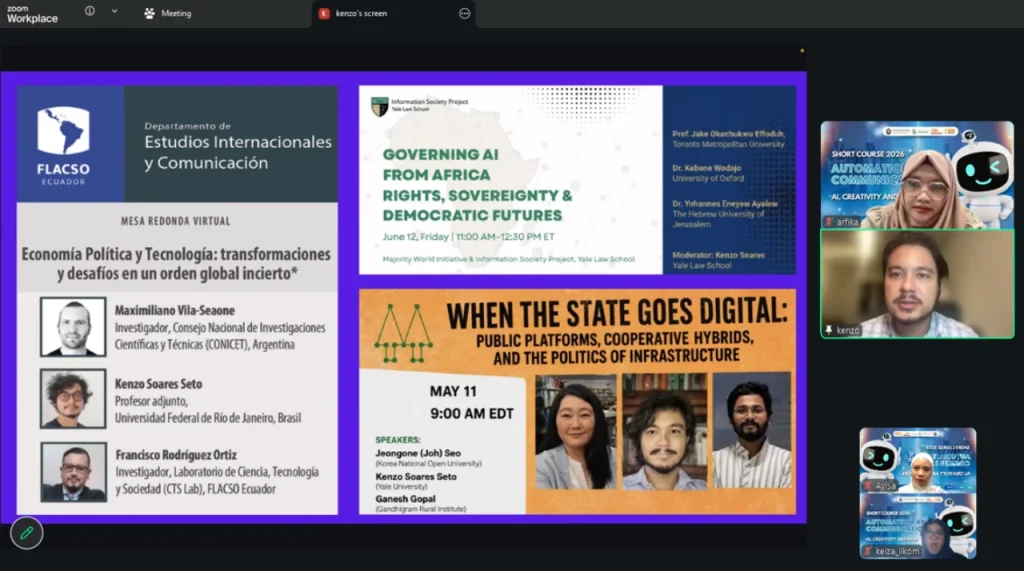
Dr. Kenzo also brought attention to the position of the Global South in the development and governance of AI. Drawing from debates on AI regulation and digital labor, the session encouraged participants to think critically about whether AI creates new opportunities for inclusion and local economic development, or whether it also reproduces new forms of inequality, dependency, and labor exploitation.
The discussion session was highly active. Participants raised various questions related to the tension between inclusion and exploitation in AI data work, the use of academic and creative works as AI training data, the possibility of enforcing platform accountability as seen in Brazil’s regulatory encounters with global technology companies, and the relevance of such cases for Indonesia.
Other questions addressed the impact of AI on small businesses and creative workers, the rise of young people’s participation in platform-based digital labor such as content creation, affiliate marketing, and live streaming, as well as how higher education and vocational curricula should prepare graduates to work alongside AI rather than compete against it.
Participants also discussed AI ethics, AI governance, and the challenges faced by countries in the Global South in developing locally grounded AI regulations. The conversation emphasized the need to balance innovation, citizen safety, cultural production, creative labor protection, and global regulatory standards.
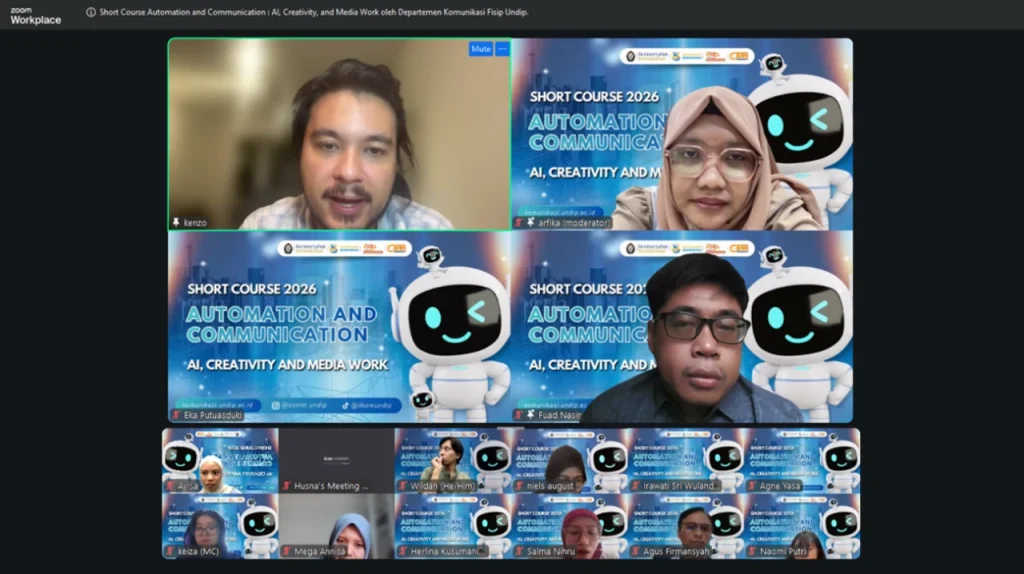
After the lecture and Q&A session, participants continued with a group discussion session. They were divided into four different rooms, each led by tutors from the Department of Communication Science. Room 1 was led by Rif’at and Herlina; Room 2 by Agne, Citra, and Wildan; Room 3 by Ira and Naomi; and Room 4 by Arfika, Amin, and Thian.
Through this session, the International Short Course 2026 provided participants with a critical understanding of the relationship between AI, platform power, and digital labor. The session invited participants to reflect on how automation affects not only media and communication industries, but also broader questions of labor rights, governance, inequality, and technological justice in the Global South.
The International Short Course 2026 continues to serve as a cross-national and interdisciplinary learning space for discussing the transformation of communication, creativity, and media work in the age of automation and artificial intelligence. (WNIS)