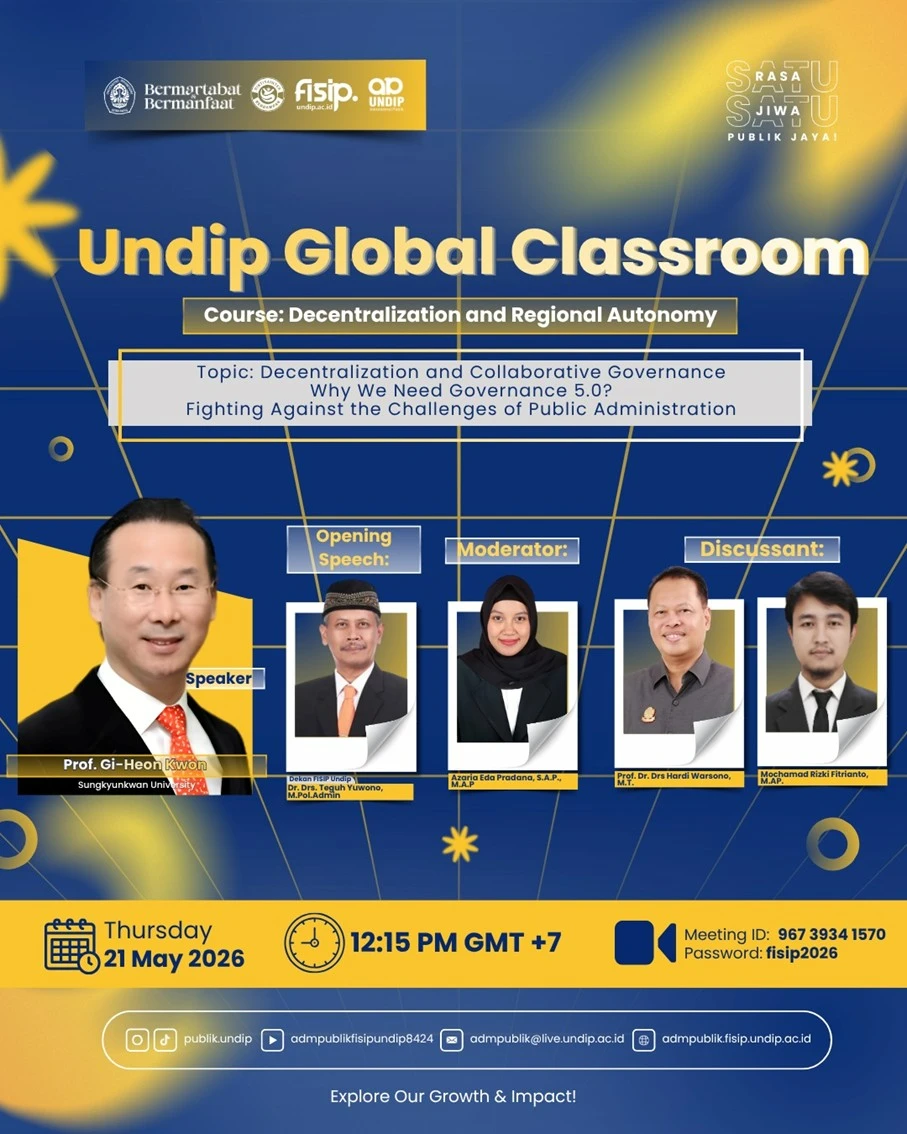
Semarang — The Public Administration Study Program of the Faculty of Social and Political Sciences (FISIP), Diponegoro University once again organized an international academic activity through the Undip Global Classroom agenda on Thursday, May 21, 2026, conducted online via Zoom Meeting. The event was part of the Decentralization and Regional Autonomy course, bringing together international academics, scholars, and practitioners in the field of public administration as a platform for discussion and the exchange of ideas regarding governance challenges in the modern era.
The event carried the theme “Decentralization and Collaborative Governance: Why We Need Governance 5.0? Fighting Against the Challenges of Public Administration.” This theme was chosen in response to contemporary governance dynamics that require governance innovation, cross-sector collaboration, and the strengthening of the government’s role in addressing increasingly complex social changes, technological developments, and public needs.
The event featured Prof. Gi-Heon Kwon as the keynote speaker. In his presentation, he explained the importance of transformation toward the concept of Governance 5.0 as a form of governance development that is more adaptive, collaborative, and people-oriented. He also highlighted how decentralization and collaborative governance can serve as strategies to improve the effectiveness of public services amid global public administration challenges.
The activity began with an opening speech delivered by Dr. Drs. Teguh Yuwono. In his remarks, he emphasized that international activities such as the Undip Global Classroom are important platforms for broadening students’ academic perspectives and strengthening international networks within FISIP UNDIP.
The discussion session was moderated by Azaria Eda Pradana, who facilitated interaction between the speaker and participants. The discussion was further enriched by responses from Prof. Dr. Drs. Hardi Warsono and Mochamad Rizki Fitrianto as discussants, who provided additional perspectives on the implementation of collaborative governance and the challenges of decentralization in Indonesia.
Through this activity, participants not only gained a theoretical understanding of Governance 5.0, but also obtained practical insights into the importance of collaboration among stakeholders in modern governance. Participants’ enthusiasm was reflected in the active question-and-answer and discussion sessions throughout the event.

In his presentation, Prof. Kwon introduced the main concept of Governance 5.0 through the RSW Coherence approach, namely Reflexivity, Spirituality, and Institutional Will. Reflexivity refers to the ability to critically reflect on government policies and actions; Spirituality serves as an ethical foundation and orientation toward the common good; while Institutional Will represents the capability of institutions to translate values and ideas into concrete actions. These three elements are considered essential to ensure that governance functions not only administratively, but also with moral direction and social commitment.
He also emphasized that collaborative governance is one of the key strategies in addressing modern public administration challenges. According to him, collaboration among government actors, communities, academics, and the private sector is necessary to build trust, strengthen social networks, and enhance the government’s capacity to respond quickly and adaptively to public issues.
Interestingly, the material also connected the concept of Governance 5.0 with the ideas of the Islamic philosopher Ibn Sina. In his explanation, Prof. Kwon described the relationship between the concepts of “Being, Intellect, Soul, and Action” and Governance 5.0, which positions reflection, ethical awareness, and institutional action as interconnected elements. Through this approach, he emphasized that governance is not merely about administrative techniques, but also about moral consciousness and value-oriented governance practices.
Participants showed strong enthusiasm during the discussion and question-and-answer sessions, particularly regarding the relevance of Governance 5.0 to public administration conditions in Indonesia. Through this activity, participants gained an understanding of the importance of governance that relies not only on technology and efficiency, but also upholds ethical values, collaboration, and social awareness in facing future challenges.
With the successful implementation of this Undip Global Classroom, it is hoped that students and the academic community of Public Administration FISIP UNDIP will continue to improve their academic capacity, broaden their global perspectives, and develop critical thinking regarding issues of public administration and governance in the future.