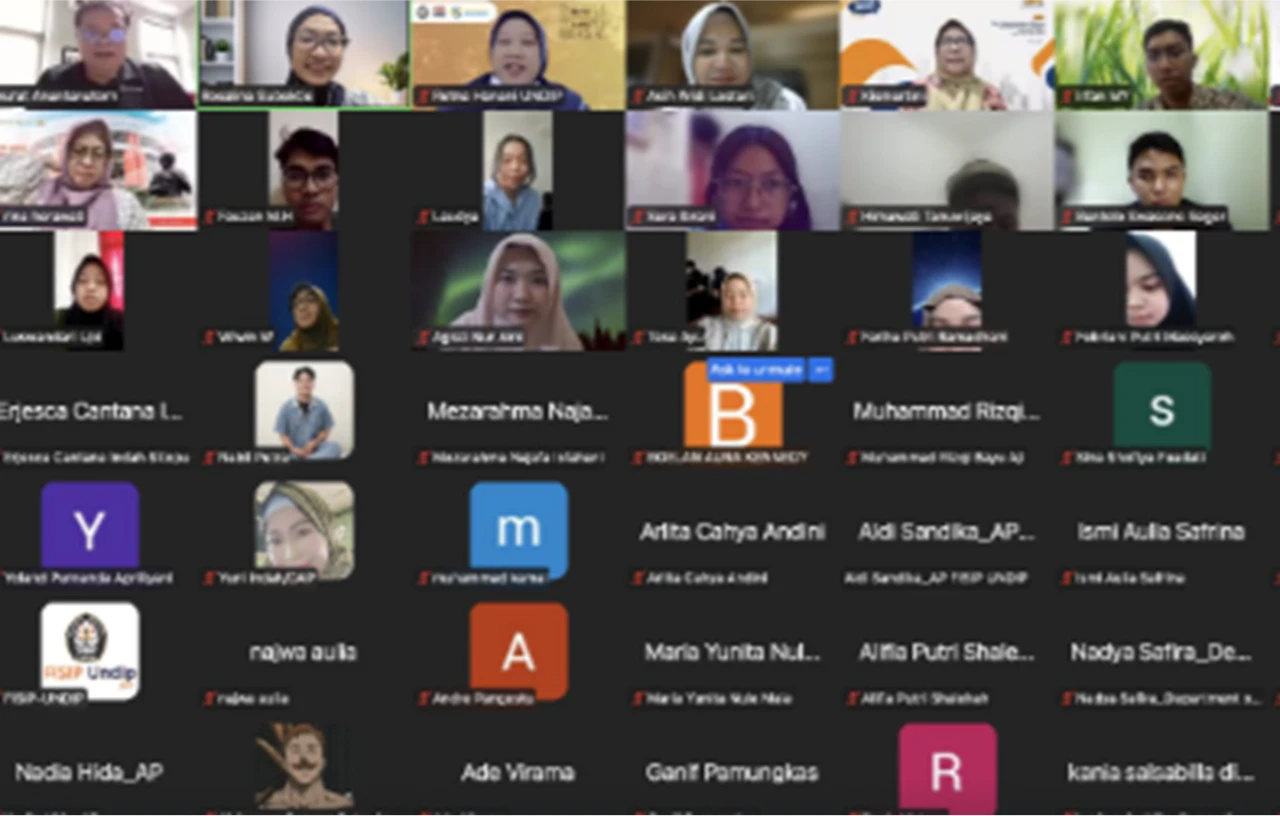
Semarang, 21 May 2026 — The Department of Public Administration, Faculty of Social and Political Sciences, Universitas Diponegoro, held the Undip Global Classroom Program for the Policy Process course by inviting Associate Professor Dr. Anurat Anantanathorn from Burapha University, Thailand. This activity is part of the department’s efforts to strengthen international learning experiences and broaden students’ understanding of public policy dynamics in a global context.
Dr. Anurat Anantanathorn is the Associate Dean of the Faculty of Political Science and Law, Burapha University, with expertise in public administration and local governance, public policy and policy design, digital government and public innovation, local development strategy, emergency management, and design thinking for the public sector. His presence provided students with the opportunity to understand the policy process not only from a theoretical perspective but also through empirical experiences and policy cases from Thailand.
In his lecture entitled “From Policy Design to Real-World Outcomes: An Exploration of Policy Implementation and Evaluation,” Dr. Anurat emphasized that public policy should not only be assessed based on the quality of its design, but also on the government’s ability to implement it effectively. The lecture discussed the implementation gap, top-down and bottom-up approaches, the role of frontline bureaucrats, factors contributing to implementation success and failure, and the importance of systematic policy evaluation. Several Thai policy cases, including the Universal Healthcare 30 Baht Scheme and PM2.5 mitigation policy, were presented to illustrate the differences between successful policy implementation and the challenges faced in practice.
Through this activity, students of the Policy Process course were encouraged to recognize that policy success is strongly influenced by political commitment, resource allocation, interagency coordination, the capacity of implementers, and stakeholder support. The session also strengthened students’ understanding that policy evaluation is not merely a final stage of the policy cycle, but an essential instrument for improving, continuing, modifying, or terminating public programs.
The Department of Public Administration UNDIP expects that this Undip Global Classroom will expand students’ academic perspectives, enhance their comparative policy analysis skills, and strengthen international collaboration with partner universities in Southeast Asia. This activity also reflects the department’s commitment to providing learning experiences that are relevant, contextual, and globally oriented for Public Administration students.