
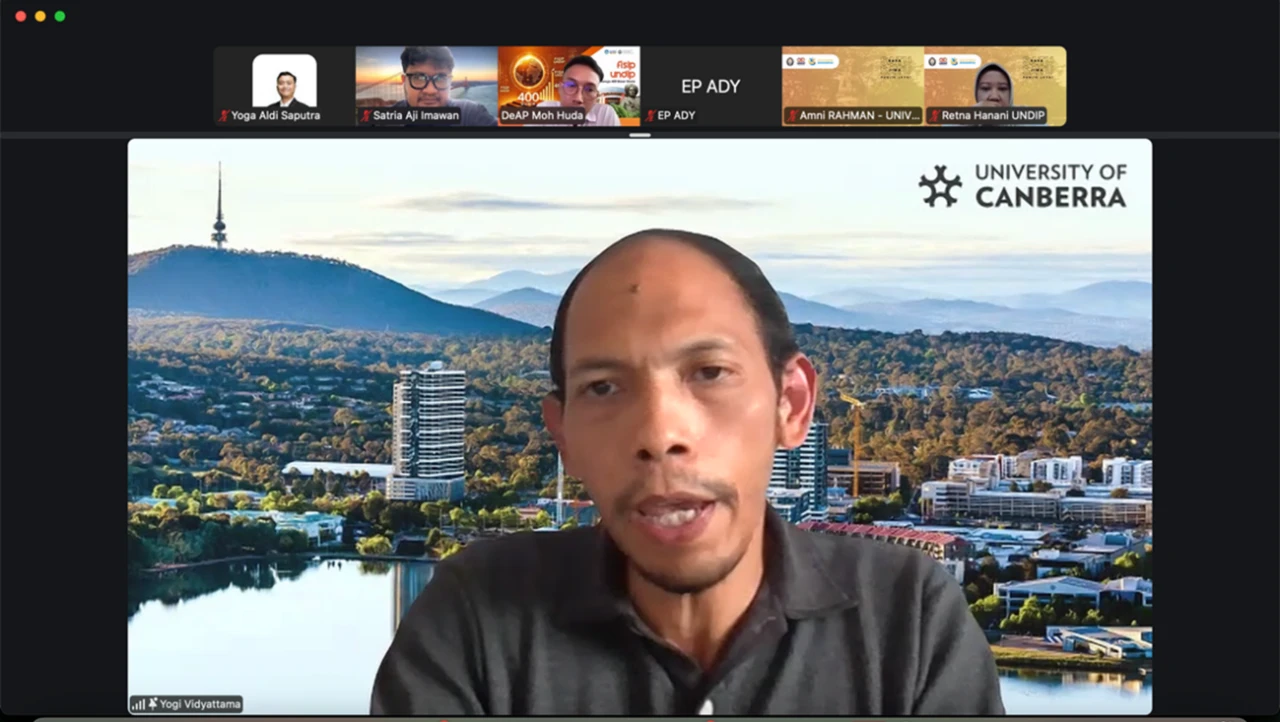
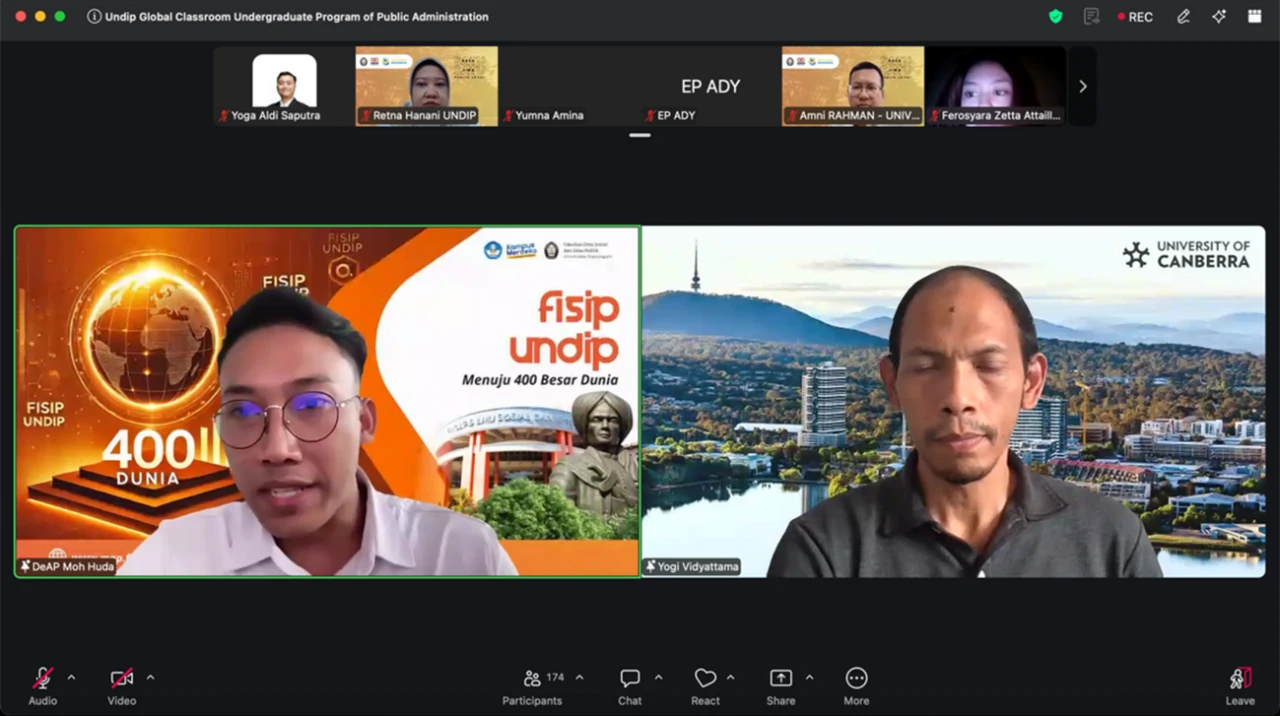
Semarang, May 4, 2026 – The Department of Public Administration, Faculty of Social and Political Sciences (FISIP), Universitas Diponegoro, once again organized the Undip Global Classroom program as part of its commitment to delivering globally oriented learning that is relevant to real-world public policy practices. Carrying the theme “Statistics for Real World Policy Making,” the event was held online on Monday, May 4, 2026, at 11:00 AM (GMT+7).
The event featured Dr. Yogi Vidyattama (Associate Professor, University of Canberra) as the main speaker, with Mohammad Nurul Huda, S.AP., MPA. serving as the discussant. It was also attended by Retna Hanani, S.Sos., MPP, Head of the Undergraduate Program in Public Administration, and Dr. Amni Zarkasyi Rahman, S.A.P., M.Si., Head of the Doctoral Program in Public Administration, who expressed their support for strengthening students’ academic capacity.
In his presentation, Dr. Yogi Vidyattama emphasized that the public policymaking process does not always follow the ideal and linear structure often described in the policy cycle. While conceptually it involves stages such as problem identification, agenda setting, policy formulation, implementation, and evaluation, in practice the process is frequently shaped by political dynamics, negotiation, and competing interests.
He further highlighted the importance of an evidence-based policy approach in navigating this complexity. Public policies should be supported by robust evidence derived from both quantitative and qualitative data. However, policymaking should not be viewed purely as a scientific process, but rather as a craft that involves values, interests, and social context.
The session also explored various sources of data that can inform public policy, including census data, surveys, administrative records, and estimation models. Statistics play a crucial role in helping policymakers identify target populations, understand the distribution of welfare in society, and assess inequality.
In addition, participants were encouraged to reflect on several critical issues in data analysis, such as the difference between mean and median in uneven distributions, the importance of recognizing outliers that may significantly influence policy outcomes, and the need for data granularity to ensure more targeted interventions. The concept of low-hanging fruit was also discussed as a strategy for achieving impactful policy results within a relatively short timeframe.
As the discussant, Mohammad Nurul Huda highlighted the relevance of these insights within the Indonesian context, where public policymaking continues to face challenges such as limited data availability, political pressures, and complexities in implementation. The discussion session reflected strong participant engagement in connecting statistical concepts with real-world policy applications.
Through this program, students are expected not only to understand statistics as an analytical tool, but also to recognize its role as a fundamental foundation for designing more equitable, effective, and evidence-based public policies. The Undip Global Classroom program further reaffirms the commitment of the Department of Public Administration, FISIP Universitas Diponegoro, to providing globally relevant and contextually grounded learning experiences for its students.