

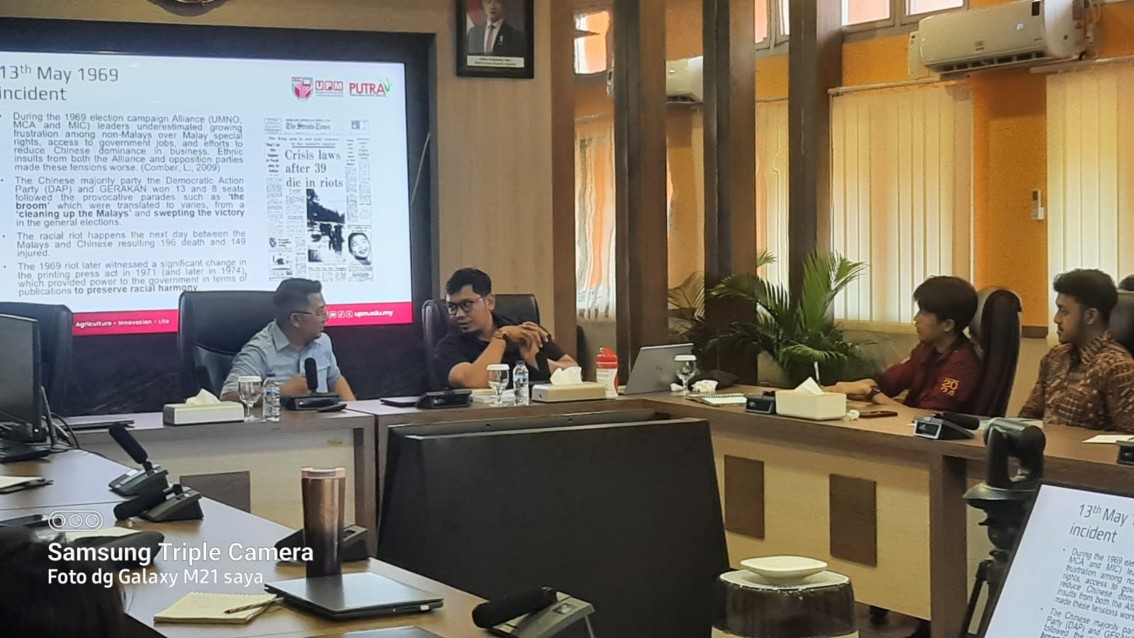
SEMARANG – The Department of Politics and Government Sciences (DPIP) Faculty of Social and Political Sciences (FISIP) Diponegoro University (Undip) held an international guest lecture entitled Undip Global Classroom on Wednesday (11/11/2026). Raising the theme “Youth, Media, and Political Participation,” the event featured senior lecturer from the Department of Government and Civilisation, Faculty of Human Ecology, Universiti Putra Malaysia (UPM), Dr. Fairuzzaman Shaharuddin, as the main speaker.
This international lecture was specifically integrated into the Participation Studies course for fifth-semester students of the Government Science Study Program, FISIP Undip. The event was officially opened by the Head of the Department of Politics and Government Sciences FISIP Undip, Dr. Phil. Wahid Abdulrahman, S.IP., M.Si., and was moderated by DPIP FISIP Undip lecturer, Hary Gunarso, M.A. Through this forum, students were invited to broaden their comparative horizons regarding how youth in the Southeast Asian region, particularly Malaysia, utilize media spaces to participate in politics.
In his presentation entitled “Youth, Media and Political Participation in Malaysia,” Dr. Fairuzzaman began the discussion by mapping the latest demographic landscape and youth policy in Malaysia. Referring to data from the Department of Statistics Malaysia (DOSM) for 2026, out of a total Malaysian population of 34.4 million, the youth group aged 15–30 years—whose age limit was officially lowered as of 1 January 2026 through the Youth Societies and Youth Development (Amendment) Act 2019—comprises around 26.8 percent or 9.73 million people, with the minimum voting age set at 18 years (Undi18). He explained that historically, political communication in Malaysia was once dominated by mainstream media (newspapers, television, and radio) operating in a controlled political system through centralized ownership and strict regulations such as the Printing Presses and Publications Act (PPPA) and the Official Secrets Act.
Dr. Fairuzzaman then traced the long history of Malaysian youth activism, from intellectual movements in the early 20th century, student protest actions in Tasik Utara and Baling in 1974, to the implementation of the Universities and University Colleges Act (AUKU) 1971 that restricted student political activity and triggered campus depoliticization. A significant turning point occurred during the 1998 Reformasi movement, when the MSC Bill of Guarantees policy, which guaranteed an uncensored internet, unexpectedly opened alternative digital public spaces through websites, mailing lists, and independent news portals, also boosting young voter registration rates. This wave of digital mobilization further intensified through the Bersih civil society movement, which utilized Facebook and Twitter hashtags to organize cross-ethnic and cross-generational actions.
Furthermore, Dr. Fairuzzaman dissected the shifting character of media usage in the last three general elections (GE) in Malaysia and current trends in youth political information consumption, known as the first “social media election,” where Facebook and blogs became the main instruments for direct party-voter communication. This transformed into the “smartphone and WhatsApp election,” in which smartphones served as a “weapon of the weak” and closed chat groups became alternative spaces for political information circulation, reaching even semi-urban and rural communities. This was followed by the “TikTok and youth election” post-Undi18 implementation and automatic voter registration, prompting political messages to be delivered more concisely, visually, personally, emotionally, and blending elements of humor and popular culture. He also discussed political podcasts—such as Keluar Sekejap in Malaysia and Bocor Alus Politik in Indonesia—which are increasingly popular among young people as sources of in-depth analysis outside mainstream coverage, though challenges remain, including selective exposure and the risk of misinformation among strongly partisan groups.
In addition to formal participation through elections and youth organizations, Dr. Fairuzzaman also highlighted the importance of informal political participation in the daily lives of young people, such as through art communities, music, street theater, and grassroots discussion spaces. Concluding his material, he emphasized the critical reflection that the high attention and popularity of political content on social media does not always correlate with depth of understanding. Therefore, youth political participation must be accompanied by literacy to verify information, listen to diverse perspectives, and consider the social impact of every message shared.
The discussion session was lively with various critical questions from students of the Participation Studies course, comparing the dynamics of youth digital activism in Indonesia and Malaysia. The organization of this Undip Global Classroom underscores the commitment of the Department of Politics and Government Sciences FISIP Undip to presenting an internationally standardized learning ecosystem and strengthening cross-country academic collaboration networks within Southeast Asia.