

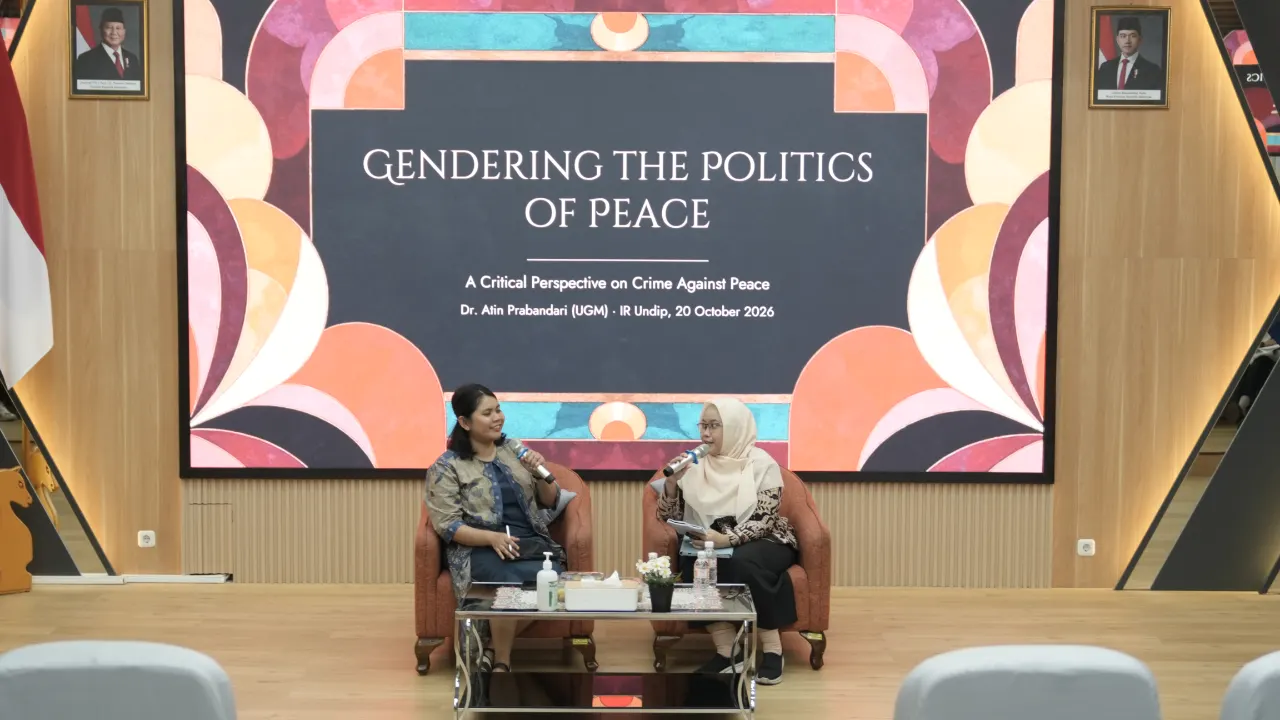
SEMARANG (20/10). On Monday, October 21, 2026, the Faculty of Social and Political Sciences (FISIP) at Diponegoro University (UNDIP) hosted a guest lecture as part of the National Postdoctoral Programme, featuring Atin Prabandari, SIP., M.A.(IR)., Ph.D. (Universitas Gadjah Mada), as the speaker. The session was moderated by Palupi Anggraheni, M.A., and held in the FISIP UNDIP Theater Room. Through such academic activities and scholarly collaboration, FISIP UNDIP continues to foster the development of knowledge and strengthen student capacity to engage with the dynamics of peace studies, specifically concerning crimes against peace, within the framework of international relations.
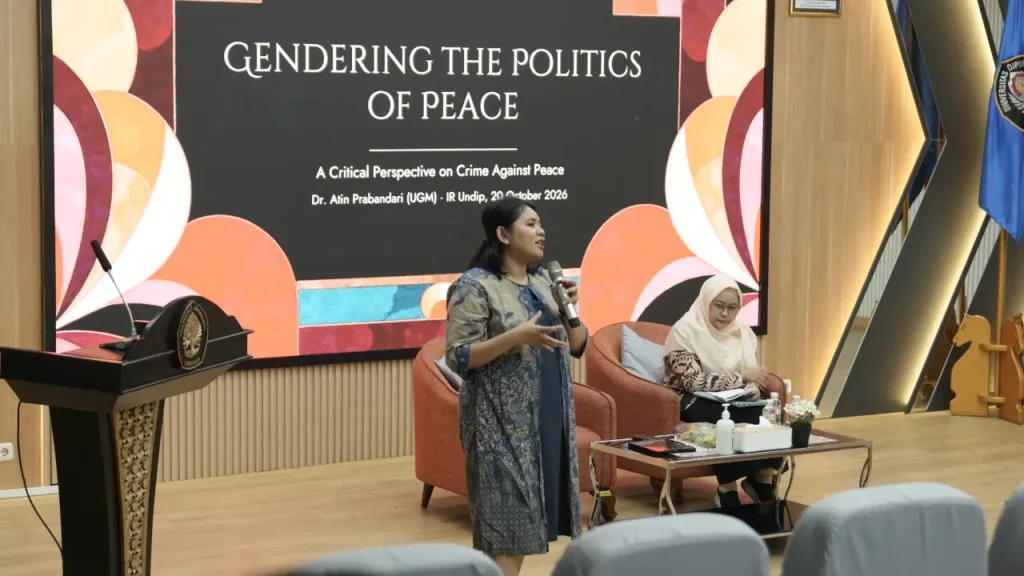
The guest lecture, themed “Gendering the Politics of Peace,” was attended by undergraduate students from the International Relations (IR) program, particularly those enrolled in the courses on International Organizations and Administration and Crimes Against Peace. Through Dr. Atin’s presentation, students gained an understanding that the relationship between gender and peace is not merely a technical matter of policy design or conflict resolution; rather, it is deeply intertwined with power relations, the production of knowledge, and the determination of who receives recognition and protection within peace processes.
Dr. Atin Prabandari highlighted how the concepts of reconciliation and justice—within both peace studies and international law—possess a long history rooted in the dominance of masculine and Western perspectives. This reality raises critical questions regarding the extent to which the experiences of women, populations in the Global South, and historically underrepresented groups are granted space in the formulation and implementation of transnational justice. To examine this, Dr. Atin introduced two analytical lenses: a gender-based perspective on peace and the framework of decolonization. The foundational concept behind this intersection of gender and decoloniality is not intended to set the Global North and the Global South against each other in a binary oppositions; rather, it aims to identify and address power relations and forms of oppression that may be overlooked by dominant approaches to peace.
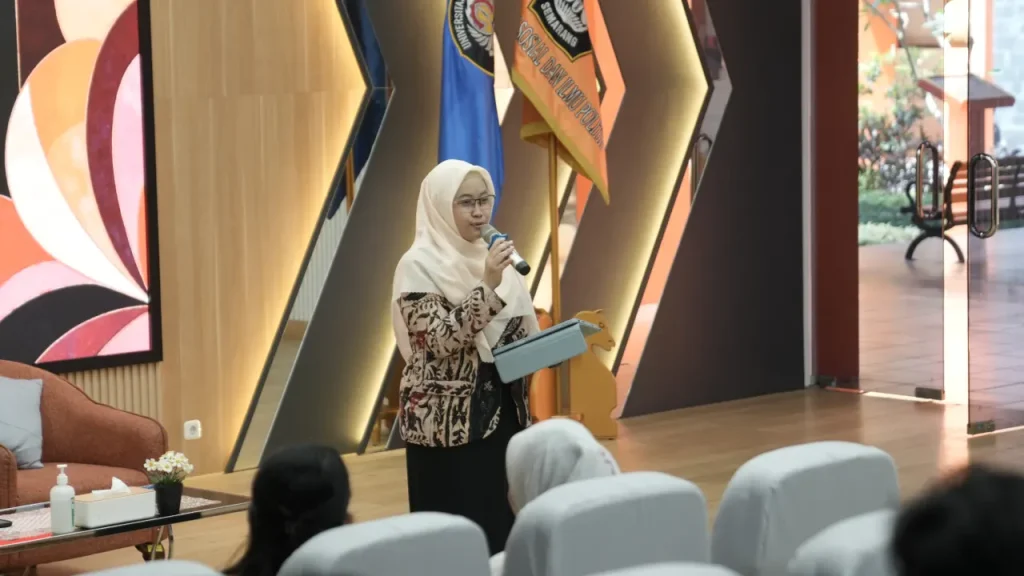
The discussion also critically examined various international legal and institutional frameworks, including the Nuremberg Tribunal, the International Criminal Court (ICC), and the concept of the crime of aggression. Through a gender lens, students were encouraged to explore how the dominance of a masculine perspective. Both in history and institutional practicecan shape the interpretation of crimes, victims, accountability, and justice. The concept of the “decoloniality of power,” as articulated by Aníbal Quijano, was employed to interrogate authority in the production of knowledge, specifically regarding who holds the right to define the experiences of victims and the forms of justice they require. This approach creates space for an intersectional perspective i.e. a framework gaining traction within Global South studies which considers how gender intersects with social, economic, and political structures, as well as colonial history, in shaping experiences of injustice.
Student Discussion: Observing Contextual Approaches to Peace
 |
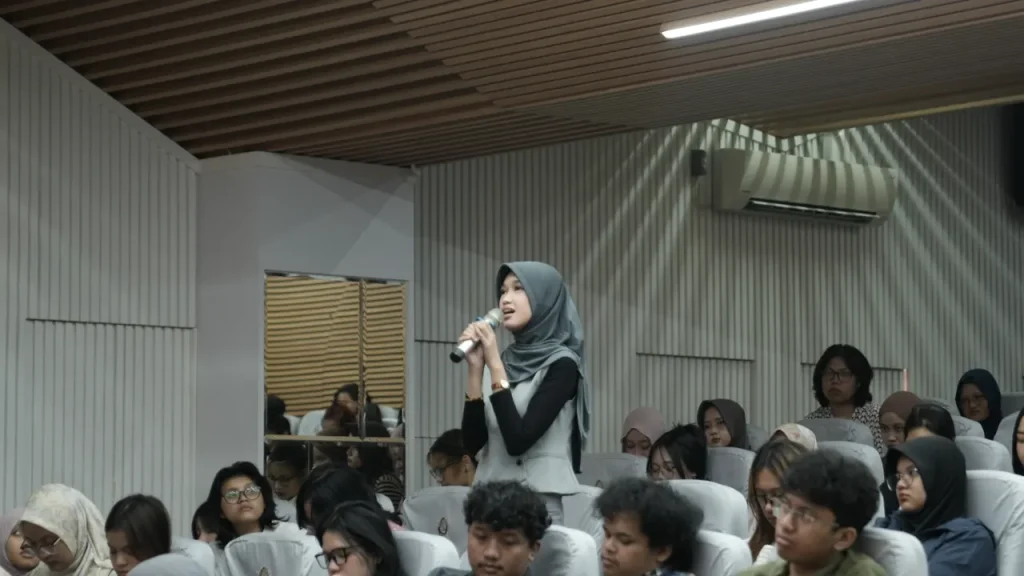 |
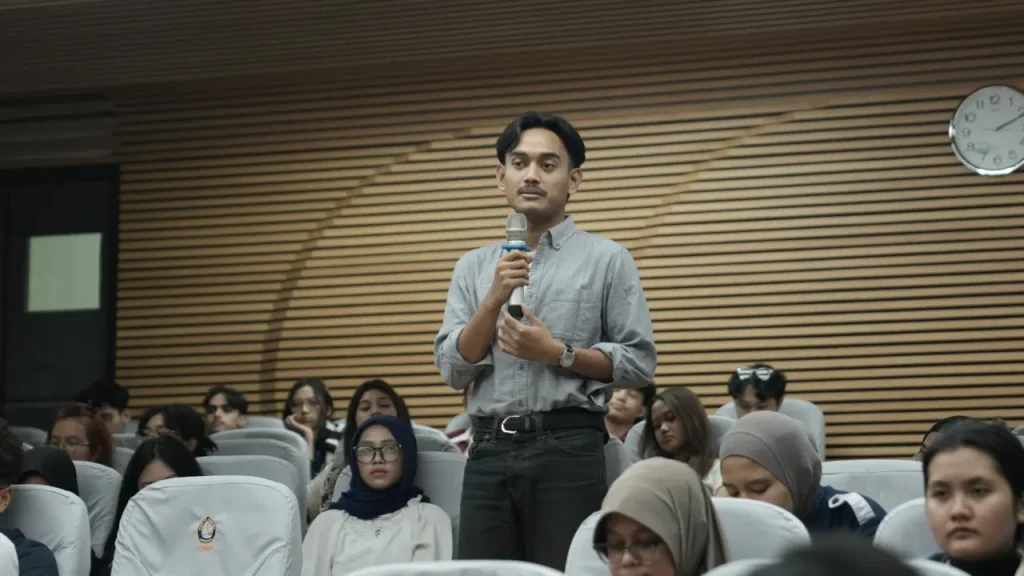
The students’ enthusiasm was evident during two Q&A sessions, each featuring three participants from the 2024 and 2025 cohorts. Their questions demonstrated a keen interest in bridging theoretical critiques with policy issues and peace-building practices within the Indonesian context. Salma, one of the students, asked how Indonesia might position itself when responding to various approaches to peace. Should the understanding of peace be centred on the concept of “Western Democratic Peace,” or could Indonesia develop a more contextual perspective—one aligned with its own unique experiences, needs, and socio-political dynamics? Meanwhile, Maqdis raised a question regarding ontological critiques within feminism, specifically how such critiques might be understood by communities not yet familiar with feminist theoretical debates. This prompted a discussion on the diversity of feminist perspectives and how these approaches illuminate the relationship between those who experience oppression and the structures that sustain it.
In response to these questions, Dr. Atin explained that feminism is not a monolithic approach; rather, it encompasses a diverse range of perspectives for understanding and responding to injustice. In practice, efforts to address oppression can begin by identifying issues within their specific contexts and leveraging available social capital to formulate responses that are relevant to the needs of societies in the Global South. As an illustration, the speaker pointed to the evolution of the GABRIELA movement in the Philippines, which demonstrates how a women’s movement can develop into a political force through electoral participation and policy advocacy—an approach that does not entirely contradict the core tenets of Liberal Feminism. This experience shows that social movements can establish channels for political representation to champion the protection of women and drive sustainable policy change.
Broadening Perspectives in International Relations Studies
This guest lecture serves as an effort to enrich the learning process within the Bachelor’s Program in International Relations at the Faculty of Social and Political Sciences (FISIP), Universitas Diponegoro (UNDIP), by fostering a dialogue between theory, empirical experience, and the evolution of critical thought in peace studies. Through discussions on gender, transnational justice, and decolonial perspectives, students are encouraged to look beyond international institutions and norms as mere formal frameworks; they are prompted to examine how these frameworks are constructed, who benefits from their implementation, and which groups continue to face limited access to protection and justice. Held as part of the National Postdoctoral Programme, this guest lecture aims to strengthen the exchange of knowledge and empower International Relations students to develop more critical, inclusive, and context-sensitive analyses when engaging with the politics of peace at both global and local levels.
Contributor
Palupi Anggraheni, M.A