

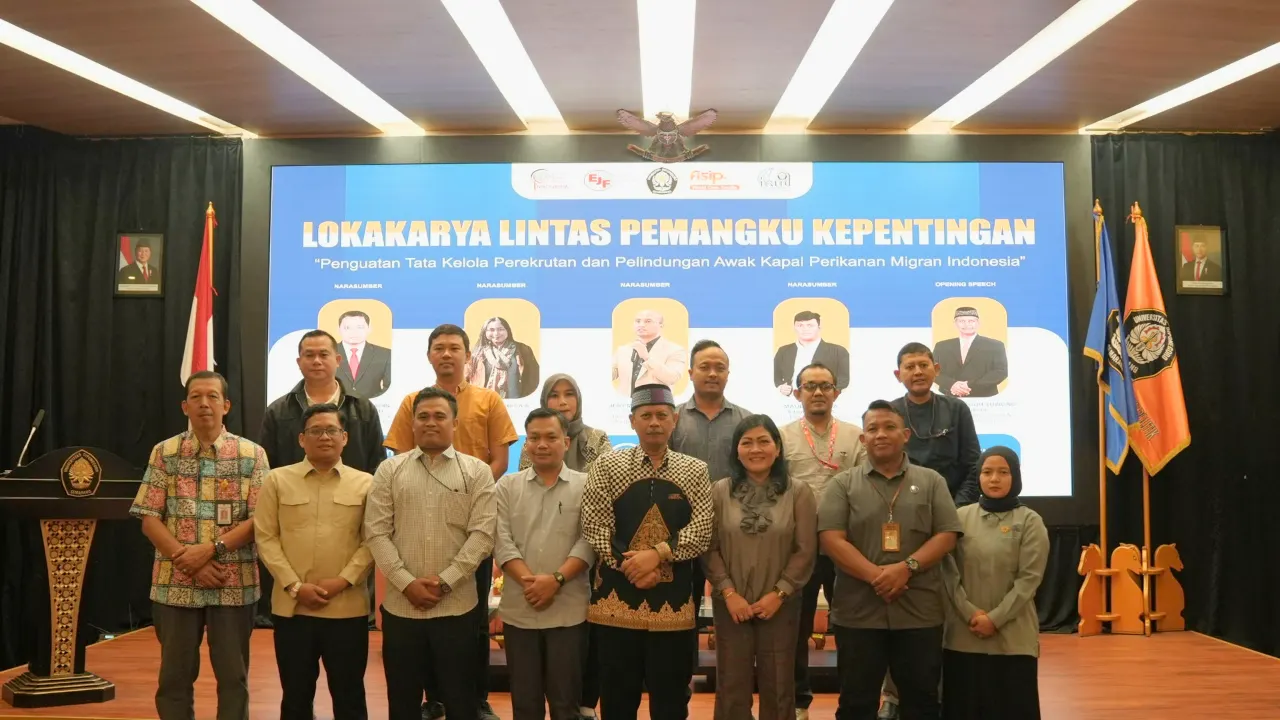
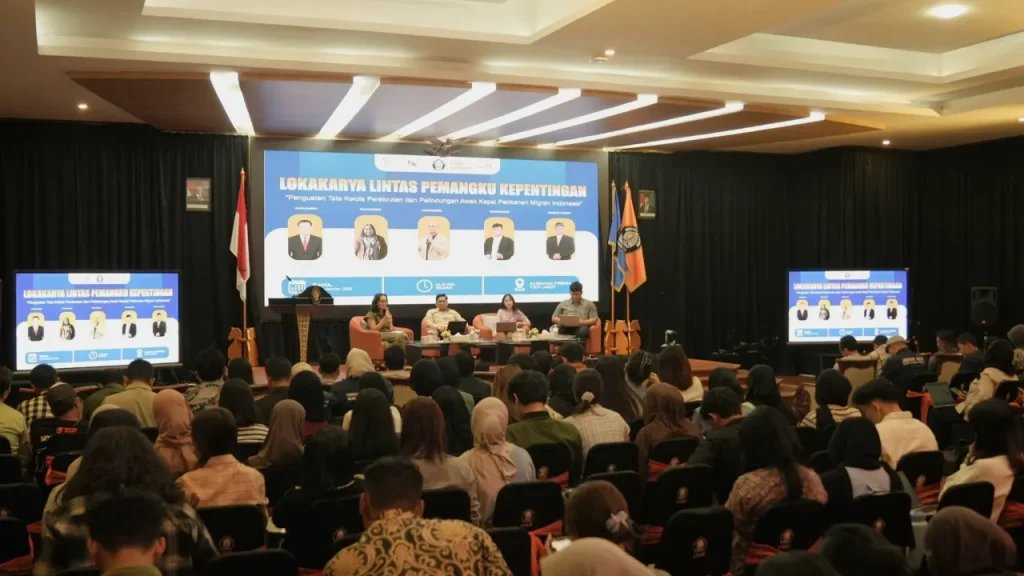
Semarang, September 24, 2026 — The Department of International Relations at the Faculty of Social and Political Sciences (FISIP), Diponegoro University held a stakeholder workshop on the governance and protection of Indonesian migrant fishing crew members on Thursday (September 24, 2026). The event took place from 09:30 to 16:00 WIB at the FIMENA Auditorium, FISIP Undip.
The workshop brought together diverse stakeholders ranging from government officials, academics, and civil society organizations to groups focused on worker protection and the maritime sector. The forum addressed the governance challenges facing Indonesian migrant fishing crew members and identified inputs to help strengthen policies regarding the protection of workers in the fisheries sector.
The event was opened by the Dean of FISIP Undip, Prof. Dr. Teguh Yuwono, M.Pol.Admin. During the forum, the issue of migrant fishing crew protection was examined within a broader context.
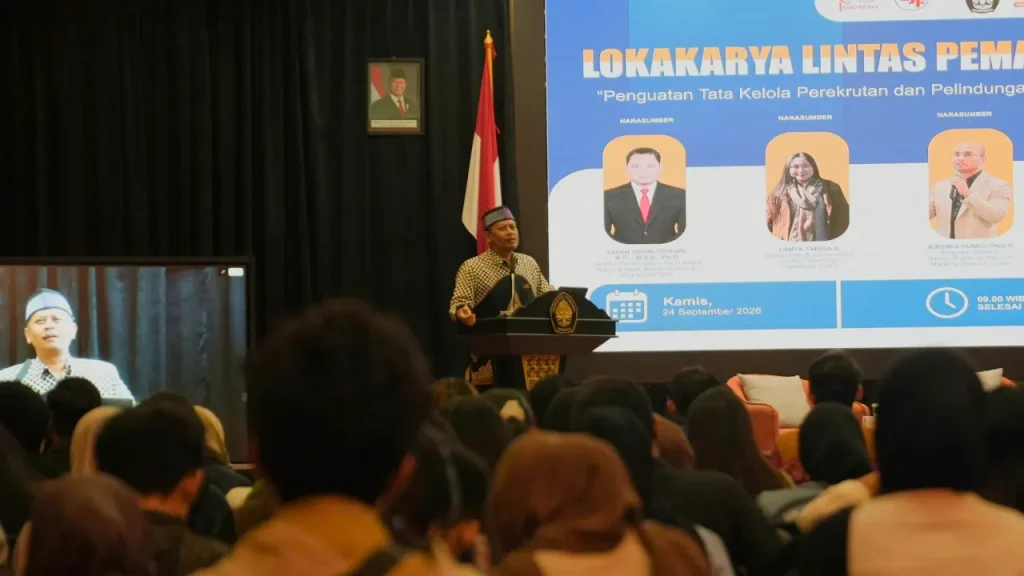
Globalization has driven the fishing industry’s increasing integration with international markets. However, beneath the high global demand for fishery products, Indonesian migrant fishing crew members still face significant issues, including opaque recruitment processes, limited legal protection, and the potential for labor exploitation.
Muhammad Romdoni of the Environmental Justice Foundation (EJF) emphasized the importance of fostering collaboration among stakeholders. He argued that efforts to protect migrant fishing crew members should focus on creating an ecosystem that supports worker welfare and protection, rather than merely seeking to assign blame when problems arise.
This view was reinforced by Kafandi, Chairperson of *Pejuang Suara Pelaut* (PSP)—an organization advocating for seafarers’ voices—who shared perspectives and experiences regarding the conditions and challenges faced by seafarers and fishery workers. The workers’ perspective serves as a crucial element in evaluating the effectiveness of existing protection systems. During the presentation session, Yayan Hernuryadin, S.Pi., M.S.E., Ph.D., from the Ministry for the Protection of Indonesian Migrant Workers (KP2MI), explained the complexities surrounding the governance and regulation of recruitment agencies for Indonesian migrant crew members.
He outlined the transnational nature of issues concerning migrant crew members, noting that they involve relationships among flag states, coastal states, port states, and the workers’ countries of origin. Consequently, protecting these crew members requires inter-agency and international coordination.
The discussion also covered the regulatory framework for migrant worker protection—including Law No. 18 of 2017 and Government Regulation No. 22 of 2022—as well as various government efforts to strengthen the placement and protection systems for migrant workers in the fisheries sector.
Meanwhile, Jeremia Humolong from the Indonesia Ocean Justice Initiative (IOJI) highlighted governance and regulatory gaps regarding the protection of Indonesian migrant fishers. He noted that the issue of migrant fishers extends beyond working conditions on board; it intersects with migration, labor, legal systems, and the potential for forced labor practices.
He also emphasized the importance of improving data quality, strengthening oversight, digitizing services, and enhancing inter-agency coordination to support a more effective protection system.
From a civil society perspective, Fanya Tarisa Annindita of the EJF presented investigation findings regarding practices that potentially disadvantage Indonesian migrant fishers during recruitment and placement. The investigation highlighted several issues, including pre-departure wage deductions, demands for security deposits, loan schemes, wage transparency, and workers’ understanding of their employment contracts.
From an academic perspective, Maula Hudaya, S.Hub.Inter., M.A., emphasized the importance of viewing the issue of migrant fishers within the context of the global fisheries supply chain. Indonesia’s position as a major source country for fisheries labor frames the protection of these workers not merely as a labor issue, but as a component of global supply chain governance.
The discussion was interactive, featuring various questions and responses from participants. Topics addressed included insurance coverage, recruitment mechanisms, pre-departure training, contract and wage transparency, and jurisdictional issues concerning fishers working in international waters.
The workshop demonstrated that protecting migrant fishers requires a cross-sectoral approach. Governments, companies, civil society organizations, academia, international organizations, and labor groups play interconnected roles in establishing more effective governance.
Beyond fostering a shared understanding, the discussion outcomes are expected to inform policy development and strengthen governance regarding the protection of Indonesian migrant fishers. Stakeholder collaboration is crucial to ensuring that policies do not merely exist on paper but also effectively address the challenges workers face in the field.
Through this workshop, the Faculty of Social and Political Sciences at Diponegoro University (FISIP Undip) reinforces its role as an academic platform that integrates research, field experience, and policy perspectives to address strategic issues concerning Indonesia’s status as a maritime nation and its role in the global fisheries supply chain.