
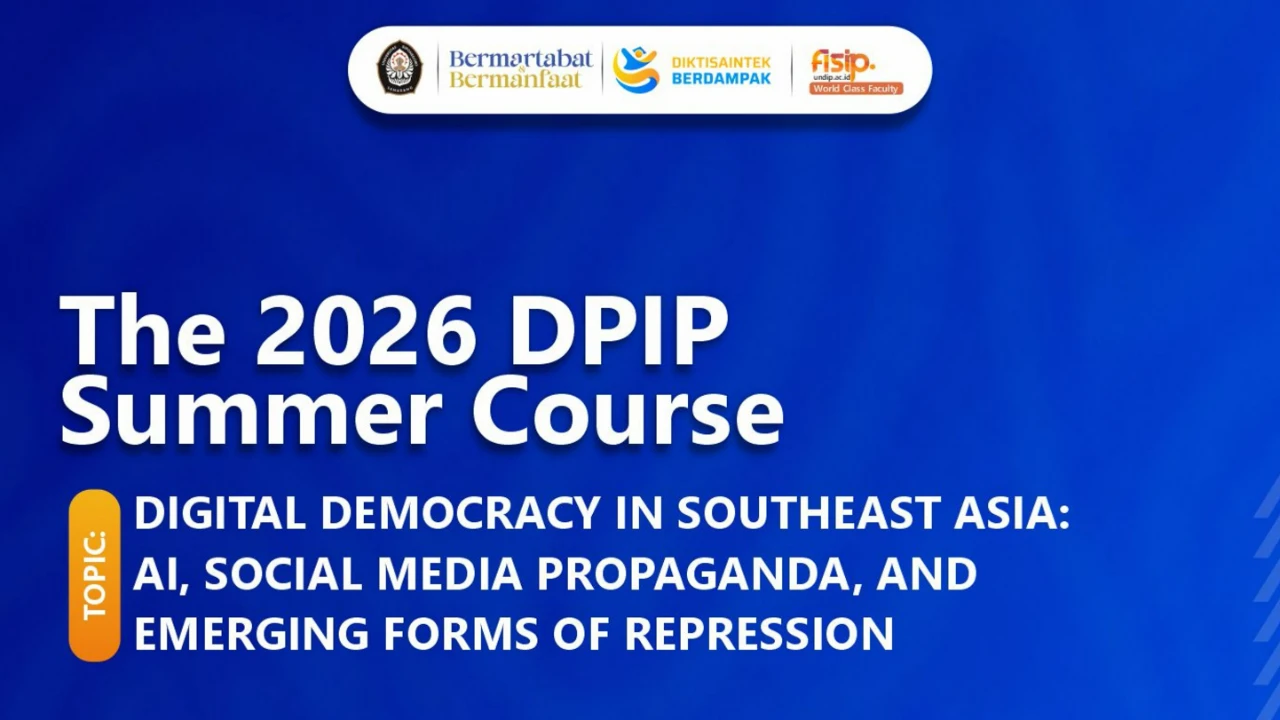
Semarang, 2–3 September 2026 – The Government Science Study Program, FISIP, Diponegoro University held a Summer Course themed “Digital Politics, Democracy, Media, and Artificial Intelligence.” The event was conducted at 15:00–17:00 WIB online via Zoom Meeting on 2 and 3 September 2026. This event discussed developments in digital technology, social media, artificial intelligence (AI), as well as the evolution of online influence operations and their impacts on politics, public participation, media, and democracy in Southeast Asia.
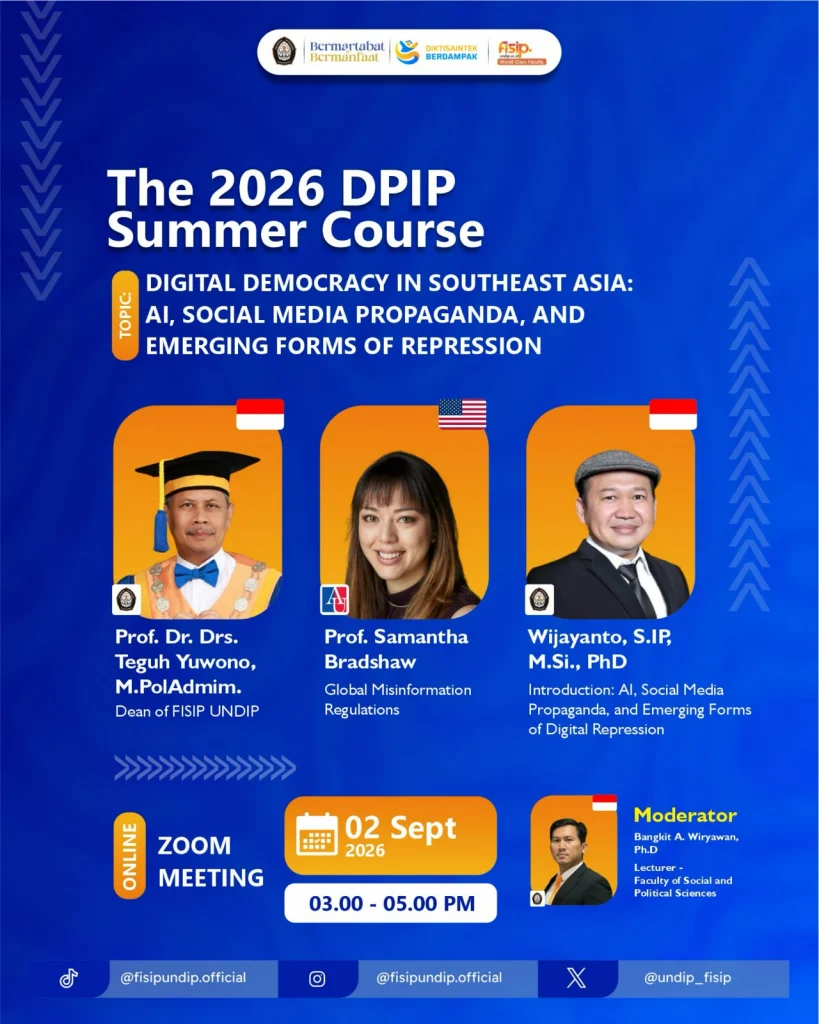
In the opening session, Dean of the Faculty of Social and Political Sciences, Diponegoro University, Prof. Dr. Drs. Teguh Yuwono, M.Pol.Admin. emphasized the importance of international academic forums and cross-country collaboration in understanding the progress of digital democracy and AI. Technology is considered capable of expanding participation and access to information but also brings challenges such as surveillance, manipulation of information, and shifts in power relations. Therefore, the development of AI needs to be critically examined with regard to political, democratic, and public rights aspects.
Next, Vice Rector for Research, Innovation, Cooperation, and Public Communication, Dr. Wijayanto, M.Si. discussed the development of digital democracy, which has changed patterns of political participation, the way media works, and the struggle for power. Social media and digital platforms can be used for community empowerment, campaigns, mobilization, and the formation of public opinion. However, technology can also potentially be used for surveillance and manipulation of information, including through the use of AI by political actors.
The main material on the first day was presented by Dr. Samantha Bradshaw from American University, Washington DC, on the challenges of global misinformation and disinformation in the AI era. She explained that information threats are not limited to fake news, but also include identity-based propaganda, AI-powered fake accounts, and coordinated information operations. Generative AI enables large-scale production of fake content and identities, making them increasingly difficult to detect. In her view, fact-checking alone is not sufficient because information needs to be understood in terms of its social, cultural, and political context, purpose, and impact on society.
To address these challenges, transparent and accountable regulation is needed, along with collaboration between government, digital platforms, academics, and civil society. Platform moderation must consider not only content removal, but also how information can spread and gain wide reach. Regulations must be able to maintain a balance between information security and freedom of expression, while society needs to be strengthened through digital literacy and effective public communication.
 |
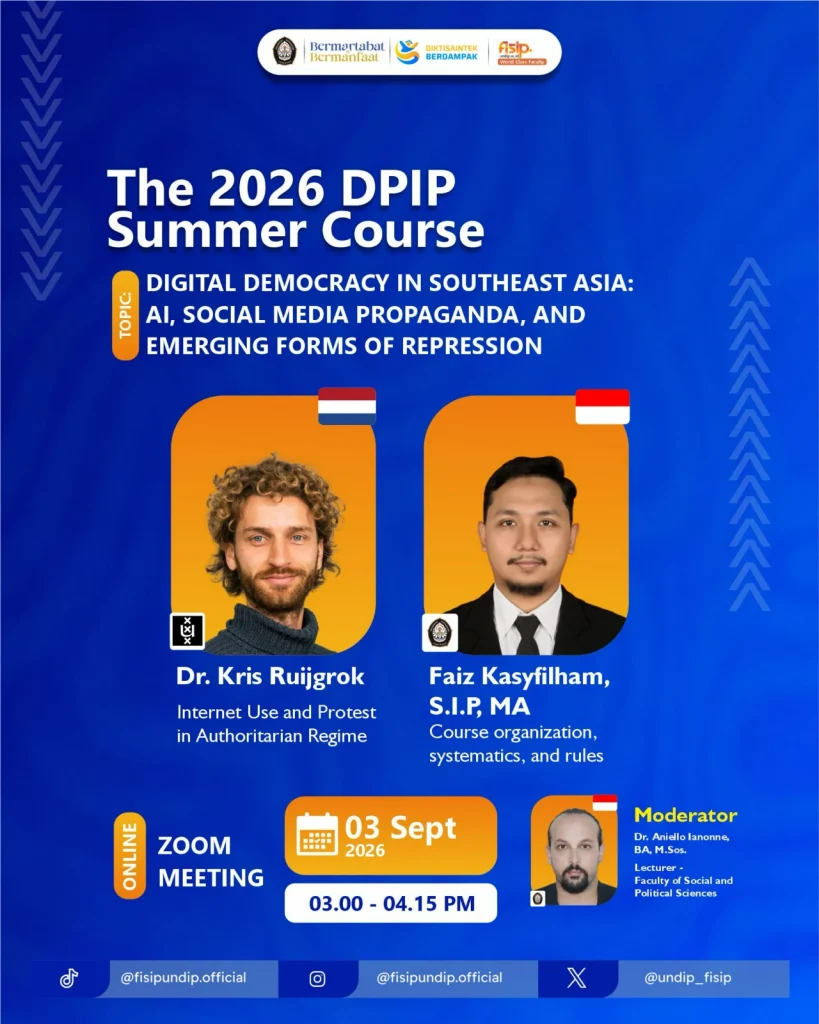 |
The main material on the second day was presented by Dr. Kris Ruijgrok from the University of Amsterdam, based on 57 interviews in Indonesia, the Philippines, and Thailand. He explained the shift in influence operations from an old pattern dominated by the state, bots, and uniform contenttowardsIO2.0, which is more professionalized, decentralized, and relies on human creativity and curated online personas.
The five main developments of IO 2.0 include the increasing diversity of political clients, greater outsourcing to the private sector and political consultants, a shift from quantity to quality of accounts, the use of re-angling or reframing of news, as well as use of data analytics, micro-targeting, and responsive communication. These changes are driven by platforms’ ability to detect bots, increased awareness among the public and media, and the professionalization of the digital political services industry.
Dr. Kris emphasized that influence operations can now be conducted by various actors with the necessary resources, resulting in a trend towards political oligarchization. To address this, digital literacy alone is not sufficient. There is a need for transparency in campaign funding, disclosure of paid political content, and awareness regarding the ethics of paid persuasion and astroturfing. The evolution of IO is also expected to continue in line with technological developments and shifting political dynamics.
Faiz Kasyfilham, M.A., Chair of the Summer Course Class DPIP FISIP Undip, explained that the Summer Course takes place from 2–30 September 2026 in a mostly online format, with one hybrid session on 14 September. The program involves participants from various countries and around 15 speakers. Learning activities include lectures, reading assignments, and group tasks.
The event, moderated by Dr. Bangkit A. Wiryawan (on the first day) and Dr. Anielo Iannone (on the second day), served as an academic discussion forum for participants to understand the opportunities and risks of digital technology for democracy. Through this event, participants are expected to develop a critical understanding of digital politics, misinformation, information manipulation, the evolution of online influence operations, the effectiveness of digital literacy, and the importance of transparency and democratic resilience in facing the development of technology and AI.