
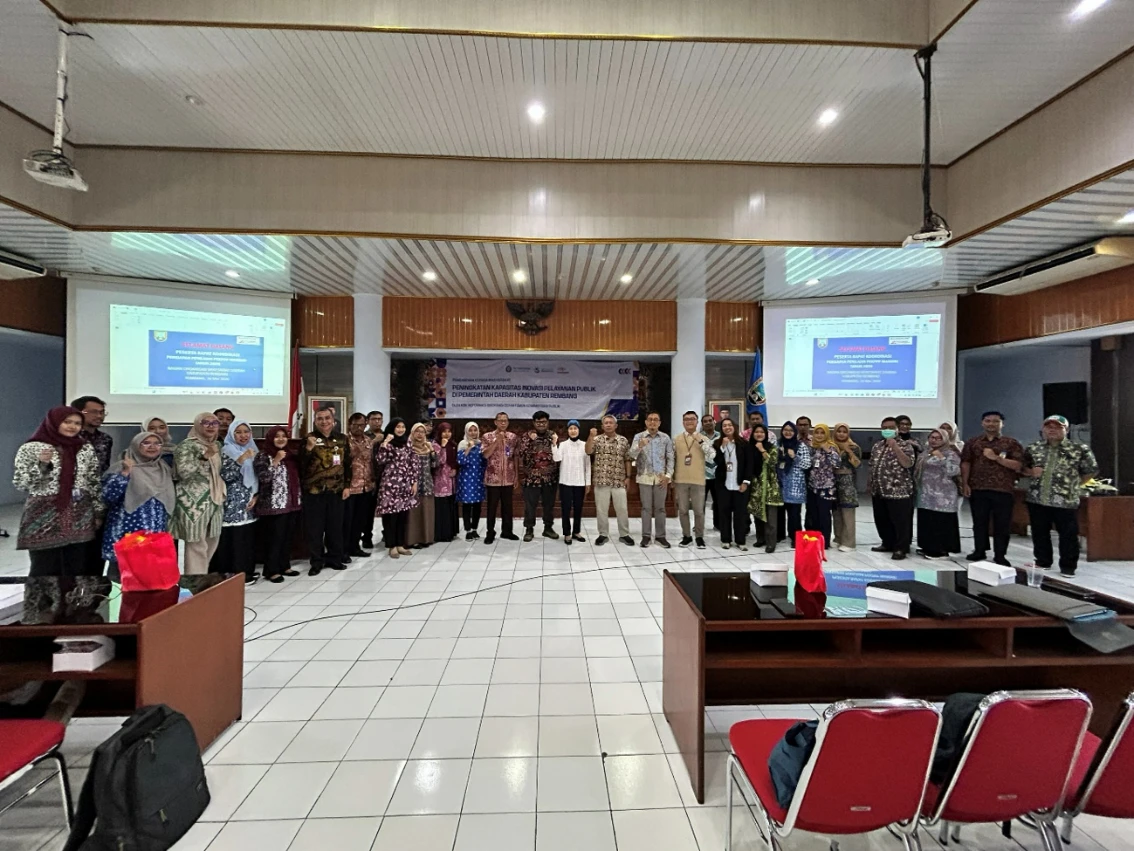
Rembang, May 26, 2026 — The Department of Public Administration, Faculty of Social and Political Sciences, Diponegoro University, held a Community Service activity titled “Improving the Capacity for Public Service Innovation in the Rembang Regency Government.” This activity is part of FISIP UNDIP’s commitment to supporting the local government in providing more adaptive, responsive, and community-centered public services.
This activity was implemented by the Bureaucratic Reform Expertise Group (KBK), targeting Regional Apparatus Organizations (OPD) within the Rembang Regency Government. Through this activity, officials were encouraged to view public service innovation not only as the use of technology or digital applications, but also as efforts to improve work processes, simplify procedures, strengthen coordination, and enhance the quality of service to the public.
This community service initiative stems from the reality that various OPDs often have existing service innovation practices, but not all of them are systematically documented. As a result, good practices emerging from field experiences cannot always be developed, replicated, or used as institutional learning. The activity proposal explains that several service reforms in Rembang Regency still need strengthening in terms of planning, documentation, implementation, and sustainability.
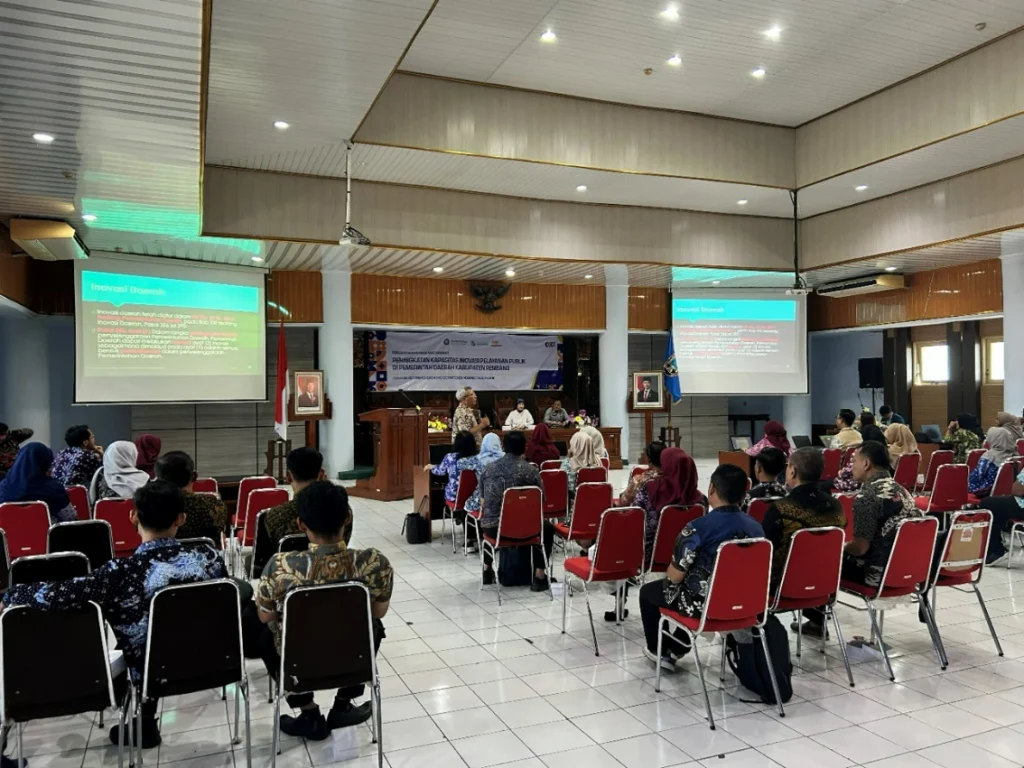
The Head of the Community Service Team, Dr. Dra. Dyah Lituhayu, M.Sc., stated that public service innovation needs to be built on real problems faced by the community and Regional Apparatus Organizations (OPD). According to her, good innovation is not simply a new program, but rather a solution that can make services easier, faster, clearer, and more impactful.
“Public service innovation must begin with the ability of officials to accurately identify service issues. From there, officials can design relevant solutions, document them properly, and ensure the innovation can be implemented sustainably,” said Dr. Dyah Lituhayu.
In this activity, participants received reinforcement on the concept of public sector innovation, service problem identification, innovation idea formulation, and public service innovation document development. The mentoring also aims to enable civil servants to develop Public Service Innovation Proposals (KIPP) and Innovation Designs (IID/IGA) as the basis for planning and implementing innovations within the Regional Apparatus Organization (OPD).
The approach used in this activity is participatory and applicable. Civil servants not only receive materials but are also mentored in developing innovation ideas based on the needs of their respective organizations. Therefore, this community service activity is expected to help OPDs develop more focused, documented innovations that have the potential for sustainable implementation.
The community service team is chaired by Dr. Dra. Dyah Lituhayu, M.Sc., with members Dr. Drs. R. Slamet Santoso, M.Sc.; Satria Aji Imawan, S.I.P., MPA; Damaris Bernike Bellastuti, M.A.; and Yoga Aldi Saputra, S.A.P., MPA. Through the team’s expertise in public administration, bureaucratic reform, public services, and regional governance, this activity is expected to strengthen the capacity of civil servants to develop innovations relevant to community needs.
This activity also provides a space for collaboration between universities and local governments to encourage mutual learning. For local governments, this activity can provide momentum to strengthen a culture of innovation within the bureaucracy. For universities, this activity represents a concrete implementation of the Tri Dharma (Three Pillars of Community Service) in supporting the direct resolution of public issues.
Through this Community Service activity, the Department of Public Administration, Faculty of Social and Political Sciences, Diponegoro University (FISIP), emphasized its role as a strategic partner of local governments in promoting increasingly high-quality public services. It is hoped that public service innovations will not remain ideas but rather become documented, sustainable institutional practices that provide tangible benefits to the people of Rembang Regency.