
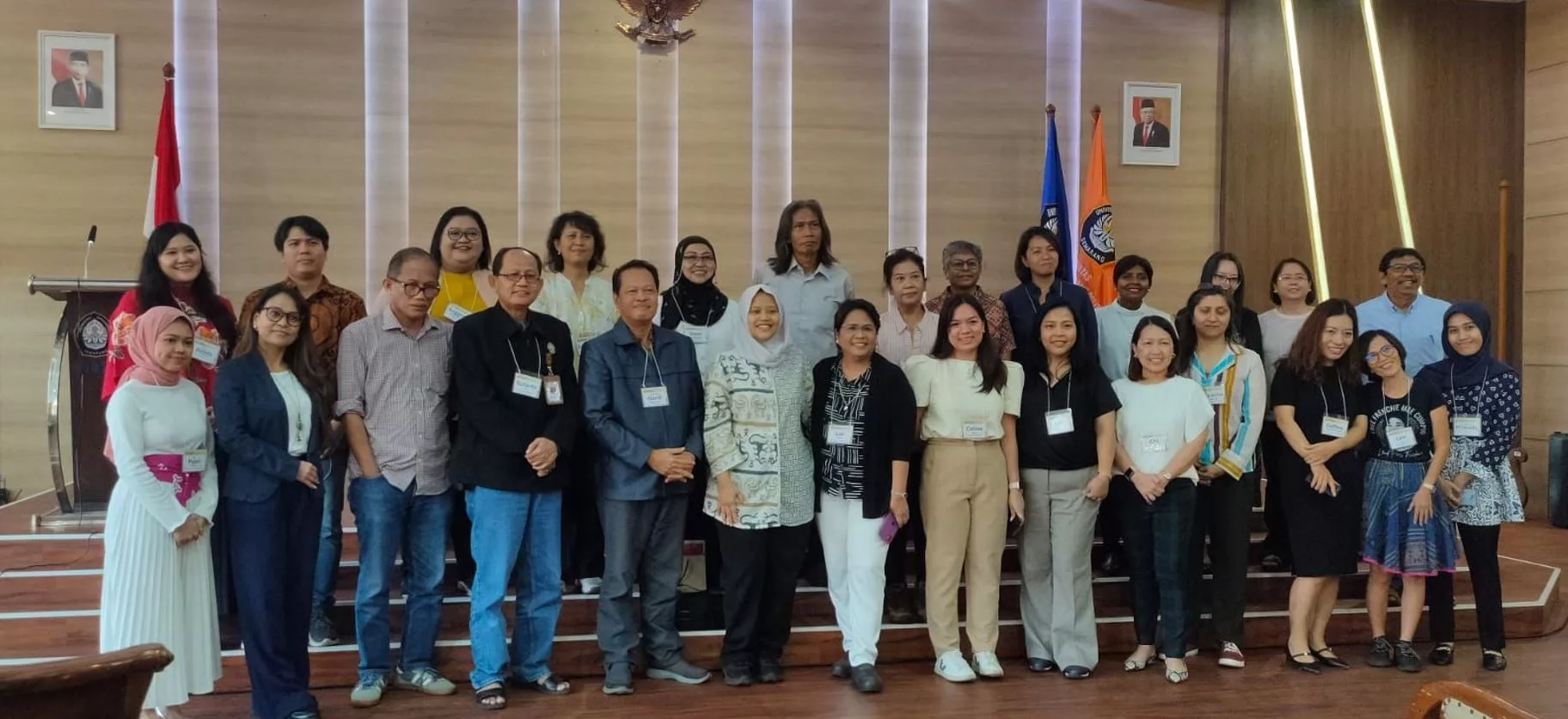

Participants of the “Asia Women Journalist for Media Freedom” Workshop with FISIP Undip Communication Science Lecturers, Wednesday (10/26)
Reporter: Almira Khairunnisa, Student of Journalism and Multimedia Concentration
Today, being a female journalist is not without various challenges. One of the challenges often faced by women journalists is their vulnerability to acts of violence while carrying out their profession. This is illustrated by a national survey initiated by PR2Media. In a survey collected throughout 2021 to 2022 involving 1,256 women journalists as respondents, 880 people or 70% of the respondents admitted to having experienced physical and digital violence. Meanwhile, 99 people admitted to having experienced digital violence, and 98 others admitted to having experienced physical violence. The remaining 174 people stated they had never experienced any violence. In the digital realm, women often receive violence in the form of death threats, insults, hacking, receiving body shaming remarks, becoming targets of misinformation, receiving unpleasant sexual comments, and the dissemination of personal information without consent, or doxing.
In response to this, the Department of Communication Science, Faculty of Social and Political Sciences (FISIP), Diponegoro University (Undip), held an international workshop entitled “Asia Women Journalist for Media Freedom” on Wednesday (10/26) to Friday (10/28). The workshop, held at the auditorium and senate room of FISIP Undip, was a collaboration between the Department of Communication Science FISIP Undip and the Asian Center for Journalism (ACFJ) at Ateneo de Manila University. Funded by the Embassy of the Kingdom of the Netherlands in the Philippines, the event was attended by 15 women journalists from various Asian countries, including Indonesia, the Philippines, Malaysia, Vietnam, India, Singapore, and Nepal.
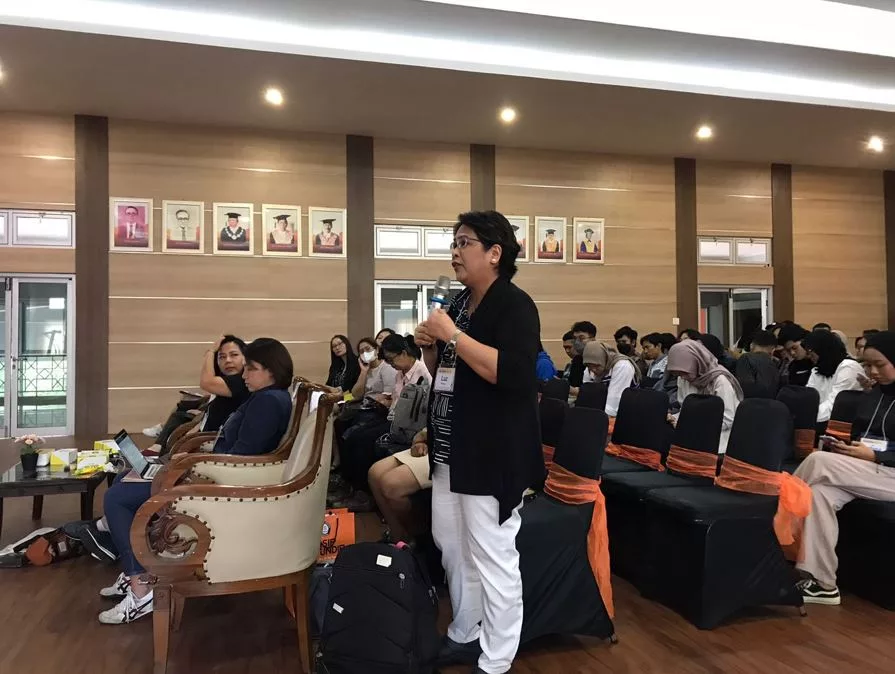
Executive Director of ACFJ Ateneo De Manila University, Luz Rimban, at the “Asia Women Journalist for Media Freedom” Workshop
Luz Rimban, as the Executive Director of ACFJ Ateneo De Manila University, revealed that this activity aimed to bring together journalists from Southeast Asian countries to discuss issues not commonly raised in the public sphere, namely issues related to the problems faced by women journalists. This aligns with the workshop’s goal to strengthen solidarity among journalists and voice the issue of media freedom for women journalists.
“The purpose of this event is to bring together (journalists) from different Southeast Asian countries to talk about issues we don’t usually talk about, so represented by the Philippines, Indonesia, Malaysia, Vietnam, Nepal, and India, and basically we talk about whatever is there, which is a safe space considering the many problems faced by women journalists while doing their work as journalists,” explained Luz when interviewed last Friday (10/28).
The workshop was divided into three days. On the first day, three speakers presented material related to gender equality in newsrooms and cases of sexual violence against women journalists, presented by Sunarto, Lecturer in Media and Gender, Communication Science FISIP Undip; Luviana Ariyanti, gender activist from the Alliance of Independent Journalists (AJI) and CEO of konde.co; and Masduki as a researcher. At the end of the session, participants took part in a discussion forum regarding the situation of women journalists in their respective countries. Then, on the second day, participants received material related to safe space principles from Dr. Mira Alexis Ofreneo, Head of the Ateneo Gender Hub, which was followed by a focus group discussion (FGD) session related to the material presented. The workshop concluded with a discussion session on resolutions and future plans for the women journalists as a follow-up to the activities that had been organized.
According to Luz, the workshop ran smoothly, thanks in no small part to the provision of a safe space for participants to discuss issues experienced by women journalists, facilitated by FISIP Undip.
“Undip played a very important role in our conference; they were generous in providing us with a space, actually a physical safe space for us, a space to freely discuss issues from our respective countries. We are pleased that Undip’s world-class facilities made it easy for us to do our work smoothly. We are happy that the (Department of) Communication deployed students and lecturers so we could carry out our work well. Our event, our workshop, successfully achieved its goals, and we are very happy to have had this place for the past two days,” she said.
Nurul Hasfi, Head of the Department of Communication Science FISIP Undip, who is also an ACFJ alumna, stated that this activity is part of the educational institution’s commitment to supporting issues of gender equality in mass media. This activity is a manifestation of the institution’s commitment to the Tri Dharma of Higher Education activities, in this case, community service at the international level.
“We are delighted to be involved in this activity and hope it becomes a discussion forum that encourages broader solidarity within the community of women journalists in Southeast Asia,” said Nurul.
To maintain the sustainability of the activity, Luz revealed that she would strive to hold regular online meetings to maintain communication with the participants. Not only that, she hopes that participants can disseminate understanding regarding safe spaces for journalists to their fellow journalists.
“At the very least, we will hold regular online meetings; we have also assigned ourselves some homework. We will formulate questions we want to ask other journalists directly about safe spaces and what we can do to address them,” Luz concluded.

0 Comments